I. Key Points for Selection (Directly applicable for foreign trade, order processing, and customer selection)
- Stone Material Selection (Priority Recommendations)
Jinan Black: Best cost-performance ratio, high density, compact structure, minimal deformation; the first choice for general precision platforms, CMM bases, and inspection plates; largest industrial usage volume.
Mount Tai Black / Zhangqiu Black: Higher hardness and better wear resistance; suitable for ultra-high precision laboratories, metrology institutes, and semiconductor equipment bases.
Black and White Marble / Ordinary Granite: Coarse texture, average stability; only suitable for ordinary tooling and rough inspection; strictly prohibited for precision instrument bases. - Selection Standards for Key Parameters
Density: ≥2.95g/cm³; the heavier, the more stable, and the better the vibration resistance.
Coefficient of Linear Expansion: The lower the better; precision equipment preference ≤6.5×10⁻⁶/℃.
Flatness Precision Grade
000 Grade: Metrology institutes, laboratory benchmarks, ultra-high precision instruments.
00 Grade: CMMs, vision measuring machines, precision inspection.
0 Grade: Workshop routine inspection, tooling and fixtures.
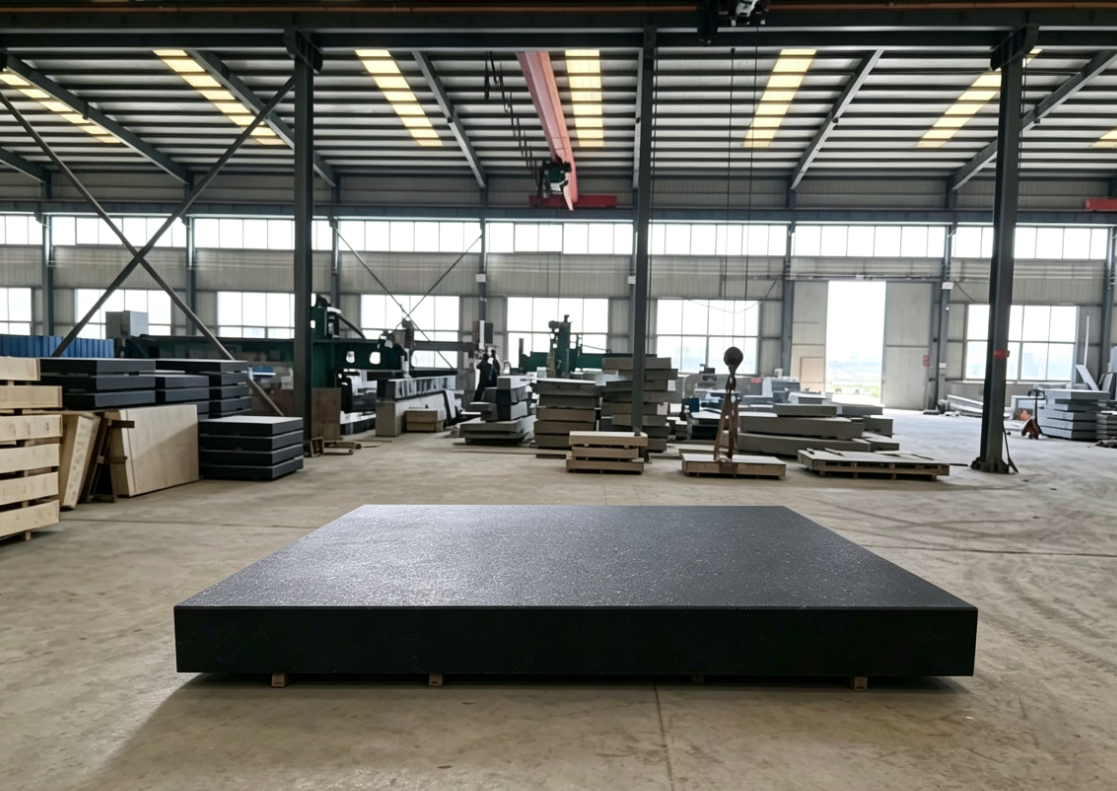
Thickness Selection: The larger the tabletop, the thicker it must be; otherwise, it is prone to deformation and sagging. - Structural Selection Pitfalls to Avoid
Large bases must have weight-reducing ribs and closed cavities to reduce weight while maintaining rigidity.
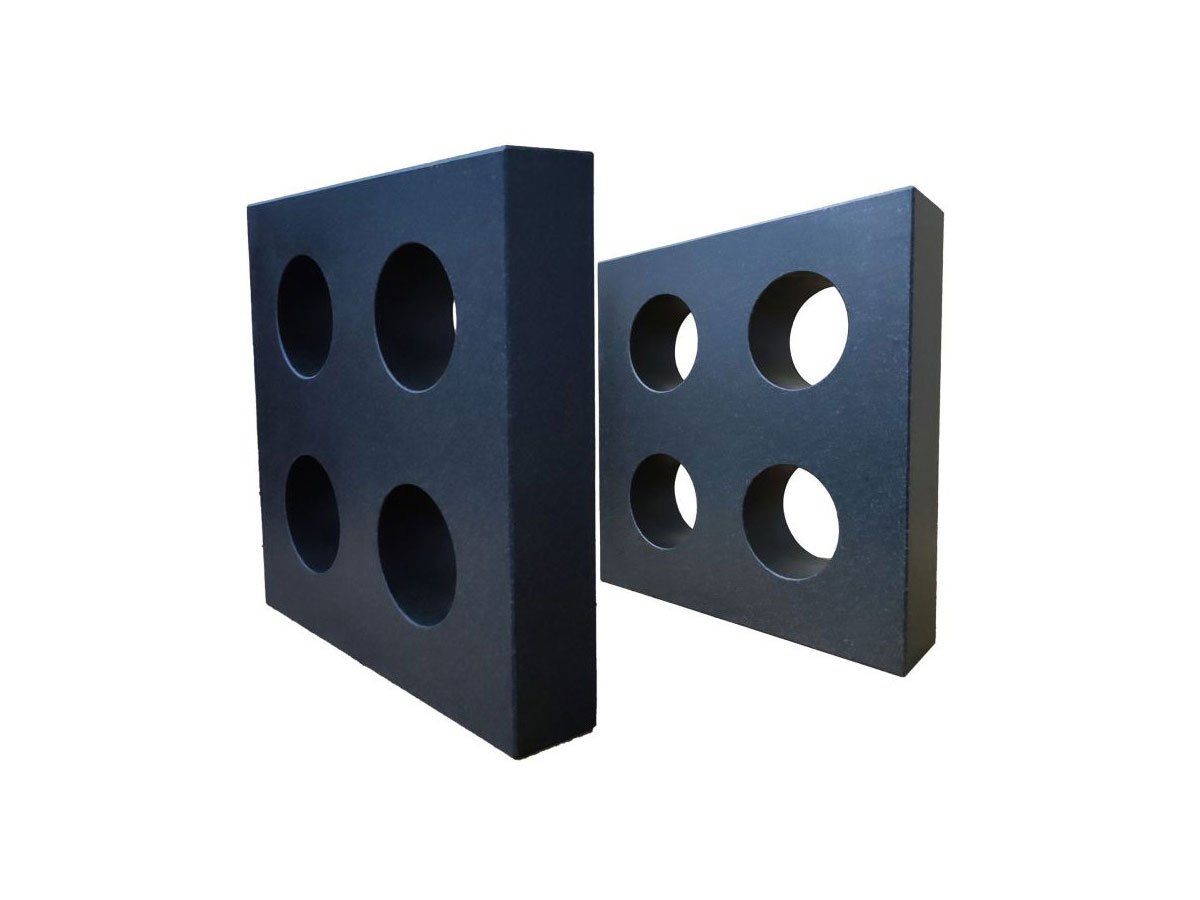
Installation holes, threaded holes, and T-slots must be customized in advance; drilling later is prone to chipping and precision loss.
Precision guide surfaces should prioritize integral single-piece granite without splicing.
II. Selection of Processing Technology (Essential for Factory Coordination)
Aging Treatment: Natural aging of raw blocks artificial secondary aging to eliminate internal stress and prevent future deformation.
Processing Flow: Rough cutting → Precision milling → Manual fine grinding → Constant temperature lapping → Laser precision inspection.
Surface Treatment:
Precision Working Surface: Fine mirror finish, micrometer-level flatness.
Non-working Surface: Flame finish / Machine cut finish to save costs.
Hole Position Precision: Position tolerance of installation holes, countersunk holes, and threaded holes controlled within ±0.02mm.
III. Installation and Workshop Placement Standards
Экологические требования
Avoid direct sunlight and direct air currents; excessive temperature differences cause thermal deformation.
Keep away from strong vibration equipment such as punch presses and cutting machines.
Precision instruments are best placed in a constant temperature workshop: 20±2℃.
Метод поддержки
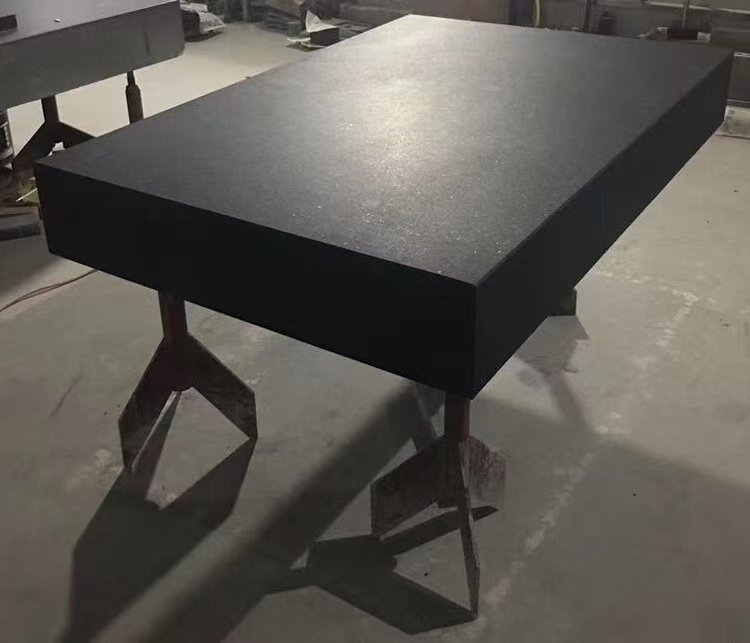
Large granite platforms use three-point positioning support (most stable, prevents twisting deformation).
Add anti-vibration pads and leveling feet for easy leveling adjustment.
Leveling Calibration
Level using a precision level; do not move or pry after fixing.
IV. Daily Maintenance and Care (To Extend Precision Lifespan)
Cleaning
Wipe with anhydrous alcohol or a dedicated neutral cleaner; do not use strong acids, strong alkalis, or machine oil.
Scratch Prevention
Do not drag steel workpieces directly; place soft rubber or copper sheets under workpieces.
Bump Prevention
Corners are most prone to chipping; handle with care during transportation and use.
Prohibition of Unauthorized Drilling/Cutting
Unauthorized processing will destroy internal stress, rendering precision useless.
Regular Re-inspection
High-precision platforms should be re-inspected for flatness every six months to one year; return to the factory for precision grinding repair if necessary.