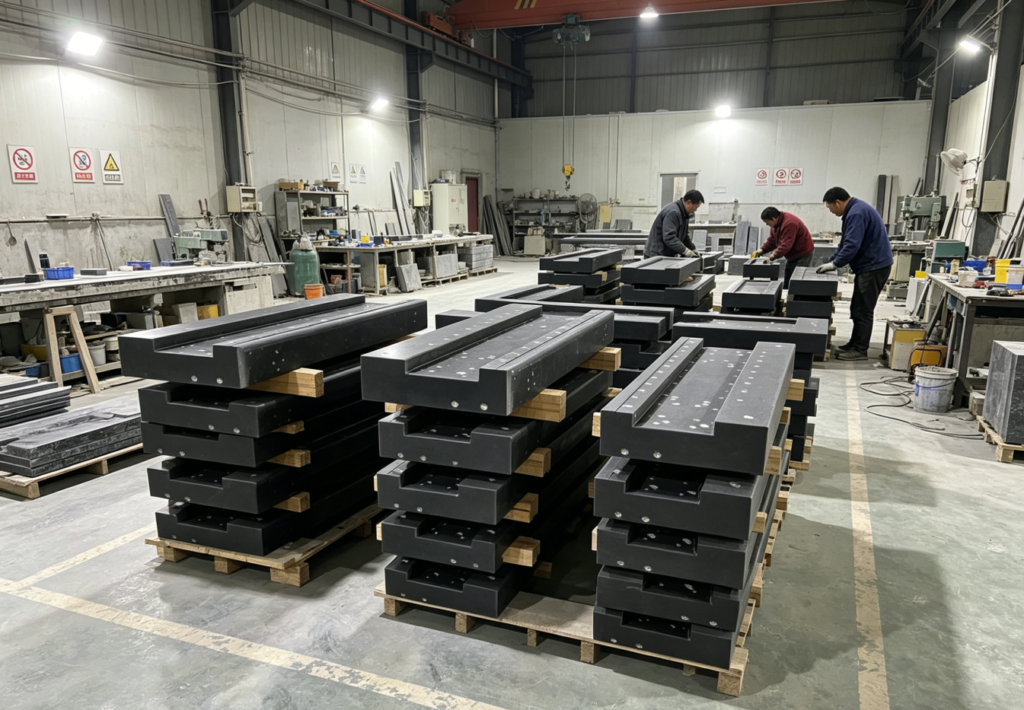
Granite Irregular Base Machining: Complete Solution to Chipping (Practical Workshop Version, Ready to Implement)
Essence of Granite Chipping: Brittle material, incorrect feed-in method, unsuitable tools, poor corner handling, inadequate cooling, and unreasonable allowances. The following covers seven aspects: preliminary design, tool selection, cutting parameters, machining path, corner handling, clamping and cooling, and post-processing. All methods are proven effective in practice.
I. Preliminary Drawing / Structural Optimization (Reduce chipping at the source)
Convert all internal right angles to rounded corners.
Prioritize R3–R6 for internal corners; absolutely avoid 90° right angles as they will chip. Communicate with the client regarding structural optimization.
Thicken edges and thin walls.
Thickness of weight-reduction slot edges and cantilever side walls must be no less than 20mm; too thin is extremely prone to chipping.
Apply chamfers C1–C2 to hole and slot openings.
Reserve chamfers in advance to ensure no chipping after machining.
II. Tool Selection (The Most Critical)
Must use sintered diamond milling cutters / diamond ball nose cutters; prohibit ordinary carbide tools.
For profiling and slotting: Use fine-grain diamond milling cutters with sharp edges that do not chip the stone.
For small holes and corner cleaning: Use small-diameter solid diamond drills / milling cutters.
Prohibit machining with dull tools; dull tools squeeze the stone and directly cause chipping.
III. Cutting Parameter Control (Core Anti-Chipping)
Low feed rate, medium to high spindle speed, layered cutting.
Speed: 2200–3200 r/min
Feed: F200–400; strictly prohibit high feed rates.
Layer depth: 1–2mm; strictly prohibit deep cutting in one pass.
Edge profiling: Tool path from inside out; do not start cutting directly from the edge of the stone.
Drilling: Pre-drill a small hole first, then enlarge it; hole openings are less likely to chip.
IV. Machining Path Optimization (Most Effective)
Prioritize climb milling; avoid conventional milling as much as possible.
Conventional milling pulls the stone, doubling the probability of chipping; climb milling ensures smooth cutting.
External contour: Traverse around the shape in the same direction, followed by a final finishing pass.
Internal slots / hollowing: Rough out first to remove material, then finish the inner walls, and finally clean the corners.
Corners: Use arc transition tool paths; do not make sharp right-angle turns.
Leave a 0.3–0.5mm finishing allowance on all edges, and perform a light finishing pass at the end.
V. Special Treatment for Corners, Hole Openings, and Thin Walls
Internal right-angle corner cleaning: Use a small round cutter for arc cleaning; do not force a straight one-cut.
Hole openings: Chamfer with a diamond counterbore after drilling.
Thin walls / cantilevers: Low speed, small depth of cut, multiple passes; reduce vibration.
Prohibit direct impact of the tool on the stone edge when starting the cut.
VI. Cooling and Chip Removal (Ignored by 90% of small workshops)
Full wet water cooling; must use water flushing for cooling.
Dry cutting causes high temperature dust compression, directly leading to chipping and hidden cracks.
Increase water flushing in deep slots and hollow areas to flush away stone powder promptly, avoiding tool compression and chipping.
Prohibit air cooling and dry cutting.
VII. Clamping and Vibration Control
Level and press the irregular base firmly; use clamping plates to ensure even force. Do not allow overhangs or vibration.
Vibration is the culprit of chipping; tooling must be stable.
For large pieces, perform layered machining in multiple passes to reduce vibration impact.
VIII. Remedies After Chipping Prevention Summary Slogan
Design first with rounded corners and chamfers
Diamond tools, low speed, layered cutting
Climb milling, wet cooling, leave finishing allowance
Arc tool paths at corners, strictly prohibit forced right-angle cutting
Core principle: Rounded corners diamond tools layered climb milling water cooling leave finishing allowance, and you can eliminate 95% of chipping.