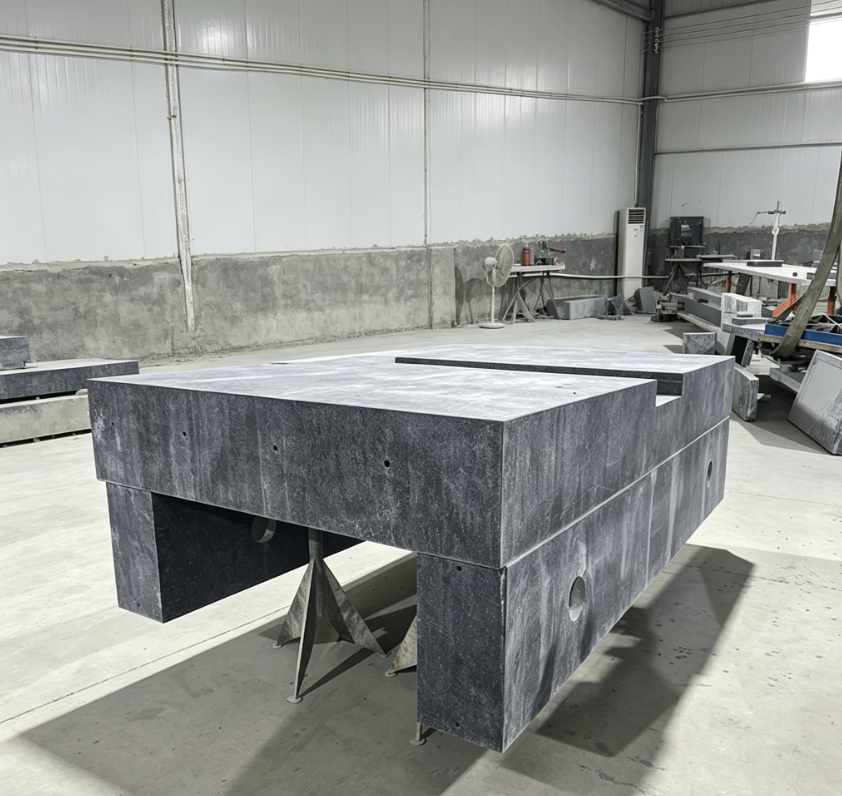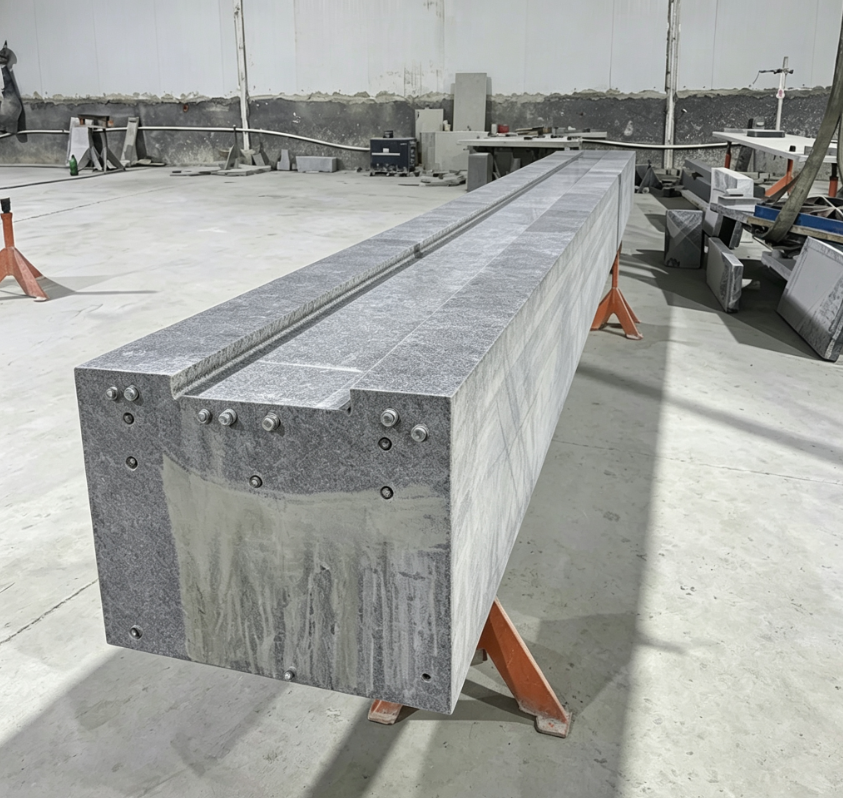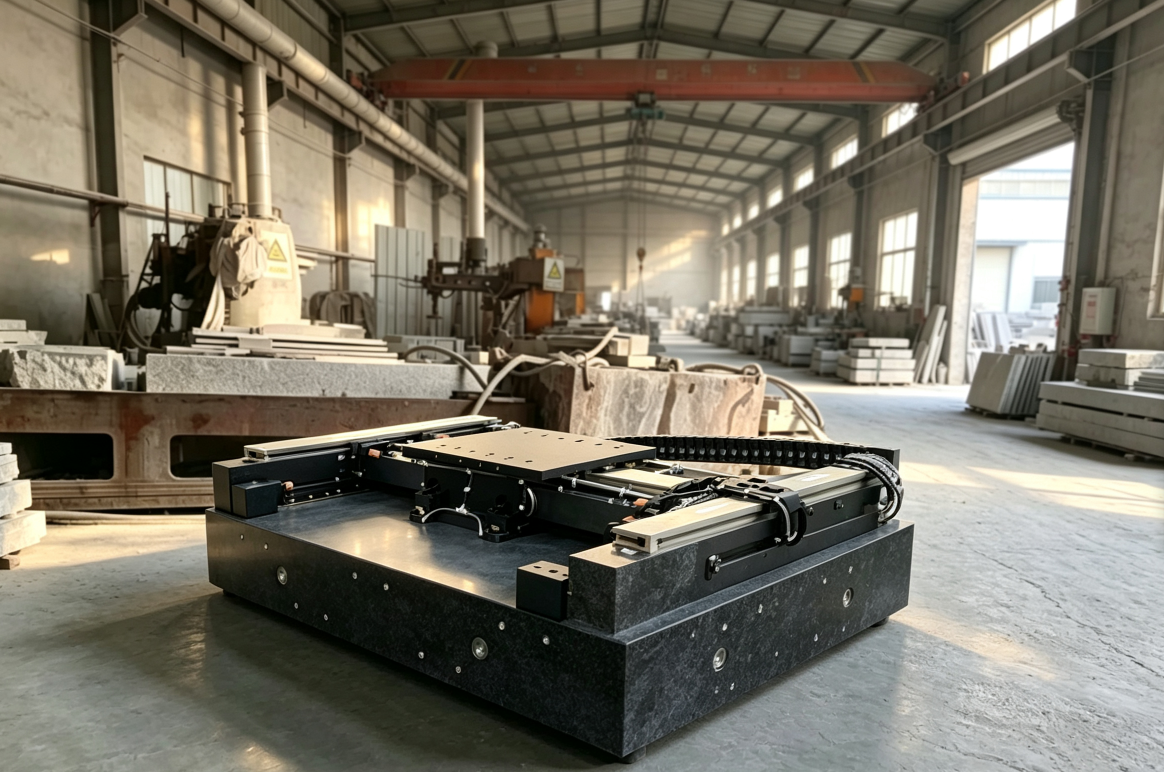
The demand for monolithic machined granite (especially machine tool beds and platform components) is growing rapidly, essentially reflecting the upgrading of requirements for “extreme precision and stability” in high-end manufacturing, which is the result of the combined effects of the material properties of granite, breakthroughs in machining technology, and cost advantages.
I. The “Hard Power” of the Material Itself, Precisely Addressing the Pain Points of High-End Manufacturing
The physical properties of granite are almost tailor-made for high-precision scenarios:
Damping performance crushes cast iron, doubling processing precision and tool life
Granite’s damping coefficient is 5-10 times that of cast iron, capable of absorbing over 85% of high-frequency vibrations. This means that machine tool vibrations are quickly “absorbed” during operation, reducing workpiece surface roughness and increasing tool durability by 37%, with particularly significant advantages in precision grinding and optical processing.
Extremely strong thermal stability, with almost no precision drift under temperature changes
Granite has an extremely low coefficient of thermal expansion and slow heat conduction, making the impact of workshop temperature fluctuations on deformation negligible. In a constant temperature environment, annual precision variation can be controlled within 0.002mm (about 1/50 the diameter of a human hair), perfectly solving the long-standing problem of “thermal deformation” in cast iron machine beds.
Maximized rigidity and wear resistance, with no loss of precision over long-term use
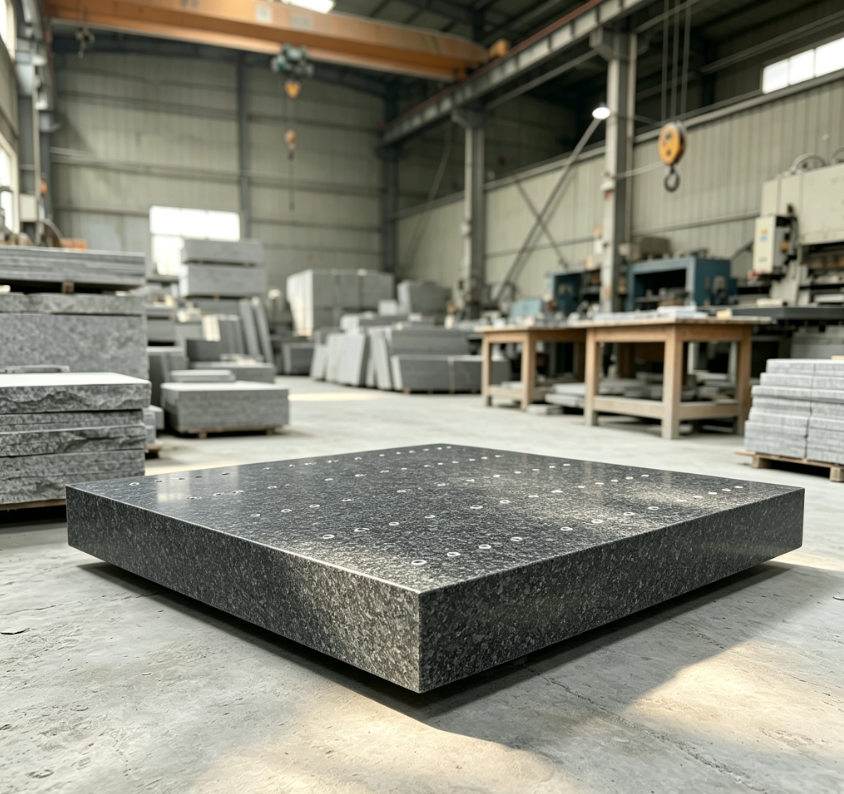
Formed by geological processes over hundreds of millions of years, granite has fully released internal stresses, exhibits no plastic deformation or magnetic reaction, and possesses high Mohs hardness, making its surface wear-resistant and scratch-resistant. After long-term use, flatness and straightness can still be stably maintained, which is crucial for high-precision equipment in semiconductors, optics, and other fields.
II. Integrated Machining Technology is Mature, Thoroughly Solving the “Shortcomings” of Traditional Granite
In the past, granite components were mostly segmented and spliced, limiting their application scenarios. Now, integrated machining technology has achieved a qualitative leap:
Concentrated multi-process machining, integrated forming without splicing errors
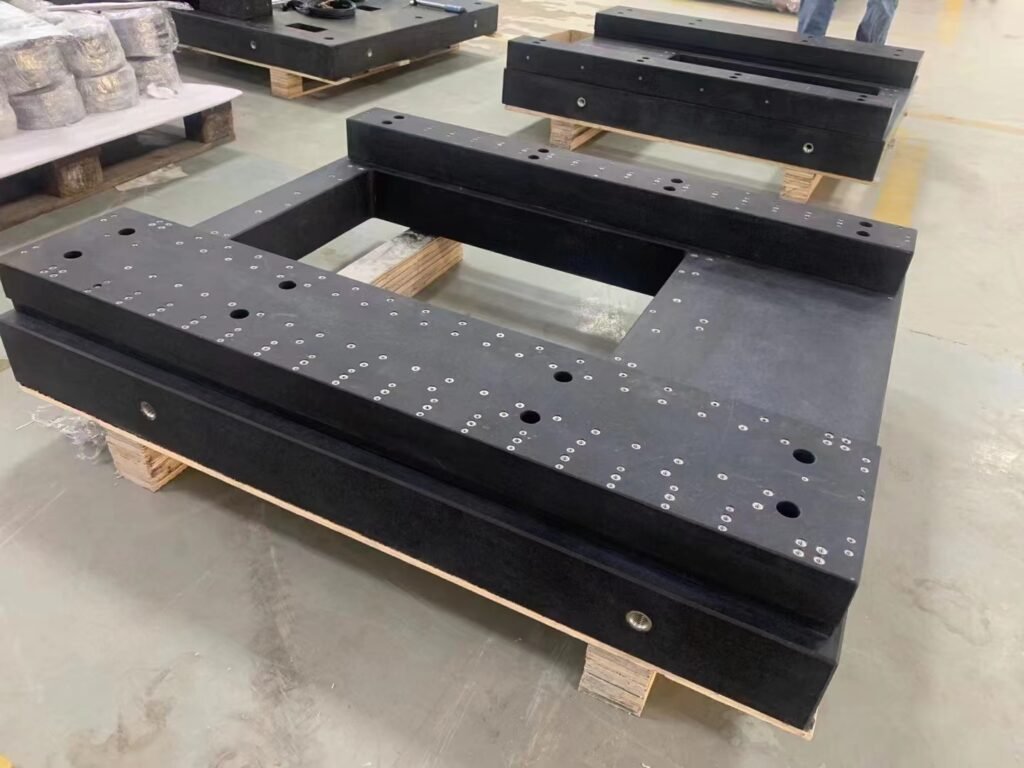
Modern large-scale CNC equipment can directly perform integrated cutting, milling, grinding, and drilling on granite blanks. Ultra-long components up to 6-7 meters can be formed in one operation, completely eliminating assembly errors from segmented splicing and significantly improving the overall structural rigidity.
Breakthrough in customization capabilities, enabling direct realization of complex structures
Unlike cast iron, which requires mold casting, customers can directly process structures such as T-slots, guide rail mounting surfaces, and irregular holes by providing drawings. Delivery cycles are significantly shortened, adaptability is extremely strong, and it can quickly respond to customized needs for different equipment.
Breakthrough in machining accuracy, reaching micron and even sub-micron levels
Domestic high-end granite processing enterprises have achieved ±1μm flatness control, and in some scenarios, even Grade 0 precision, far exceeding the Grade 2 precision limit of traditional cast iron machine beds. This meets the stringent standards of ultra-precision manufacturing in semiconductors and aerospace.
III. Outbreak of Downstream High-end Manufacturing, Demand Directly “Spurring” Growth
Semiconductor / Chip Industry: Extreme Requirements for Stability
Wafer inspection, lithography machine supporting equipment, and semiconductor packaging equipment all require granite platforms to provide vibration-free, non-magnetic, and high-precision reference support. This is currently one of the fastest-growing application scenarios.
New Energy Vehicles / Precision Molds: Upgraded Requirements for Machining Precision
Electric motors, battery structural components for new energy vehicles, and high-precision injection molds require increasingly higher stability and surface quality from machine tools. Granite machine beds can significantly improve machining consistency and yield rates.
Optics / Display Panels: A Necessity for Micron-level Positioning
Printing and cutting equipment in LCD and OLED production, as well as machine tools for optical lens processing, rely on the thermal stability and vibration resistance of granite platforms to ensure long-term stable positioning accuracy.
IV. Cost and Environmental Advantages, More Cost-effective than Cast Iron in the Long Run
Controllable comprehensive costs, more economical over the life cycle
Although the cost of granite blanks is not low, there is no need for casting and mold opening, subsequent maintenance costs are extremely low, and the lifespan is much longer than cast iron components (virtually no wear and no rust). In the long run, the comprehensive usage cost of granite components is even lower than that of cast iron.
Green and environmentally friendly, in line with the “Dual Carbon” trend
Granite processing avoids the high energy consumption and high pollution problems associated with the casting process, and it is recyclable. Under the background of stricter environmental policies, it has a greater policy advantage compared to cast iron components.
V. Industry Recognition and Technological Popularization Drive the Rapid Expansion of Application Scenarios
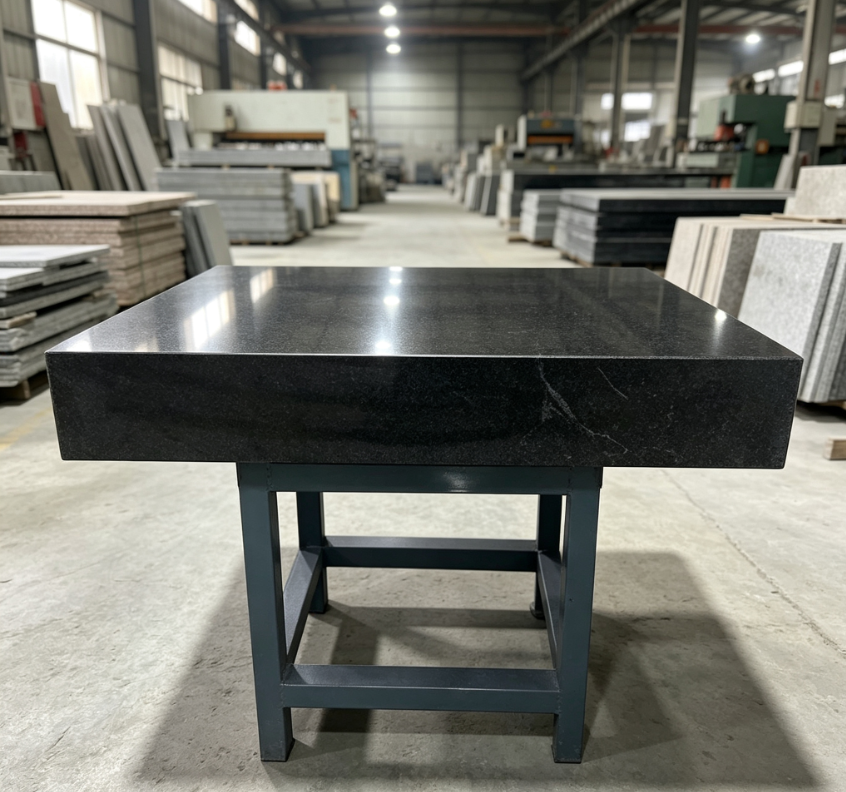
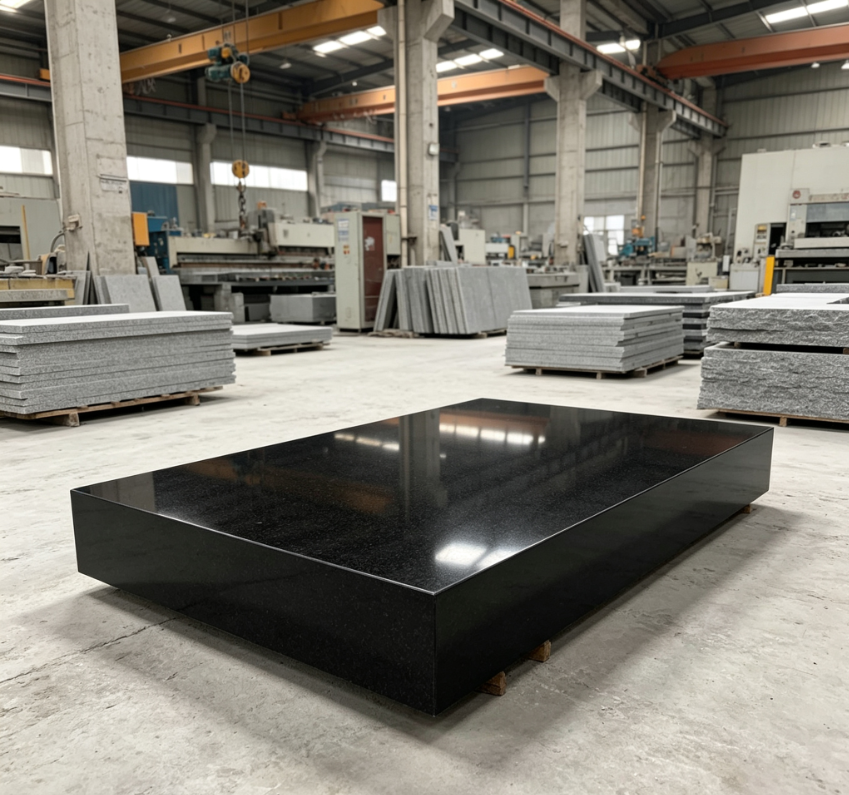
In the past, granite was primarily used for inspection platforowever, with the maturation of technology, its application has expanded to core structural components such as machine tool beds, gantry beams, and columns. Industrial belts for granite, such those in Gaotang, have established a complete industrial chain ranging from raw material extraction to precision machining. This has driven down the cost of integrated granite components and promoted the popularization of th technology, enabling more enterprises to access high-performance granite products.
Supplement: Granite is not a panacea.
It is relatively brittle, with inferior impact resistance compared to caand requires high standards for machining equipment and processes. Currently, its applications are mainly concentrated in high-precision, low-impact scenarios, while mid-to-low-end general-purpose machine tools still pminantly use cast iron. However, with technological advancements, the boundaries of its application are continuously expanding.