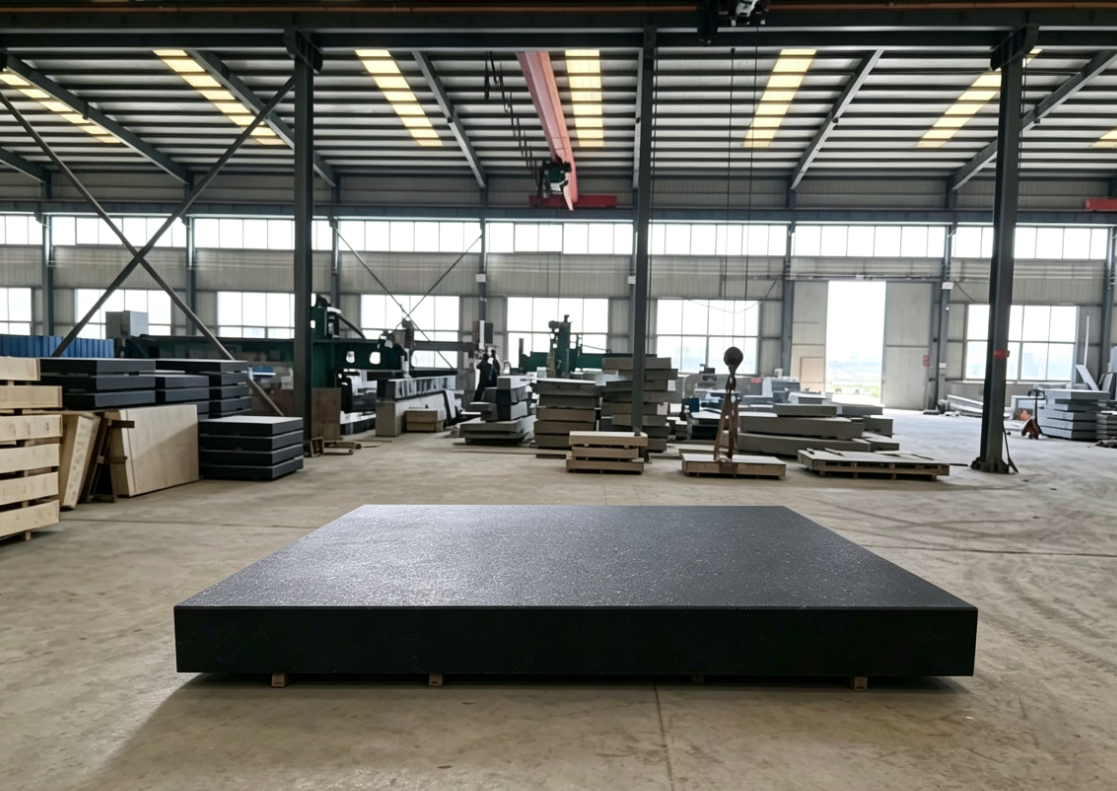
Granite Equipment Base · Full Process of Irregular Machining (Machine Tools / CMM / Semicose Practical Processes)
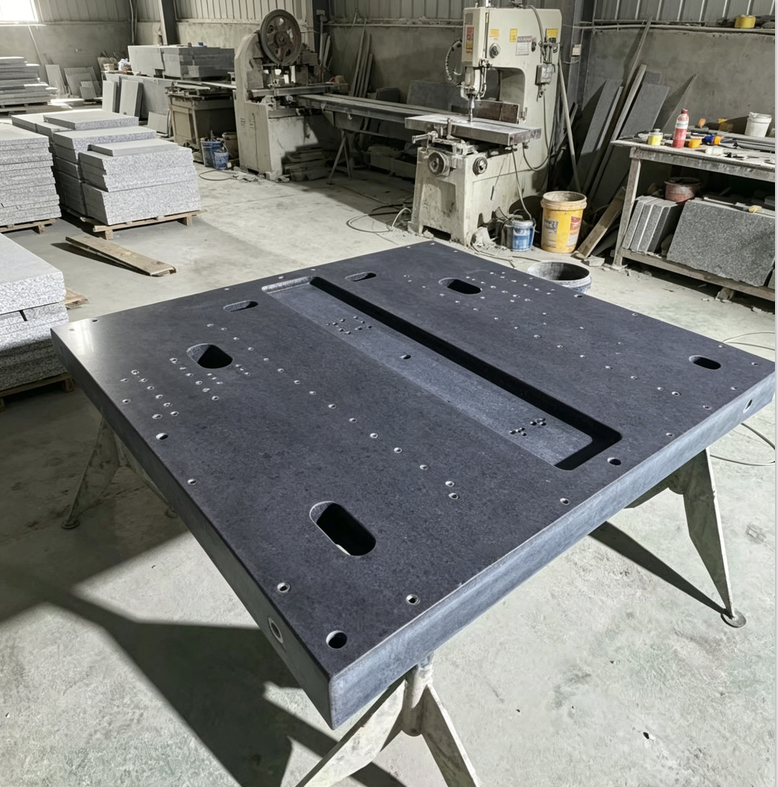
Characteristics of Irregular Granite Bases: Non-standard shapes, irregular grooves, bosses, cantilevers, cutouts, chamfers, multi-surface perpndicularity, embedded threaded inserts, counterbores, wire holes, weight-reduction slots, irregular guide surfaces. High precision requirements, prone to chipping, difficult stress control. The followg provides a complete explanation covering process steps, tools, fixtures, difficulties, pitfalls, and aging coordination, directly applicable to production.
I. Preparatory Work (Determines Finished Produ Pass Rate)
Material Selection Priority
Jinan Green > Indian Black > Zhangqiu Black. Must be free of hidden cracks, white veins, and porosity. Ordinary granite must be used for irregular cutouts/cantilever parts.
Drawing Breakdown
Decompose: Outer contour, weight-reduction slots, angled holes, irregular steps, embedded threaded inide surfaces, installation datum surfaces. Prioritize establishing the large flat datum surface.
Rough Machining Allowance
Leave an overall allowance of 6–1mm; leave 8–15mm for irregular grooves and cutout positions to prevent chipping and cracking.
Rough Machining → Constant Temperature Aging
After all outer shapes, grooves, holes, and weight-reduction structures are rough milled, immediately perform 55°C constant temperature aging for 48–72 hours to release cutting stresses before precisionachining.
Irregular parts are most prone to deformation later; aging must be done upfront.
II. Core Irregular Machining Processes (Primarily CNC Gantry Milling)
1.tum Leveling (Must be done first)
First machine the large bottom surface main datum surface to ensure flatness and perpendicularity. All subsequent irregular structures are positioned relative to the datsurface.
Pad the bottom flat, use vacuum suction cups / clamping fixtures; strictly prohibit cantilevering or single-point loading.
- Contour, Weight-Reductioots, and Cutout Machining
Use sintered diamond milling cutters, cutting in layers with a depth of 1–2mm per layer; strictly prohibit deep single cts.
Cutouts, Internal Corners: Use arc transitions; avoid right angles as they are extremely prone to chipping. Right angles on drawings can be modified to small radii.Cantilevers, Thin-Wall Structures: Coarse first, then finish; use low-speed feed to prevent stone breakage.
Leave a 0.5–1mm finishing allowance inner walls and sides of weight-reduction slots. - Chamfers, Angled Surfaces, Irregular Steps
Use 3-axis linkage on CNC gantry milling to machine anged surfaces, matching tool inclination.
Subsequent manual finishing grinding of angled surfaces to ensure flatness. - Irregular Holes, Counterbores, Wire Holes, Threaded rt Embedding
Use diamond drill bits; pre-drill with a small drill bit first, then enlarge the hole to avoid chipping.
Counterbores and stepped holes are mill in layers.
Stainless steel threaded insert embedding: Apply glue inside the hole to fix it, ensuring perpendicularity and hole spacing accuracy, preventing loosening. - Precision Machining fter Aging)
Precision mill all irregular surfaces, grooves, and steps; leave an allowance of 0.2–0.5mm for grinding preparation.
Ensure parallelism, perpeularity, and hole spacing tolerance, generally ±0.02~±0.05mm. - Precision Grinding of Irregular Surfaces (Hardest Process)
Large Fat Surfaces: Mechanical grinding
Irregular grooves, angled surfaces, guide surfaces, inner sides: Manual hand-held grinding discs grinding sand for step-by-step precision grinding
Precision rade: Grade 0 for ordinary equipment, Grade 00/000 for precision CMM/semiconductor, micrometer-level flatness
III. Tools and Cutting Parameters (Gen Factory Use)
Tools: Diamond milling cutters, diamond drill bits, ball-nose diamond cutters
Speed: 2000–3500 rd: Low-speed uniform feed, F300–600
Cooling: Wet cooling (water flushing) to reduce dust, temperature, and prevent chipping
Dry cuttingy prohibited; dry cutting easily causes thermal cracking and chipping
IV. Major Challenges in Irregular Machining & Key Points to Avoid Pitfalls
Chipping at internal right angles
Solution:ly R3–R5 fillets at internal corners or use small-diameter tools for corner cleaning; direct cutting of right angles is prohibited.
Breakage of cantilevers and thin walls
Use sl and layered cutting for roughing; ensure proper aging; handle with care during lifting.
Inconsistent accuracy of irregular surfaces
Unify the datum; grind the datum surface first, thenhe irregular structure.
Deformation after machining
Roughing must be followed by thermal aging; extend the holding time for irregular parts to 72 hours.
Skew of embded parts
Drill vertically, fix with adhesive, and recheck hole spacing after precision machining.
V. Complete Standard Process Flow (One Sentence)
Select dense granite blocks → Cutting → Rouging of shape/slots/holes/lightening structures → Stress relief via constant-temperature thermal aging → Precision milling of irregular surfaces → Shaping with diamond tools → Manual precision grinding → Precisioinspection → Protective treatment → Finished product