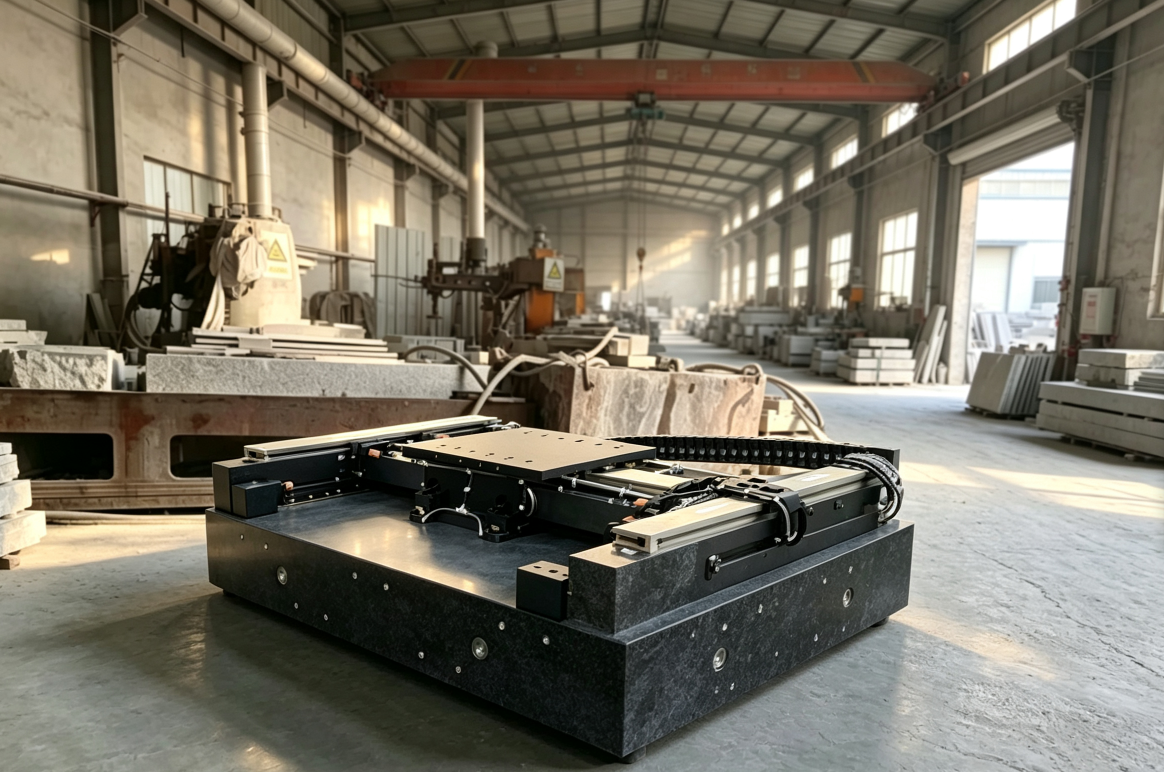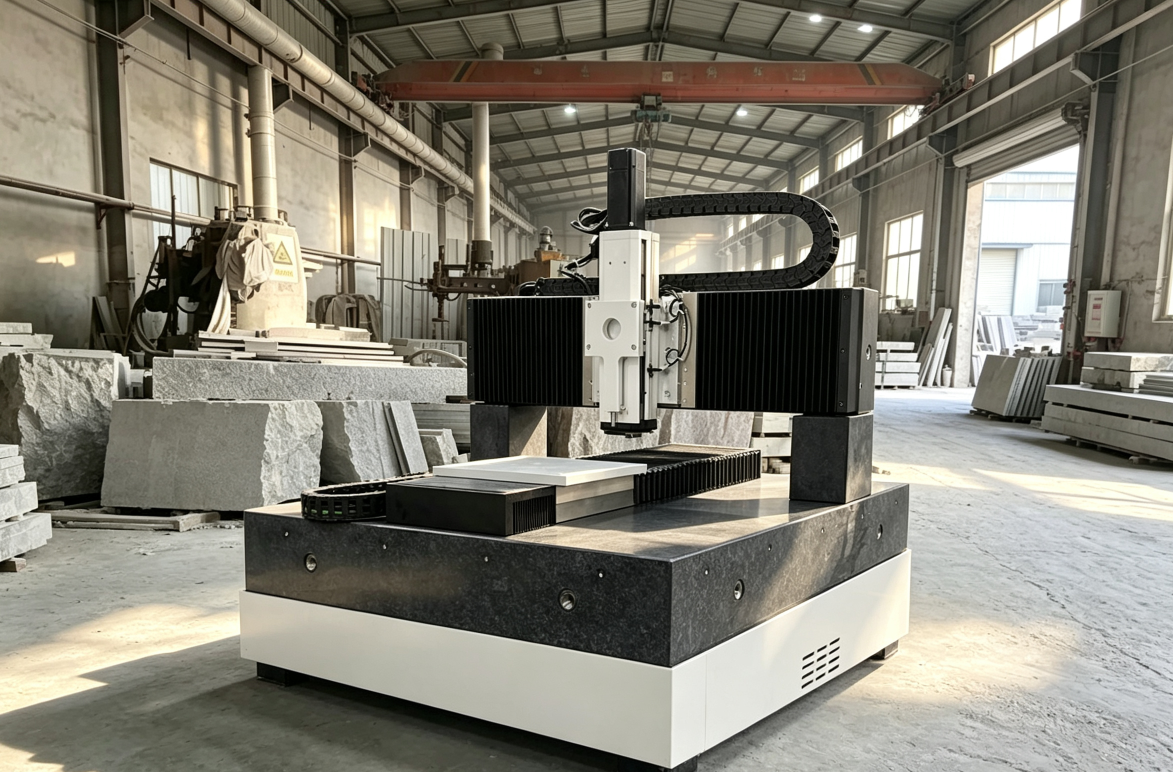
Complete Selection Guide for Precision Granite (Marble) Surfaces
Targeting scenarios such as guide rail inspection, multi-axis slide table bases, linear motor platforms, and vision/laser inspection equipment, distinguishing between standard inspection plates and integrated equipment bases, suitable for direct client presentations and technical proposals.
I. Step One: Selecting the Stone Raw Material (The Top Priority)
- Preferred Choice: Jinan Blue Granite (Industry standard material for precision metrology)
✅ Advantages:
High density, compact grain structure, low coefficient of thermal expansion (≈4.5×10⁻⁶/℃), excellent vibration damping, resistant to edge chipping, and can be ground to 00/000 grade.
Suitable for: 00 grade and 000 grade high-precision platforms, linear motor bases, and guide rail inspection benchmarks.
❌ Materials to Avoid:
Ordinary Sesame Gray or out-of-town granite: Loose material structure, difficult to grind to 00 grade, prone to pores, and higher temperature drift;
Marble (Dolomite-based): Low hardness, easily scratched, sensitive to acids and alkalis, strictly prohibited for use as precision metrology surfaces.
Industry common term “Marble Platform” is essentially all black granite; procurement communication must specify: Jinan Blue.
II. Step Two: Determining the Precision Grade (Based on your inspection accuracy requirements)
Refer to National Standard GB/T 20428 “Rock Surface Plates”
Cuadro
Grade | Typical Application Scenarios | Suitable Environment
000 Grade | Metrology lab benchmarks, instrument calibration, nano-scale optical inspection | Constant temperature 20℃ metrology lab, avoid workshop on-site use
00 Grade (Most mainstream) | Guide rail/module factory inspection, linear motor platform bases, 3D vision inspection equipment | Constant temperature workshop, enclosed inspection room (temp difference <±3℃)
0 Grade | Standard assembly, ordinary 2D vision equipment, routine component sampling | Ordinary clean production workshop
1 Grade | Tooling positioning, scribing, rough inspection, not recommended for precision measurement | General workshop environment
⚠️ Critical Reminder:
After slotting, extensive tapping, or drilling lifting holes, the flatness will change slightly.
For 00/000 grade bases, require the manufacturer to re-grind and re-test flatness after precision machining of holes.
III. Step Three: Dimensions, Thickness, and Rigidity Design (Common pitfalls for customers)
Thickness Selection (Determines rigidity and prevents self-weight deformation)
≤600×600mm: Thickness ≥100mm
800×1200mm: Thickness ≥150~200mm
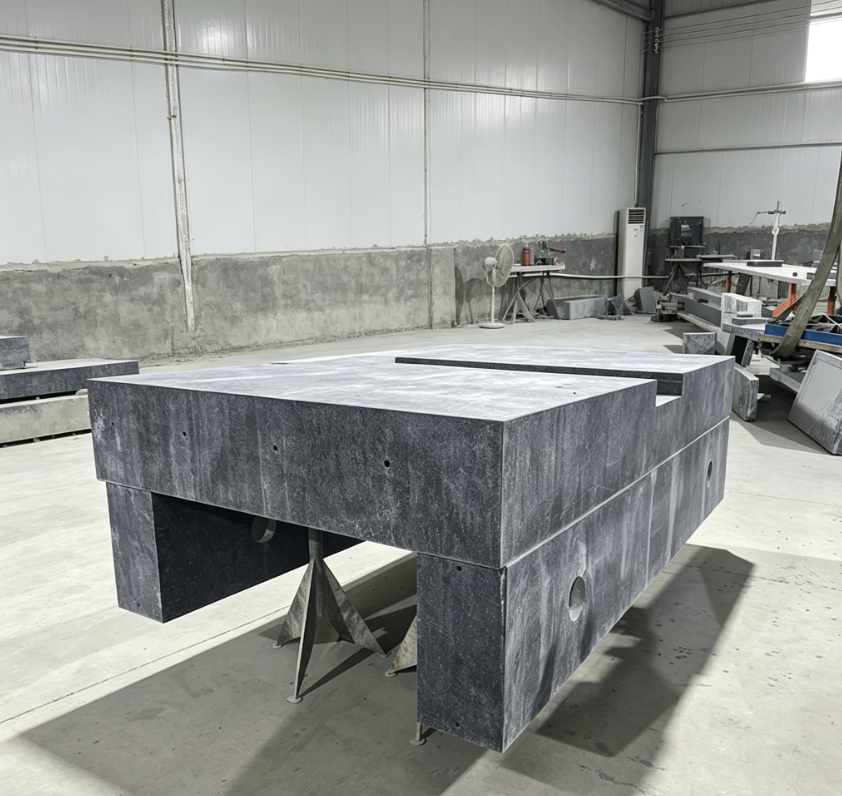
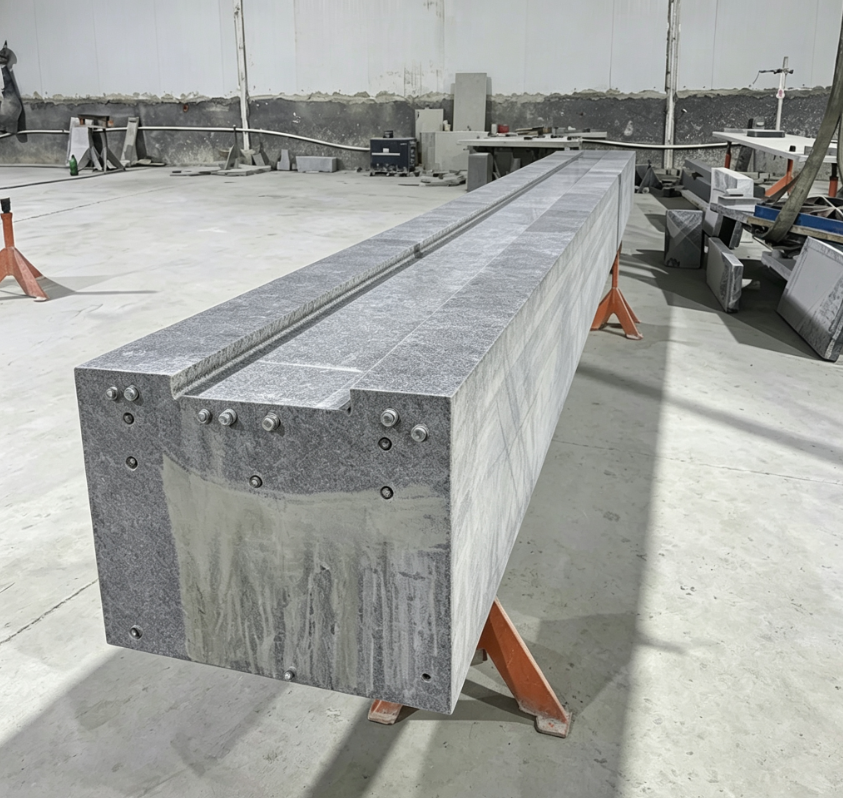
Length >1500mm long gantry beams / long bases: Thickness ≥250mm, reinforcement ribs or box-type integrated structure required (like the slotted gantry structure in your image)
Surfaces that are too thin will experience slight deflection due to self-weight, causing parallelism to continuously deteriorate after mounting the slide table.
Support Layout Principles
Standard platforms use the three-point support principle; for large custom bases, plan support points in advance. They cannot be suspended or bear weight on one side, otherwise, force distortion will destroy the grinding precision.
Travel Margin
When mounting multi-axis gantry slide tables, the surface length and width must be greater than the equipment’s moving outer contour, reserving installation space and cable drag chain clearance areas.
IV. Step 4: Distinguish between the two types of applications, as processing requirements are completely different
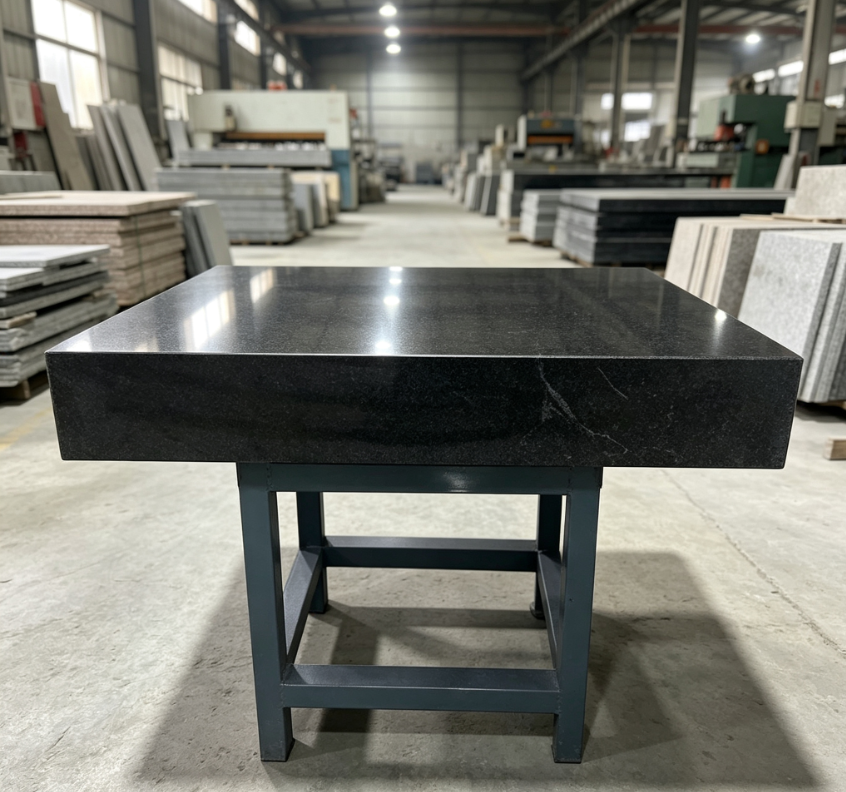
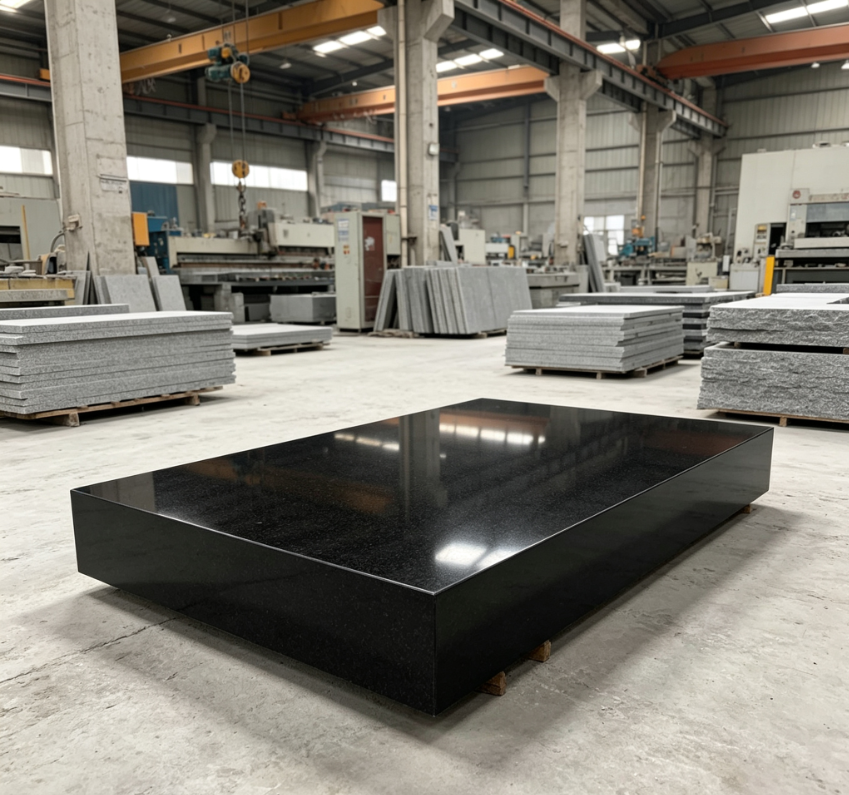
Type A: Standard Inspection Plate (flat surface, used for placing workpieces for inspection)
Requirements: High-precision flatness on the top surface; only a few threaded holes; high-precision verticality on the sides is not required.
Type B: Integrated Equipment Base (for mounting linear motors / gantry slides, your core products)
Top surface flatness cannot be the only metric! Additional requirements:
Parallelism and verticality between guide rail mounting reference surfaces;
Depth and position tolerance of mounting threaded holes;
Side reference surfaces and lifting threaded holes;
Machining of dust-proof grooves and cable routing clearances;
This category belongs to precision granite mechanical components, not ordinary inspection plates.
V. Step 5: Surface processing and additional requirements
Working surface: Fine grinding; non-working surfaces can be ordinary machine-planed to reduce costs;
Protection: No painting required! The natural bare surface of granite is best after grinding; painting will cover pores, and paint deformation due to temperature changes will introduce errors;
Threaded holes: Must use steel wire inserts to prevent the hard stone from stripping;
Lifting: Reserve lifting threaded holes for large-sized components; direct binding of edges with steel wire ropes is prohibited (prone to chipping corners).
VI. Step 6: Environmental matching and selection (do not blindly pursue the highest precision)
Ordinary workshop, large temperature fluctuations, machine tool vibrations
Prioritize Grade 00 or Grade 0, paired with air spring vibration isolation bases; Grade 000 is not recommended, as environmental fluctuations will offset the high precision.
Constant temperature inspection room, high-precision guide rails / linear motor factory inspection
Directly select Grade 00 Jinan Blue granite; for laboratory metrological traceability, Grade 000 is optional.
Online continuous 24h running inspection equipment base
Thickened structure to enhance rigidity; focus on ensuring the stone is fully naturally aged to avoid slow deformation later.
VII. Pitfall Checklist (verify directly during negotiation and ordering)
❌ Only writing “granite plate” without specifying Jinan Blue, precision grade, or national standard compliance;
❌ Only specifying top surface flatness, ignoring parallelism and verticality of guide rail mounting surfaces;
❌ Base is too thin, pursuing low prices, leading to bending deformation during long-term use;
❌ Not re-verifying precision after grooving and drilling;
❌ Purchasing decorative light-colored marble as metrological granite;
❌ Directly placing Grade 000 plates in ordinary production workshops for use.