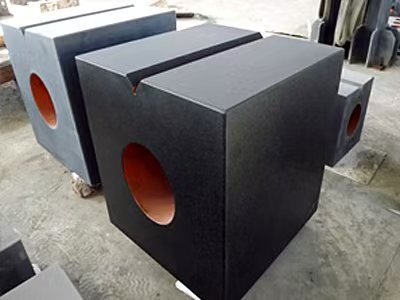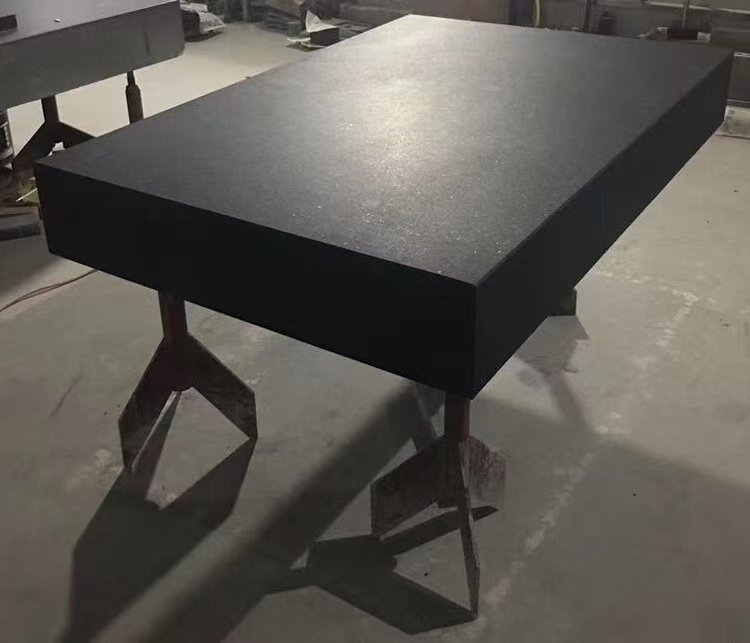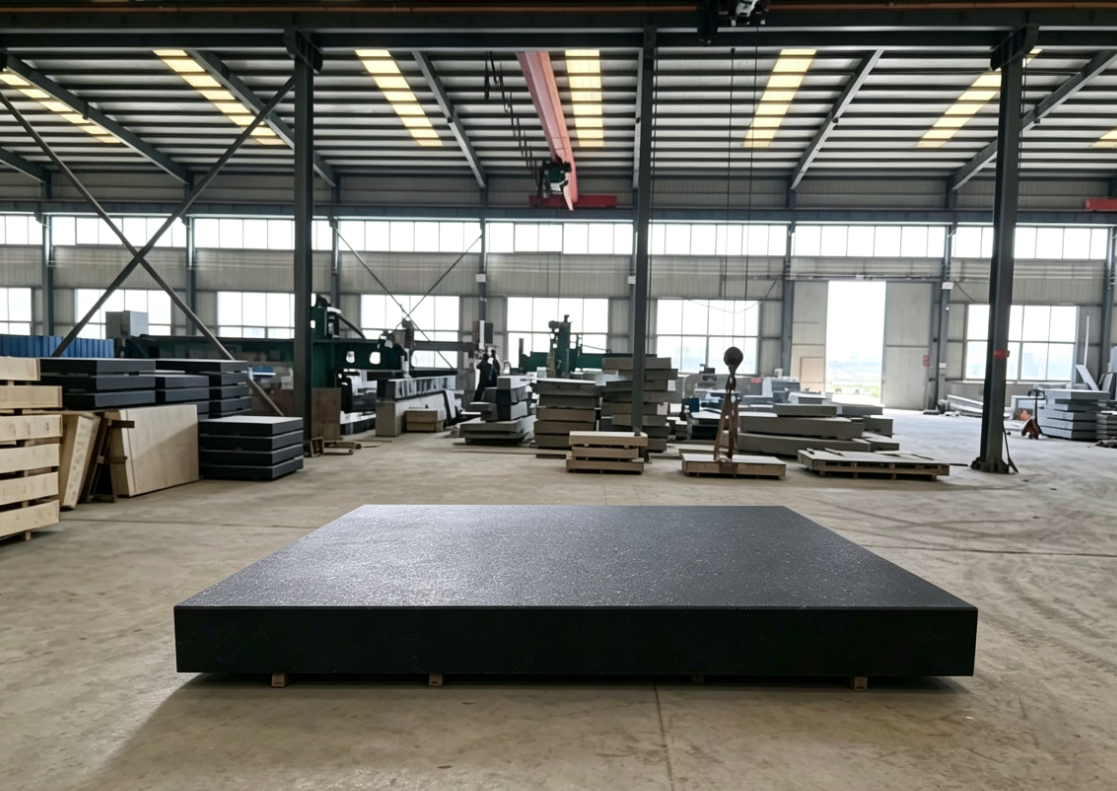
Marble square (commonly referred to as granite square) is a high-precision right-angle reference gauge. Its core purpose is to provide a stable 90° reference surface for inspecting and calibrating flatness, perpendicularity, and straightness, and it is widely used in precision machining, metrological inspection, and equipment installation.
I. Core Applications (Four Major Scenarios)
- Precision Inspection (Most Common)
- Workpiece Inspection: Using the vertical surface of the square as a reference, dial indicators/micrometers are used to measure the perpendicularity, parallelism, flatness, and straightness of parts; such as right-angle and flatness verification for shafts, housings, molds, and gauges.
- Machine Tool Calibration: Inspecting the perpendicularity and straightness of machine tool worktables, guideways, and spindles to correct geometric accuracy and ensure machining precision.
- CMM Support: Serving as a reference block for Coordinate Measuring Machines (CMMs) to provide a stable right-angle coordinate system and reduce reference errors.
- Scribing and Positioning: Pressing against the vertical surface of the square during precision scribing to ensure lines are strictly perpendicular to the reference surface.
- Equipment Installation and Calibration
- During the installation of precision equipment (instruments, optical equipment, CNC machine tools), adjusting level and verticality to ensure the equipment’s reference surface fits against the square, achieving micron-level installation accuracy.
- Calibration and verification of tooling fixtures and inspection gauges to ensure the right-angle accuracy of the tooling.
- Metrology and Laboratory Reference
- Serving as a high-precision reference tool in metrology rooms and quality inspection departments for the comparison and calibration of gauges (straight edges, square rulers, V-blocks).
- Providing a stable, non-magnetic reference for precision measurement scenarios sensitive to temperature changes and magnetic fields in fields such as optics, electronics, and aerospace.
- Other Industrial Applications
- Positioning and supporting workpieces during precision assembly to ensure assembly perpendicularity and positional accuracy.
- Flatness verification of inspection platforms and surface plates, serving as a reference for comparison.
II. Core Characteristics (Why Use Marble)
- High Precision and Stability: Natural granite (Jinan Green) has aged over millions of years, resulting in zero internal stress and an extremely low coefficient of thermal expansion, meaning it does not deform under temperature changes; accuracy grades reach Grade 00/Grade 0 (flatness ±2μm, perpendicularity ±3μm).
- Rust-proof and Acid/Alkali Resistant: Non-metallic material, non-corrosive, suitable for humid/acidic/alkaline environments.
- Non-magnetizable: Non-magnetic, does not attract iron filings, and does not affect magnetic field-sensitive measurements.
- Wear-resistant and Long Lifespan: Mohs hardness of 6–7, resistant to wear, with stable accuracy over long-term use.
III. Common Specifications and Accuracy
- Specifications: 100×100mm to 1000×1000mm, non-standard sizes can be customized.
- Accuracy: Grade 00 (highest), Grade 0, Grade 1; working surface flatness and adjacent surface perpendicularity errors are at the micron level.
IV. Comparison with Cast Iron Squares
- Marble: Higher precision, better stability, rust-proof, non-magnetizable, and longer lifespan; suitable for high-precision, temperature-change/magnetic-field sensitive scenarios.
- Cast Iron: Lower cost, slightly better impact resistance; used for general precision inspection.