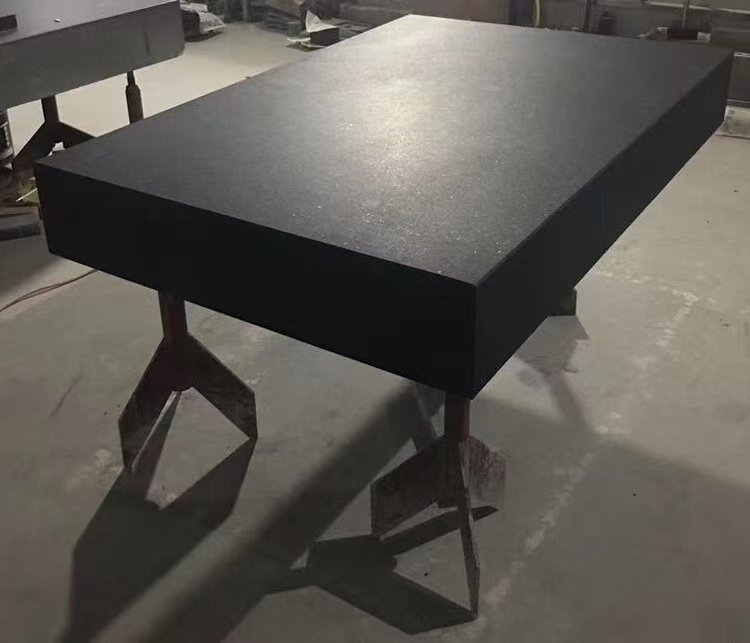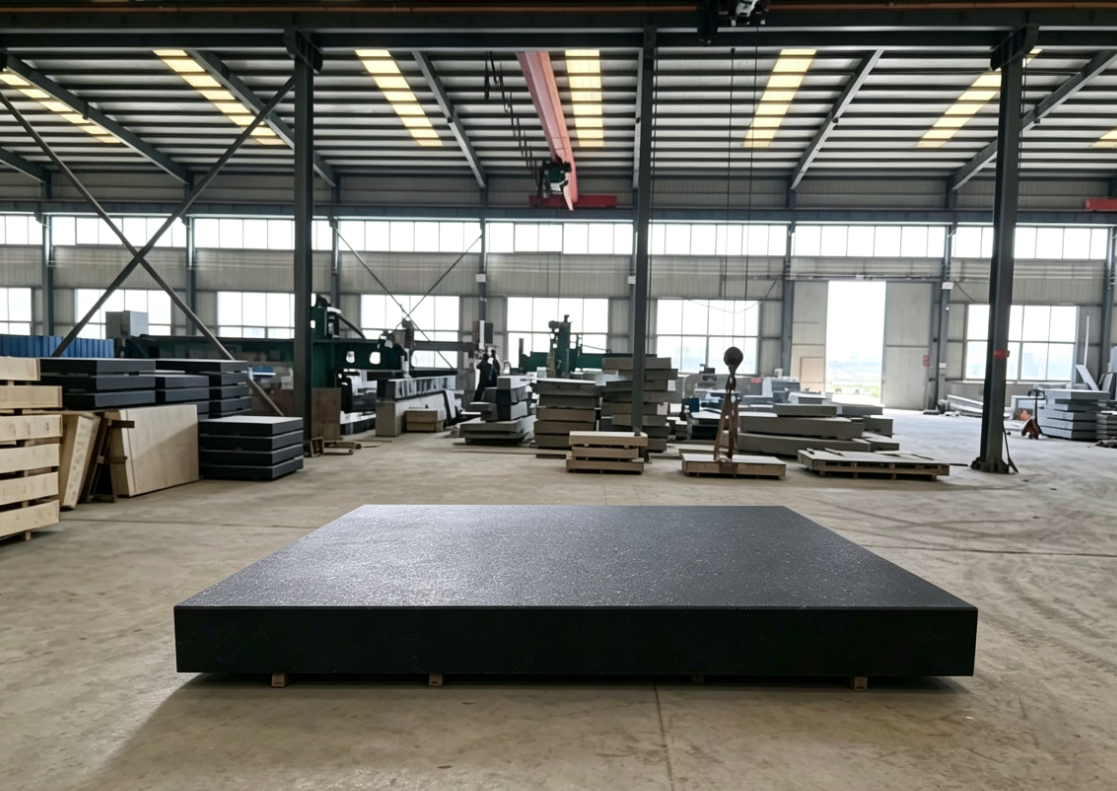
If Shandong Jintailai’s granite precision platforms are used for CMM, measurement, inspection, or assembly, their lifespan cannot simply be judged in “years”—the granite body itself is extremely stable, and what truly determines the service life is often wear, bumps, and contamination of the working surface, as well as whether the platform is correctly supported and subjected to long-term stress.
From the general characteristics of granite, with normal use and proper maintenance, it is quite common for them to last for over a decade or even several decades; some data also describes the lifespan of highquality precision granite platforms as several decades.
I. Main Factors Affecting the Lifespan of Jintailai Granite Platforms
Usage frequency and load: Placing heavy workpieces in same position for a long time can easily cause localized wear.
Bumps: Granite does not undergo plastic deformation like cast iron, but falling heavy objects may cause localized or pitting.
Dust and metal chips: This is an easily overlooked source of wear for precision platforms. Sand particles and abrasive dust trapped between the workpiece and the platform produce a “grinding” effect.
Temperature changes: Granite has a small coefficient of thermal expansion, but high-precision measurements should still try to control the ambient temperature avoid significant temperature differences between the platform and the measured workpiece.
Support method: If the support points at the bottom of the platform are not arranged according to the manufacturers requirements, it may cause uneven stress on the platform, affecting flatness.
Long-term localized use: If all workpieces are concentrated in one area of the platform, the in that area will be significantly faster than in other areas.
II. How to Perform Daily Maintenance
- Clean before each use
It is recommended to clean the working surface a clean, soft, and non-abrasive cotton cloth/dust-free cloth.
If there is oil contamination, a cleaner suitable for precision granite can be, and then the surface should be wiped dry.
Special things to avoid:
Metal chips left on the platform;
Residual sand particles and abrasive dust;
Wiping forcefully a rough cloth;
Dragging workpieces with burrs or iron chips directly across the platform.
Dust and abrasive particles entering between the workpiece and the platform is an important factor wear on the working surface. - Do not “drag” workpieces
This is a very important point.
Do not drag steel parts horizontally directly on the granite.
The correct method is:
Lift → Place down → Measure/Adjust → Lift again to move.
Especially for carbide, hardened steel parts, or parts with sharp, try to use protective pads or special supports. - Strictly prohibit heavy objects from directly hitting the platform
Granite has high hardness, but this does not mean it is “estructible.”
For example, if a large steel part falls from a height of dozens of centimeters, even if there are no obvious cracks, it may still cause local pits.
Therefore, it is recommended to:
Use lifting equipment for heavy workpieces;
Reduce speed when approaching the platform;
Place soft protective pads large parts;
Do not perform tasks such as tapping, hammering, or chiseling on the platform.
Granite platforms may develop micro-pits when subjected to impact, precision measurement platforms especially need to avoid impact.
III. Always cover it when not in use
If the workshop is quite dusty, it is recommended to cover the with a dedicated dust cover every day after cleaning it.
This step is very effective in extending the lifespan.
Because what the platform truly fears is not ordinary, but:
Dust abrasive particles repeated movement of workpieces = long-term micro-grinding.
Manufacturer data also suggests covering the platform when not use to reduce dust and damage.
IV. Do not apply oil to the work surface at will
This is different from cast iron plates.
Granite itself does not rust, and under normal circumstances, there is no need to apply anti-rust oil like cast iron plates.
If your plate has metal inserts, threaded holes, brackets, or other metal parts, you can apply anti-rust treatment to these metal components, but do not treat ordinary anti-rust oil as a daily maintenance product for the granite work surface.
V. Temperature control is also very important
If it is a general inspection plate, there are usually no problems when used at normal workshop temperatures.
However, if it is a Grade 00, Grade 000, or used for CMM/high-precision measurement, it is recommended to keep the ambient temperature as stable as possible.
Generally, a precision measurement environment is based on approximately 20–21°C, but the specific standard should be based on the factory inspection report, technical requirements, and actual metrological specifications of the Jintailai plate. Although granite has better thermal stability than many metal materials, measurement errors will still occur when there is a temperature difference between the plate, the workpiece, and the measuring instrument.
Special attention:
Do not immediately perform high-precision measurements right after wiping the plate with a large amount of alcohol or volatile solvents.
Rapid evaporation will cause a short-term temperature change on the plate surface, affecting the measurement results; precision granite manufacturers have also specifically warned about this.
VI. How often should the accuracy be checked?
If the plate is for general production inspection purposes, a cycle can be established based on the intensity of use.
If it is a high-precision measurement plate, I suggest:
Daily: Visual inspection and cleaning;
Monthly: Check for obvious bumps, pits, or local abnormal wear;
6–12 months: Perform an accuracy check;
After bumps occur, the plate is moved, or reinstalled: Recheck promptly;
For metrology/CMM and other critical measurements: Follow the enterprise metrology management system and calibration requirements.
According to professional granite plate data recommendations, a new plate should undergo a comprehensive calibration within one year of use; if used frequently, this can be shortened to about six months.
VII. What to do if the plate develops small pits?
This is a very common problem.
Unlike cast iron, granite typically shows local grain loss or pitting after an impact, rather than producing metal-like raised burrs.
If it is just a very small pit in a non-critical measurement area, it may not mean the entire plate is scrapped.
However, if:
The pit is located in a main measurement area;
Obvious scratches appear;
Cracks appear on the plate;
Local wear is severe;
The flatness has exceeded the original accuracy grade;
You should have a professional metrology/granite plate repair agency perform an inspection, and if necessary, regrind and recalibrate it, rather than trying to handle it yourself with tools like sandpaper or angle grinders.
Severely worn or out-of-tolerance plates usually require professional regrinding and calibration.