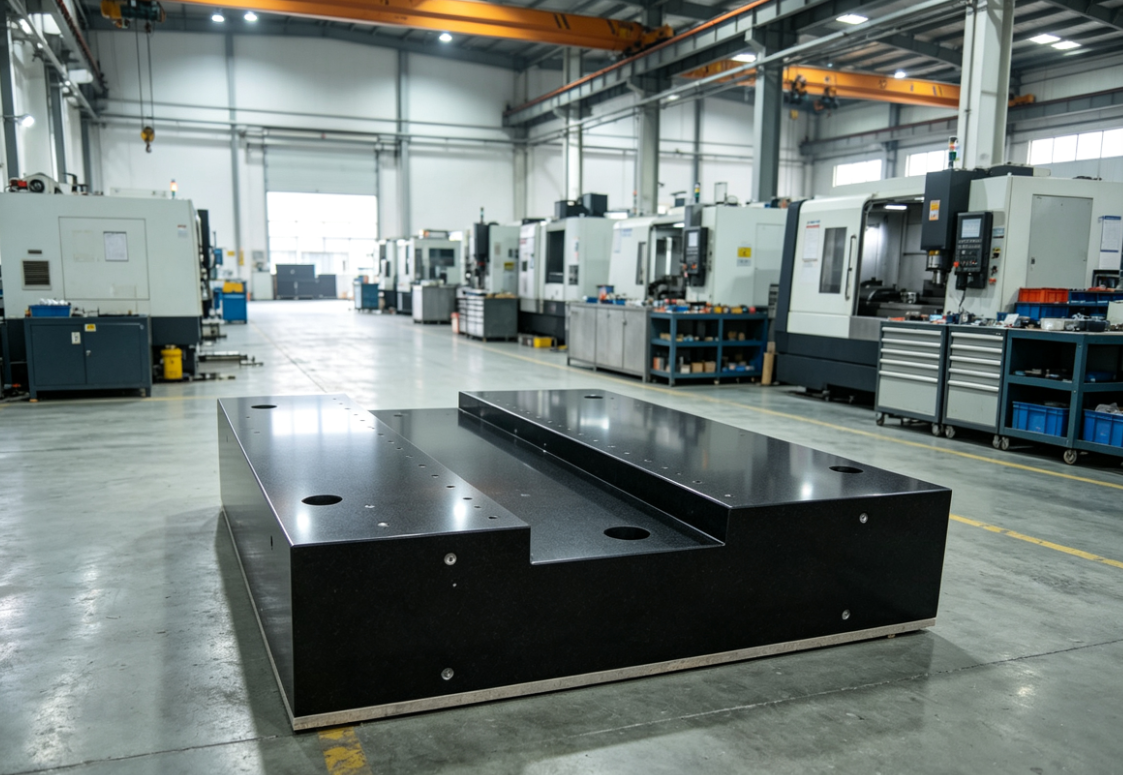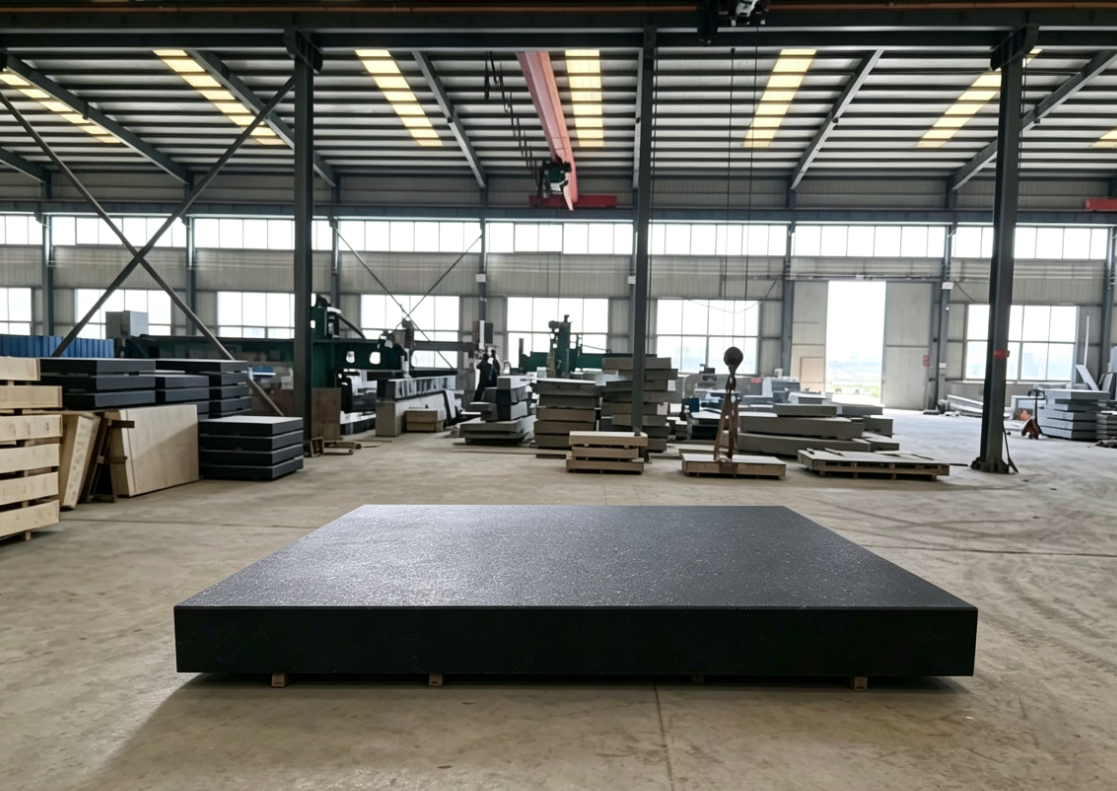
Specific Manifestations of Granite Platform Wear Resistance
I. Inherent Wear Resistance of the Material
High Mohs Hardness
High-quality precision granite (Jinan Green / Zhangqiu Black) has a Mohs hardness of 6–7, higher than cast iron, ordinary steel, aluminum, and Invar.
Cast iron hardness is about 3–4 HRC, and steel is 5–6 HRC;
Probes, steel fixtures, and workpieces can be dragged and rubbed back and forth without easily producing deep scratches;
Iron chips and hard debris falling and sliding will not quickly scratch the reference surface.
Dense Fine-Grained Mineral Structure
Formed by the dense crystallization and compression of quartz, feldspar, and mica, the grains are tightly bonded with no loose pores. During friction, no particles will fall off or produce powder, preventing dust from adhering to gratings and optical lenses and affecting CMM measurements.
High Compressive Strength
Compressive strength ≥80 MPa. Long-term heavy pressure contact from tooling and heavy workpieces will not cause surface indentations or depressions.
II. Wear Resistance in Daily Use Scenarios (Real CMM Workshop Conditions)
- Reciprocating Dragging and Friction of Workpieces and Tooling
During inspection, steel plates, aluminum parts, and fixtures are pushed and pulled on the surface. Long-term high-frequency friction only produces extremely shallow, fine lines without damaging the reference flatness; cast iron platforms will wear down and sink over a large area after long-term dragging, leading to direct scrapping. - Frequent Point Contact Wear of Probes
CMM ruby probes and carbide probes continuously tap the surface. Repeated single-point impacts result in no pits or chipping; metal surfaces are prone to point-like depressions after long-term tapping, causing measurement deviations. - Wear Resistance to Crushing by Iron Chips and Hard Particles
In machining-accompanying CMM stations, workpieces carry steel chips and hard abrasives that fall onto the surface. After moving the workpiece, deep scratches are not easily formed; metal surfaces are extremely easy to be gouged by iron chips, and the repair cost is very high. - Wear Resistance During Cleaning and Wiping
Repeatedly wiping the reference surface with scouring pads, dust-free paper, alcohol, and cleaning agents will not wear down the polished layer; ordinary coated metal platforms will lose their coating and luster after long-term wiping, causing a rapid decline in accuracy.
III. Surface Sealing and Polishing Process Further Enhances Wear Life
Multi-stage Ultra-precision Grinding Mirror Polishing
The working surface undergoes cross-grinding with 2000#–5000# diamond abrasives. The surface crystals are tightly compressed, making the surface dense and smooth with a low friction coefficient, reducing scratch damage.
Penetrating Sealing Protection Treatment
Silane sealant penetrates and cures within the internal micropores, forming a hard composite wear-resistant layer:
Blocks oil and cutting fluids from penetrating and expanding the pores;
Enhances the overall hardness of the surface layer and slows down frictional wear;
Prevents internal stone grains from loosening, falling off, and producing dust.
IV. Long-term Service Wear Resistance Advantages (Compared to Cast Iron and Metal Bases)
Longer Accuracy Maintenance Period
Under the same usage intensity, the granite surface can stably maintain 00/000 grade accuracy for 5–10 years; cast iron platforms will show large-scale wear after 2–3 years, and the flatness will exceed standards, requiring regrinding.
Low Repair Cost After Wear
Slight scratches and worn areas can be locally precision-ground and polished to restore original accuracy; cast iron wear can only be repaired by overall re-milling, which is time-consuming and expensive.
No Secondary Wear Caused by Metal Corrosion
Steel and cast iron rust when exposed to moisture, and rust particles will continuously grind and scratch the surface; granite does not rust, so there is no problem of rust dust exacerbating wear.