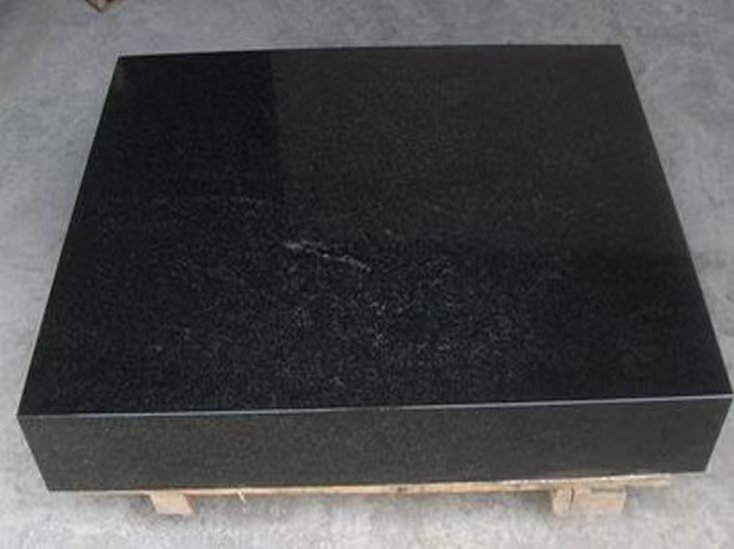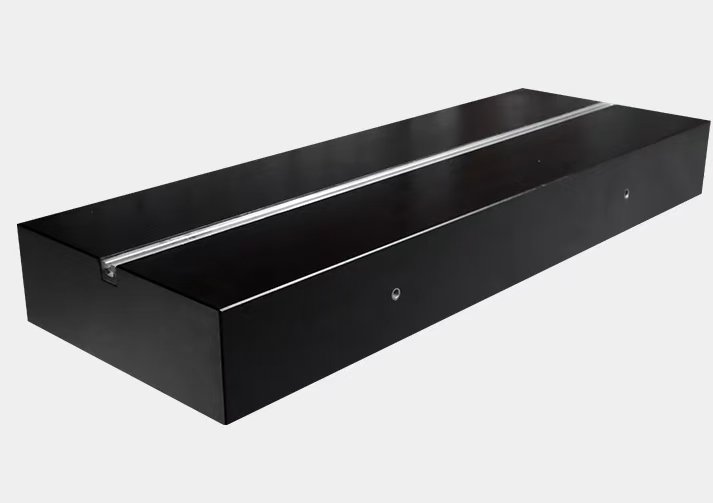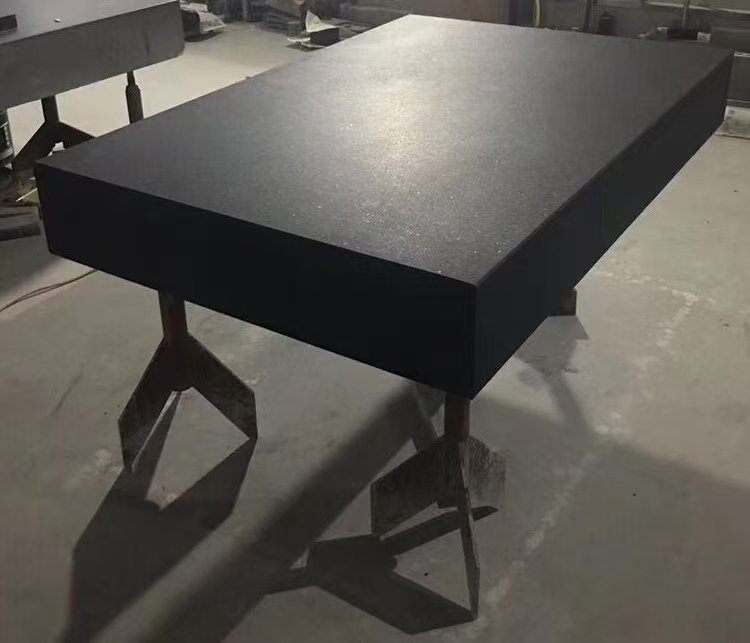
- Suitability Analysis of Different Types of CNC Machine Tools
Different types of CNC machine tools exhibit significantfferences in their motion modes, load characteristics, and precision requirements — which directly determines the property requirements for the base material. The adaptability of granite gantry bases must be analyzed in conjion with the specific operating conditions of the machine tool type.
6.1 Vertical Machining Centers
The typical operating condition of a vertical machining center involves significant vertical loads on the Z-axis aly withstands cutting forces in the vertical direction — meaning that the machine base requires high vertical stiffness and vibration resistance to counteract the combined effect of the Z-axis spindle’s gravitytting forces. Furthermore, vertical machining centers are often used for machining high-precision parts such as molds and optical components, imposing extremely high requirements for the control of thermal deformation and vib.
The adaptability advantages of granite bases are mainly reflected in two aspects: First, high damping characteristics effectively suppress the vibration of the Z-axis spindle, improving surface machining quality — for exter adopting a granite base, the vibration amplitude of the Juren Intelligent HSM600 high-speed machining center is ≤0.0005mm, and the surfaroughness Ra value of the machined mold is ≤0.4μm; Second, the low coefficient of thermal expansion effectively controls thermal deformation, improving positioning accuracy — the thermal deformaf this model is reduced by 46.5% compared to a cast iron base, and positioning accuracy is improved from ±0.02mm t±0.01mm.
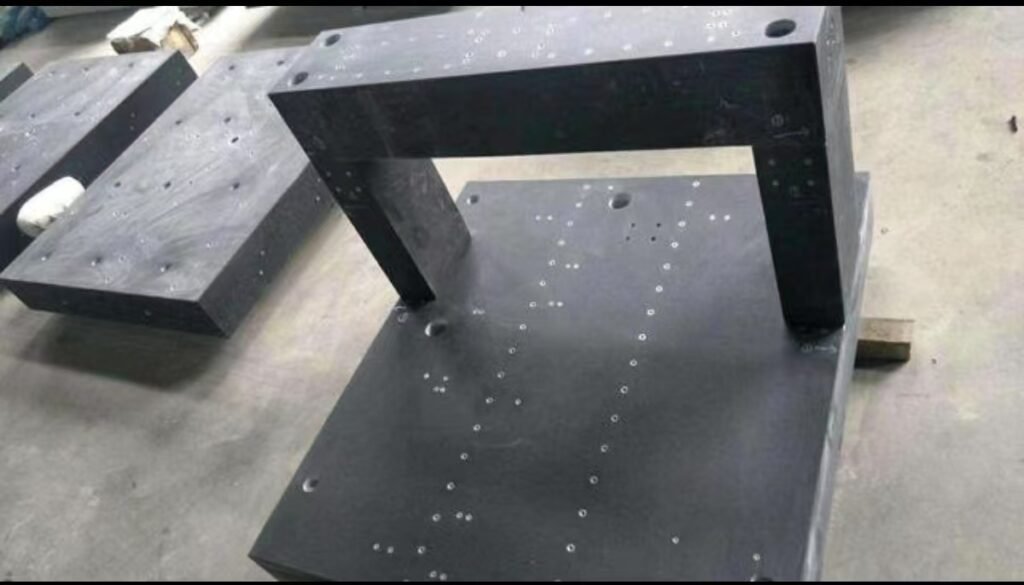
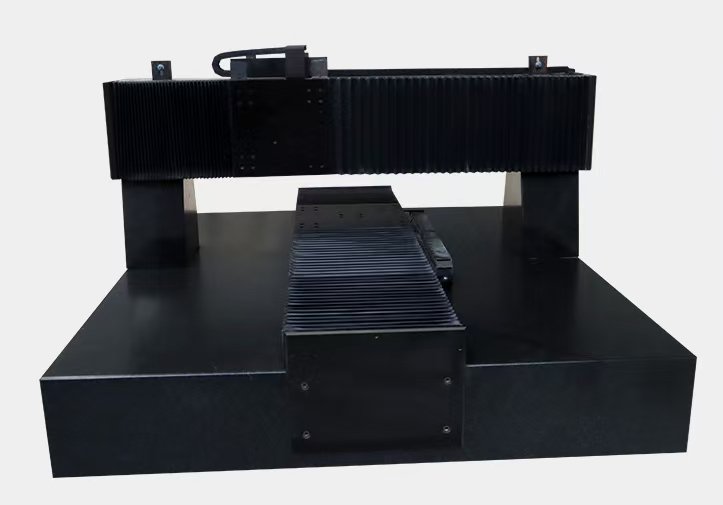
To maximize the advantages of granite, vertical machining centers typically adopt a “box-in-box” structural design: integrating the Y-axis side supports into columns to form a complete closed foroop with the top beam and base, allowing cutting forces to be uniformly distributed through the closed structure and avoiding local stress concentration. For instance, the LS-BU series vertical machining c by Shenzhen Lishang Precision Machinery, which combine a granite base with a “box-in-box” structure, can achieve a surface accuracy of ±0.02mm when machini molds for aero-engine blades.
6.2 Horizontal Machining Centers
The typical operating condition of a horizontal machining center involves heavy workpiece weights (usually exceeding 1 ton) and primariy withstands cutting forces and torque in the horizontal direction — meaning that the machine base requires high torsional stiffness and load-bearing capacity to resist torsional deformation caused by horizontal cutting forces. , horizontal machining centers are often used for machining deep cavities and large box-type parts, imposing high requirements for long-term precision stability.
The adaptability advantages of granite bases are mainly cted in high specific stiffness and torsional stiffness — their closed frame structure effectively disperses horizontal cutting forces and suppresses torsional deformation. For example, a certain model of horizontal machinicenter by Shandong Klaime, after adopting a mineral casting base (with properties similar to granite), maintained an error of 0.008mm during continur machining of aero-engine blades, compared to an error of 0.03mm with a traditional cast iron base, increasing the pass rate fom 72% to 98%.
It should be noted that due to the large loads of horizontal machining centers, pre-stressed optimization design is usually required for granite bases — for example, applying prioning force inside the base to counteract deformation caused by cutting forces, further improving torsional stiffness. Additionally, horizontal machining centers have high requirements for chip removal, so the chip removal strure design of the granite base needs to be specially optimized to avoid chip accumulation affecting precision.
- Failure Cases and Improvement Measures in Engineering Applications
Despite the numerous advantages of granite bases, failures may still occur in engineering applications if design, machining, or usage are improper. These issues are not defects of the granite material itself but stem from a lack of understanding of its proties. Summarizing the causes of typical failure cases can provide references for subsequent design and application, preventing the recurrence of similar problems.
7.1 Typical Failure Modes and Cause is
(1) Micro-crack Aggregation and Fracture
The brittle nature of granite makes it highly sensitive to local stress concentrations. If design features stress concentration sources such as sharp corners orsmall holes, or if preload control during installation is improper, micro-crack aggregation and propagation are easily triggered, ultimately leading to fracture.
Case: A high-end equipment manufacturing enterprise in Jiang purchased a batch of granite platforms without considering crack orientation matching. Within 12 months of installation, the platforms experienced regional subsidence exceeding 0.5 μm. Uponction, micro-cracks were primarily concentrated in the depth range of 0.5-2 mm below the sawing/grinding interface. This area is a zone of residual stress concentration geneg processing. Since the crack orientation was perpendicular to the load direction, crack propagation was accelerated, eventually leading to regional subsidence.
Causes: First, crack orientation detection was not ormed on the granite block, resulting in crack orientation perpendicular to the load direction. Second, the installation preload torque deviation exceeded ±10%, causing local stress to exceed the tensile strengtof granite (approximately 10-20 MPa), which triggered crack propagation.
(2) Uneven Thermal Expansion and Precision Overrun
The low thermal conductivity of granite mre sensitive to the influence of local heat sources. If the thermal conduction path between heat sources (such as spindles or guides) and the base is designed improperly, localrheating can easily occur, generating temperature gradients and subsequently causing precision overrun.
Case: After a grinder adopted a granite base, no thermal insulation layer was installed between the spindle housing nd the base. This caused heat from the spindle to be directly transmitted to the base, raising the local temperature of the base by 2°C and ultimately resulting in a machiningerror of 0.01 mm. Upon inspection, the local temperature difference of the base reached 1.5°C. With a linear expansion coefficient f 4.61×10⁻⁶/°C for granite, this resulted in a deformation of approximately 0.007 mm, which directly manifested as machining error.
Causes: First, the thermaduction path was designed improperly, allowing heat from the heat source to be directly transmitted to the base. Second, no temperature monitoring and compensation system was installed, making it impossible to timely arrors caused by thermal deformation.
(3) Improper Installation and Deformation
The installation accuracy of granite bases has a significant impact on their performance. If the support levelness is inscient or the load distribution on the support points is uneven, the base is prone to being in a non-stable state for a long time, leading to slow deformation.
Case: When ng a granite platform, a company had a height difference of over 0.02 mm/m at the four corners of the support, causing the platform to remain in a tiltede for a long time. After 6 months of operation, the flatness deviation of the platform increased from 0.001 mm to 0.005 positioning accuracy decreased by 5 times. Upon inspection, the deformation of the platform was caused by long-term uneven loading, which led to the slow propagation of internal m
Reasons: First, the levelness of the brackets was not strictly controlled during installation; second, the lness of the platform was not regularly calibrated, leading to the gradual accumulation of deformation.
7.2 Improvement Measures and Solutions
In response to the aforementioned failure cases, the industry has develo improvement plan, with the core principle being “to adapt to the characteristics of granite and avoid stress concentration and thermal unevenness”:
(1) Optimization in the Design Phase
Avooncentration sources: Changing the sharp corners of the base to transition fillets (fillet radius ≥10mm), avoiding high-stress areas (such as the middle of te crossbeam) for hole positions, and adopting a smooth transition hole design (such as elliptical holes) to reduce the stress concentration factor — for example, after a certain enterprise changharp corners of the base to R15mm fillets, the stress concentration factor decreased by 30%.
Thermal symmetry design: Symmetrically arranging heat-generating compnts (such as spindles, motors) on both sides of the bed to ensure uniform heat distribution; meanwhile, setting up an insulation layer (such as ceramic insulation sheets) between thet source and the bed to block the heat conduction path — for example, after a certain grinding machine set up an insulation layer between the spindle box and the bed, the local temperature drence of the bed decreased from 1.5°C to 0.3°C.
Optimizing support structure: Adopting a three-point or four-point support structure to ensure unifforce on the base; meanwhile, setting up elastic pads (such as rubber pads) at the support points to buffer interference from external vibrations — for example, after a certain enterprise adopted aoint support structure, the flatness deviation of the base decreased from 0.005mm to 0.002mm.
(2) Optimization in the Macining Phase
Crack orientation detection: Using Digital Image Correlation (DIC) to inspect the rough block and screening out rough blocks where the crack orientation is parallel to the load direction —for example, after a certain enterprise in Jiangsu adopted crack orientation detection, the occurrence rate of the granite platform sinking problem dropped from 100% to zero.
Controlling machining resdual stress: Adopting a multi-pass machining process, controlling the machining allowance of each pass within 0.5mm to avoid residual stress caused by removing too much material at once, performing natural aging treatment after machining (aging time ≥30 days) to further release machining residual stress.
(3) Optimization in the Usage Phase
Environmental control: Conthe workshop temperature at 20±2°C and humidity at 40-60%; avoiding direct sunlight or proximity to heat sources (such as furnaces) to reduce the impact of environmental temperature fluctuations on the base — for example, after a certain ultra-precision machining workshop controlled the temperature at 20±0.5°C, the thermal deform the granite base decreased by 80%.
Regular calibration: Calibrating the flatness and levelness of the base every 6 months to timely adjust deviations caused by installation errors oreformation — for example, after a certain enterprise adopted regular calibration, the flatness deviation of the base was long-term controlled wit