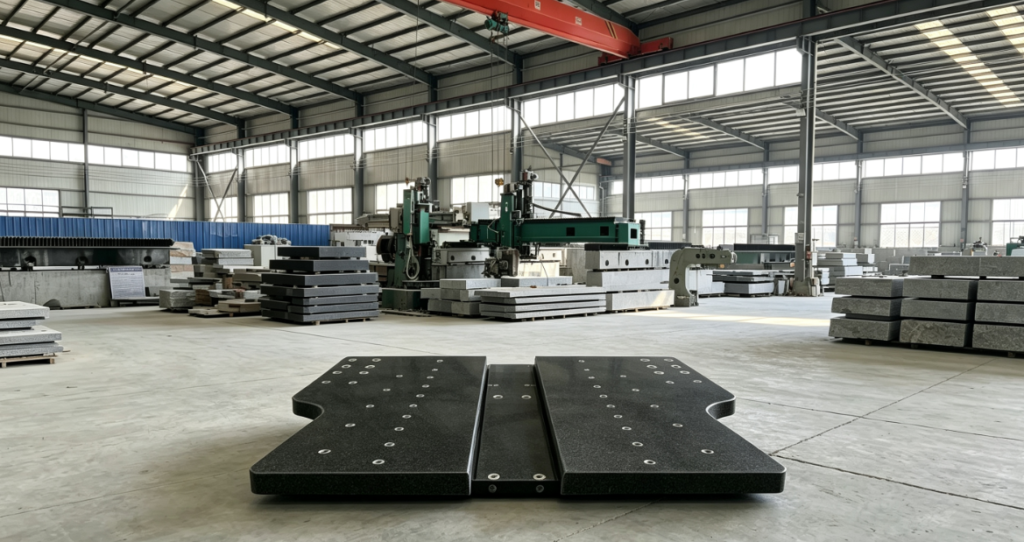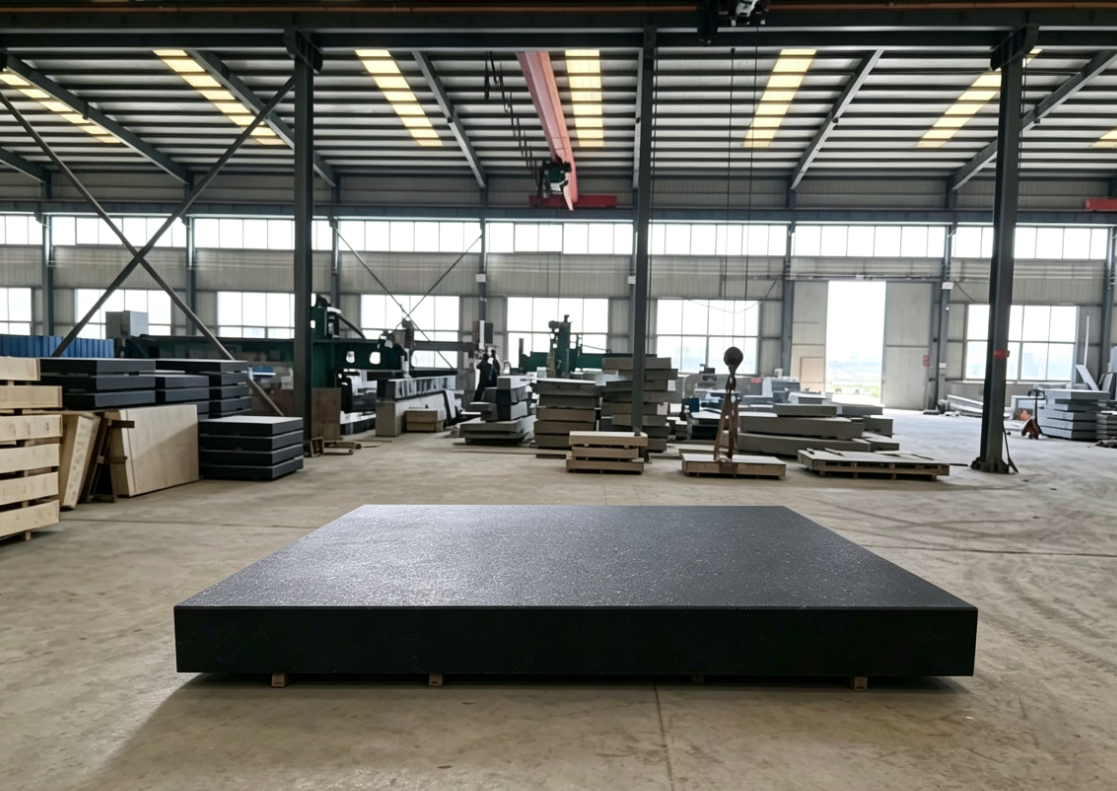
Granite vs. Cast Iron Base — Comprehensive Vibration Control Comparison
I. Core Vibration-Related Material Parameters
Tableau
Performance Indicator Natural Granite (Jinan Green / Black Granite) Gray Cast Iron HT250/HT300 Impact on Vibration Reduction
Damping Coefficient (Core of Vibration Reduction) 0.06–0.12 0.02–0.03 Granite damping is 3–4 times that of cast iron, vibration decay is much faster
Elastic Modulus Approx. 50GPa 100–140GPa Cast iron has higher rigidity but poor damping, vibration lasts longer
Density 2900–3100kg/m³ 7200kg/m³ Cast iron has greater self-weight but weaker shock absorption, relying solely on weight to suppress vibration
Inherent Internal Stress Almost no natural internal stress, stable after machining Residual internal stress from casting, prone to deformation and exacerbated resonance if aging is insufficient Resonance points of cast iron easily shift during long-term use, granite is stable
Coefficient of Thermal Expansion 4.5×10⁻⁶/℃ 11×10⁻⁶/℃ Temperature changes cause deformation, indirectly generating micro-vibration drift
II. Item-by-item comparison of vibration control dimensions
- Vibration absorption (damping vibration reduction, the most critical difference)
Granit
Dense internal crystal grains natural micro-cracks; once vibration is transmitted, energy is continuously dissipated through friction at the crystal interfaces.
High-frequency micro-vibrations generated by high-speed cutting, linear motor reciprocation, and high-speed grinding wheel rotation decay rapidly within seconds;
Does not produce continuous resonant ripples; the machined surface is free of vibration marks, and measurement data shows no jumps.
Suitable for: Ultra-precision grinders, CMMs, optical equipment, laser processing machines.
Cast Iron
Homogeneous metallic structure; vibration energy is difficult to dissipate internally, relying solely on self-weight to suppress vibration.
Vibration decay is slow, and micro-vibrations will continue to echo;
Resonance is extremely likely to occur under high-speed and high-frequency operating conditions, causing ripples and tool marks on the workpiece;
Must thicken the wall thickness, add ribs, and increase weight to compensate for the vibration reduction deficiency. - Suppressing externally transmitted vibration (vibration isolation)
Granite: High inherent damping moderate self-weight can effectively block low-frequency interference from workshop cranes, air compressors, and adjacent machine tools; the crystal structure can scatter incoming vibration waves.
Cast Iron: Relies on high density and large mass for passive vibration suppression; if the external vibration frequency is close to the machine tool’s natural frequency, resonance is easily excited, and simply increasing weight only treats the symptoms, not the root cause. - Resonance characteristics
Granite: Low resonance peak and narrow resonance range; daily machining speeds/feed rates are unlikely to hit the resonance zone;
Cast Iron: Sharp resonance peaks; slight changes in speed or temperature can easily trigger resonance, causing dimensions and roughness to deteriorate significantly during finishing. - Dynamic stability (high-speed reciprocating motion scenarios)
Linear motors and high-speed gantries frequently starting and stopping generate impact vibrations:
Granite bases have fast vibration decay and stable positioning repeatability (±0.001~0.003mm);
Cast iron bases have long-lasting impact vibrations; every start and stop brings a slight positioning drift, leading to increased precision dispersion during long-term batch machining. - Long-term stability (indirectly affecting vibration performance)
Granite: No casting stress; the structure remains undeformed over years of use, and inherent vibration characteristics remain unchanged for decades;
Cast Iron: If low-temperature aging is insufficient, internal stresses are slowly released during use, causing slight deformation of the bed and changing the natural frequency; unexplained vibrations and precision decline are more likely to occur after 1-2 years of use.
III. Summary of advantages and disadvantages of vibration control for the two types of bases
Granite Base (Vibration reduction advantages)
✅ Ultra-high damping, high-frequency micro-vibrations are rapidly absorbed, eliminating vibration marks
✅ Weak resonance, extremely strong dynamic machining stability
✅ No internal stress, vibration characteristics remain unchanged over the long term
✅ Low thermal expansion, small thermal deformation, reducing thermally induced micro-vibration offsets
❌ Lower density, self-weight is less than cast iron for the same volume, poor impact resistance in heavy-duty/heavy-load conditions
❌ High brittleness, cannot withstand severe impacts or heavy cutting shocks
Cast Iron Base (Vibration reduction deficiencies, compensated only by self-weight)
✅ High density and strong load-bearing capacity, suitable for heavy-duty milling/boring and heavy-cutting/high-impact equipment
✅ Good toughness, resistant to impacts and heavy-load cutting shocks
❌ Extremely low damping, slow vibration decay, prone to tool vibration during finishing
❌ Prone to resonance, sensitive to speed and external vibrations
❌ Insufficient aging causes slow deformation, with vibration characteristics deteriorating year by year
IV. Selection Scenarios (Classified by Vibration Requirements)
Priority: Granite (Extremely high requirements for vibration control)
CMM, vision measuring machines, ultra-precision grinders, diamond lathes, laser micromachining, semiconductor equipment, optical inspection platforms, micro-precision engraving machines;
Requirements: Micron/nanometer-level precision, mirror-surface machining, optical path stability, zero vibration interference.
Priority: Cast Iron (Allows slight vibration, focuses on heavy-load impact resistance)
Large floor-type boring machines, heavy-duty gantry machining centers, CNC lathes, stamping equipment, rough milling machines;
Operating conditions: Large cutting volumes, heavy tool impact, heavy workpiece loads, precision requirements above 0.01mm.