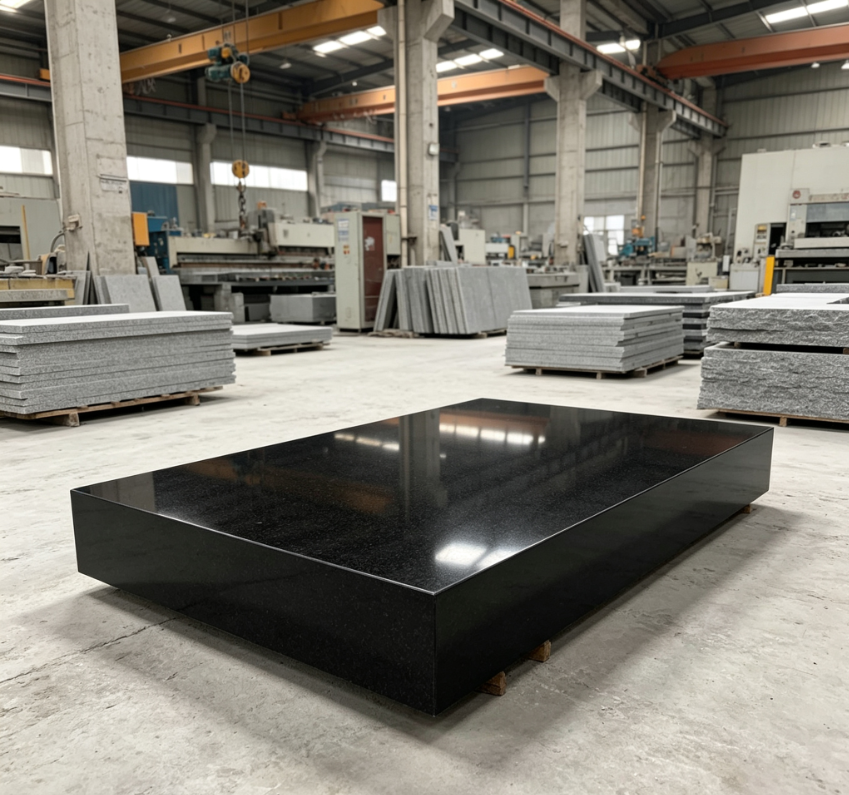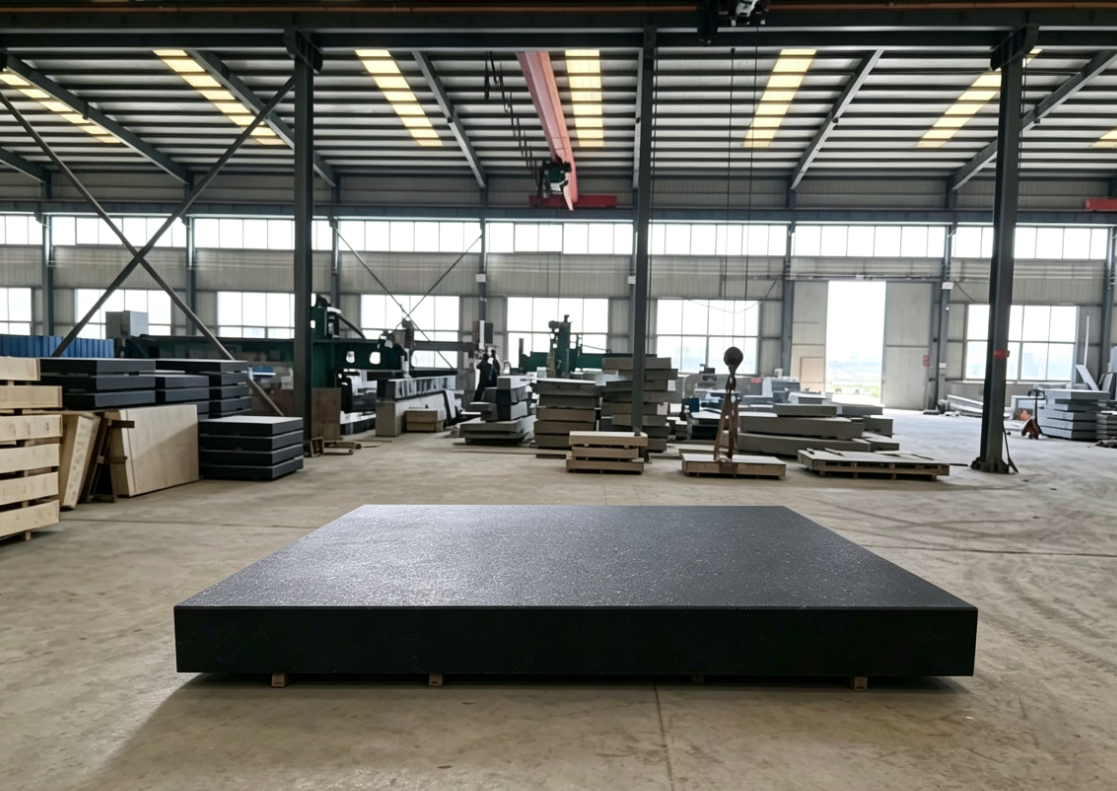
Explication détaillée des classes de précision des plateformes en granit rainurées (granit bleu de Jinan, GB/T 20428)
I. Conclusion principale, tout d'abord
Le rainurage n'équivaut pas à une déclassification directe, mais ce processus comporte des risques en matière de précision ; le niveau de précision final est déterminé à partir des données issues du réaffûtage et des nouveaux contrôles effectués une fois toutes les opérations de rainurage et de taraudage terminées.
Les produits disponibles sur le marché se répartissent en deux grandes catégories, régies par des normes distinctes :
Plaques d'inspection standard à surface lisse : sans rainures, avec peu de trous filetés, étalonnées en usine directement selon la classe 000/00/0/1 ;
Socles en granit rainurés sur mesure (socles de portique, plateformes de fixation pour tables coulissantes, comme sur votre photo) : il s’agit de composants mécaniques de précision en granit qui ne peuvent pas simplement se conformer aux règles de réception applicables aux plaques standard.
II. Plage de précision atteignable
En utilisant du granit « Jinan Blue » comme matière première, les qualités suivantes peuvent être obtenues à l'issue d'un traitement approprié :
✅ Grade 00 (précision standard pour les bases rainurées)
La grande majorité des plates-formes à moteur linéaire, des équipements d'inspection à portique et des plates-formes rainurées servant de référence pour l'assemblage de rails de guidage utilisent cette nuance.
✅ Niveau 0
Équipement de vision classique, bases rainurées pour outillage modulaire standard, à moindre coût.
⚠️ Le grade 000 n'est pas recommandé pour le rainurage aléatoire
En principe, les plaques de référence métrologiques de classe 000 doivent éviter les rainures larges et les trous profonds en grand nombre ; en effet, le rainurage entraîne une libération des contraintes internes, ce qui fait que la planéité dépasse facilement les tolérances. Si un rainurage s'avère nécessaire, un meulage de précision secondaire est obligatoire, ce qui représente un coût extrêmement élevé.
❌ Rectification d'une idée reçue : de nombreux acheteurs pensent qu“” une fois rainurée, seule la classe 0 peut être obtenue », mais avec des procédés adaptés, il est tout à fait possible de produire une plate-forme rainurée de classe 00 stable une fois les travaux terminés.
III. Pourquoi le rainurage entraîne-t-il facilement une perte de précision ?
Le fait d'enlever une grande quantité de matière de la pierre entraîne une redistribution des contraintes internes, ce qui provoque une légère déformation de la plate-forme ;
Des microfissures se forment facilement aux angles des rainures, et les variations de température à long terme aggravent la déformation ;
Le rainurage effectué uniquement après un meulage d'ébauche, sans meulage de finition, entraîne un écart de planéité dépassant directement les tolérances.
IV. Afin de garantir un niveau de qualité 00 stable pour les plates-formes rainurées, les exigences relatives au processus doivent être précisées dans le contrat
Séquence de traitement (priorité absolue)
Usinage grossier de la pièce brute → Vieillissement naturel pendant 7 à 15 jours → Rainurage, perçage et taraudage → Rectification de précision secondaire globale → Nouveau contrôle de planéité final et établissement du rapport d'inspection
❌ Piège à éviter : ne commencez pas par rectifier avec précision, puis par rainurer ! La précision obtenue sera très probablement perdue après le rainurage.
Contraintes de conception structurelle
Veiller à ce que l'épaisseur de la paroi (≥ 60 mm) entre la rainure et le bord de la plate-forme soit suffisante afin d'éviter l'effondrement et la déformation du bord ;
Pour les rainures traversantes de portiques de grande longueur, évitez les excavations de grande superficie d'un seul côté afin d'éviter les contraintes asymétriques.
Les indicateurs d'acceptation ne doivent pas se limiter à la planéité de la surface supérieure
Contrôle supplémentaire pour les socles d'équipements rainurés :
Planéité de la surface inférieure de la rainure de fixation du rail de guidage
Parallélisme et perpendicularité entre les différentes surfaces de montage
Il ne s'agit pas seulement de la précision d'une seule surface supérieure.
V. Référence relative au scénario de sélection
Bases de portique à moteur linéaire, outillage d'inspection de rails de guidage de haute précision
Exigence : atteindre le grade 00 à l'issue de l'opération ; il faut exiger du fabricant qu'il procède à un meulage secondaire après le rainurage et qu'il fournisse un rapport d'inspection.
Équipements de vision 2D classiques, bases modulaires à vis standard
Condition requise : atteindre le niveau 0 à l'issue de la formation ; option privilégiée pour les budgets limités.
Plateformes de référence pour salles de métrologie, tables de comparaison d'outils de mesure de haute précision
Il est préférable de choisir des plaques de catégorie 000 à surface lisse et d'éviter les rainures sur de grandes surfaces.