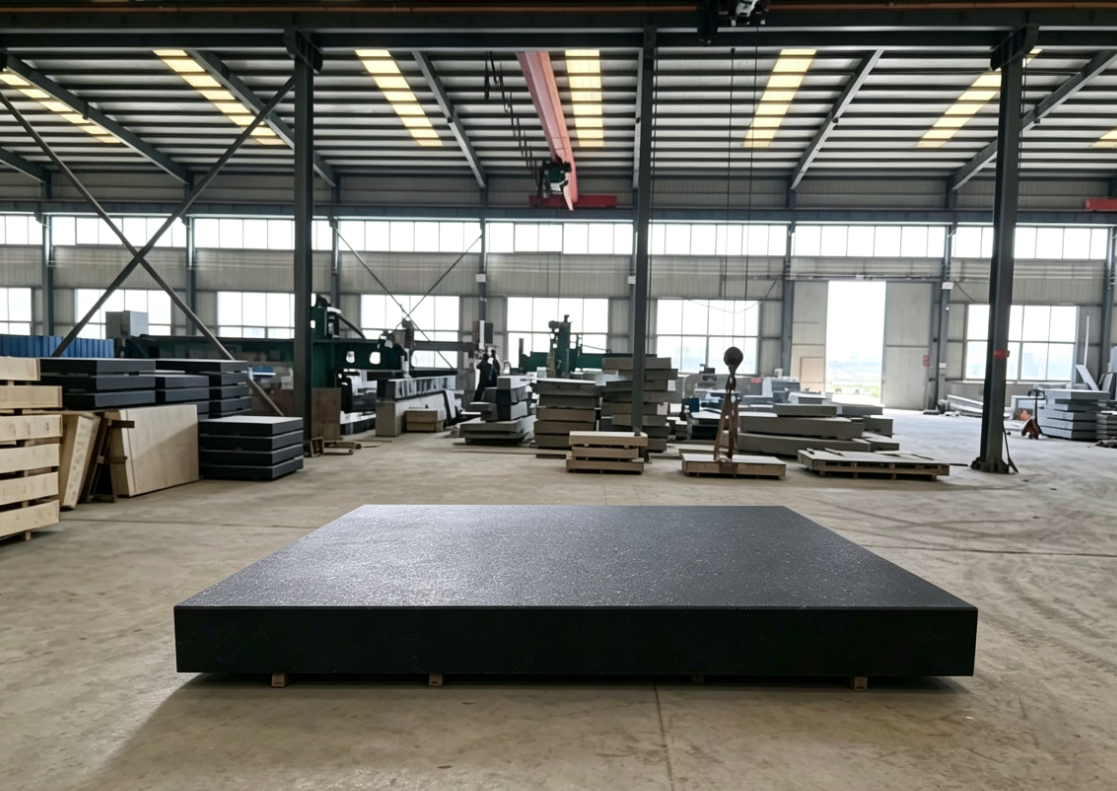
I. Main Causes of Deformation
- Environmental Factors (Most Common Triggers)
Temperature Fluctuations: Although granite has a low coefficient of thermal expansion, environmental temperature fluctuations exceeding ±5°C can cause local warping and micro-cracks due to thermal expansion and contraction; direct sunlight or proximity to heat/cold sources create local temperature gradients, accelerating deformation.
Humidity Effects: When relative humidity remains >70% for a long time, granite undergoes slight moisture absorption and expansion; it contracts in dry environments, and repeated wet-dry cycles lead to dimensional instability.
Vibration Interference: External vibrations (from equipment operation or personnel movement) cause redistribution of internal stresses; long-term accumulation triggers micro-deformation. - Material and Processing Factors (Intrinsic Roots)
Residual Internal Stresses: Geological stresses are retained during the formation and mining of natural granite; mechanical stresses are introduced during processing such as cutting and rough grinding; the slow release of these stresses during long-term use leads to platform creep and warping.
Material Selection and Process Defects: Choosing unstable stone, failing to perform sufficient stress-relief treatment during processing, or insufficient grinding precision all create hidden risks for long-term deformation. - Usage and Loading Factors (Direct Triggers)
Overloading and Localized Pressure: Exceeding the rated load (usually 1/10 of compressive strength) or placing workpieces concentrated in corners/local areas causes stress concentration, leading to local crushing and grain spalling.
Improper Operation: Striking, welding, or dragging heavy objects on the platform surface generates impact and friction damage, destroying surface precision and internal stress balance. - Installation and Support Factors (Foundational Causes)
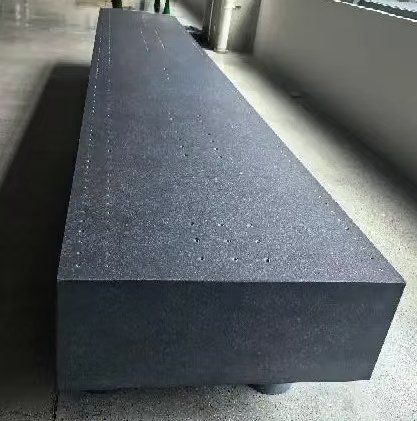
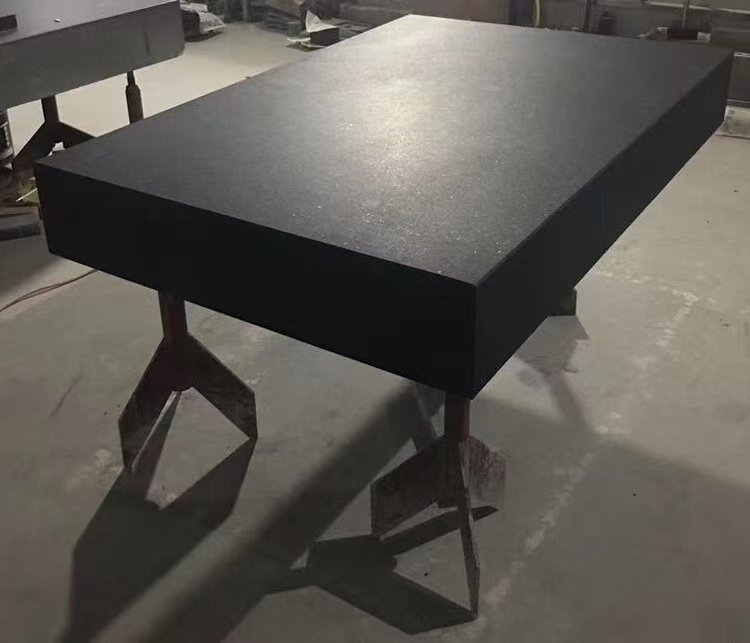
Unreasonable Support: Three-point support is commonly used for small and medium platforms; for large platforms (>1 ton), if three-point support is still used, the large distance between support points easily leads to center sagging.
Improper Leveling and Unstable Foundation: Uneven force distribution on support points, foundation settlement, and lack of vibration isolation treatment lead to platform twisting and deformation under long-term uneven loading.
II. Prevention and Control Measures
- Environmental Control (Source Prevention)
Constant Temperature and Humidity: Precision measurement environments should be controlled at 20±2°C with humidity 40%–60%; for ultra-precision scenarios, 20±0.5°C is recommended.
Isolation of Interference: Keep away from heat/cold sources (direct sunlight, air conditioner vents, radiators, machine tools) and vibration sources; install vibration isolation pads or anti-vibration bases.
Temperature and Humidity Equilibration: Allow the platform and workpieces to acclimate in the same environment for 24–72 hours before use to eliminate thermal deformation caused by temperature differences. - Material and Processing Control (Intrinsic Assurance)
Optimal Stone Selection: Select stable granite such as Jinan Qing or Mount Tai Qing that has undergone sufficient geological aging.
Adequate Stress Relief: Perform natural aging for 6–12 months before processing, or use vibration stress relief or heat treatment to release internal stresses.
Precision Processing: Adopt high-precision grinding and polishing processes to ensure surface flatness and uniform internal stress distribution. - Installation and Support Optimization (Foundational Stability)
Rational Support: Use three-point support for small and medium platforms; for large platforms, use multi-point or floating support to evenly distribute self-weight and load.
Precise Leveling: Use electronic levels or laser interferometers for repeated calibration, following the principle of “low before high, gradual approach” to avoid excessive local stress.
Installation Acclimation: Allow the platform to acclimate for 24–72 hours after installation before use, letting it adapt to the environment and release installation stresses.
- Standard Usage and Maintenance (Process Assurance)
Load Control: Strictly do not exceed the rated load; distribute workpieces as much as possible and use shims to disperse localized pressure; the load is recommended not to exceed 80% of the rated value.
Handle with Care: Prohibit striking, dragging, or welding; handle workpieces and measuring tools gently to avoid impact.
Daily Cleaning: Wipe with a microfiber cloth; do not use acidic or alkaline cleaning agents; deal with oil stains promptly using a neutral cleaner.
Regular Calibration: Check flatness every 6 months using a laser interferometer and electronic level; return to the factory for grinding and repair immediately if errors exceed tolerances.
Long-term Monitoring: Set up fixed monitoring points, record coordinate changes regularly, analyze precision drift trends, and issue early warnings for deformation.
III. Recommendations for Handling Deformation
Minor Deformation / Wear: Use manual grinding diamond grinding paste for local repair to restore surface precision.
Moderate Deformation: Return to the factory for re-precision grinding and scraping to eliminate warping and restore flatness.
Severe Deformation / Cracks: Replace the platform after assessment to avoid affecting measurement reliability.