Precision Manufacturing’s Accuracy Challenges for Motion Platforms
Integrating marble linear motor platforms, granite precision guide rails, and nanometer-scale positioning scenarios (semiconductor inspection, optical processing, CMM, micro-assembly, laser precision machining), systematically review core challenges, suitable for technical blog posts, technical white papers, and foreign trade technical presentation materials.
I. Static Accuracy Challenges (Downtime / Steady-state Positioning Indicators)
Continuous Downward Pressure on Geometric Accuracy Limits
Traditional micron-level platforms can no longer meet high-end demands; semiconductor and optical inspection equipment require sub-micron to nanometer-scale positioning accuracy. Key indicators: straightness, flatness, perpendicularity, parallelism.
Cast iron platforms are prone to deformation due to aging and internal stress; steel materials suffer from stress release.
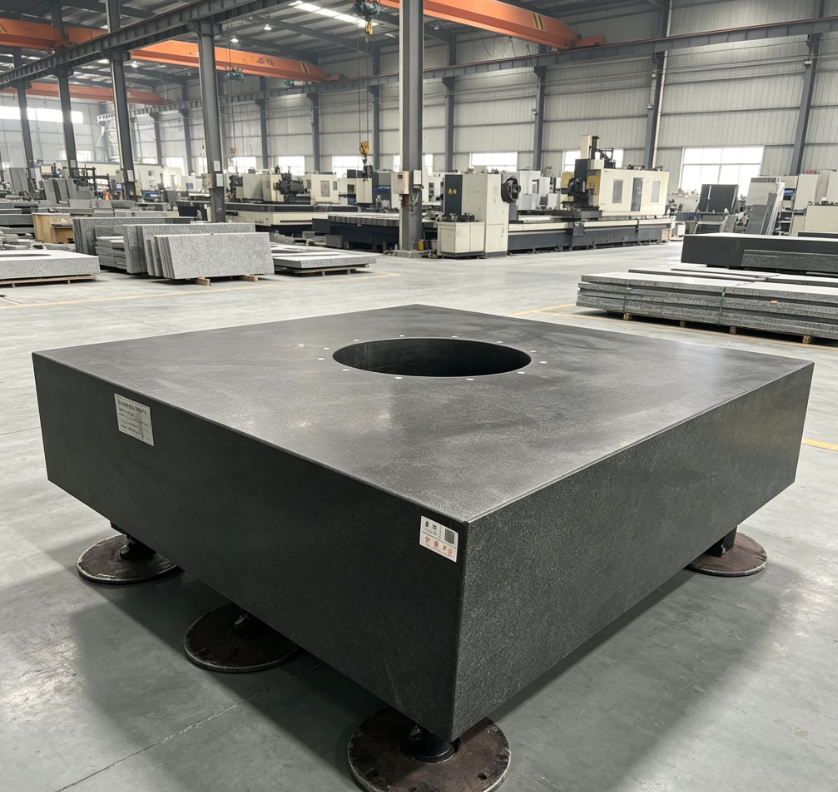
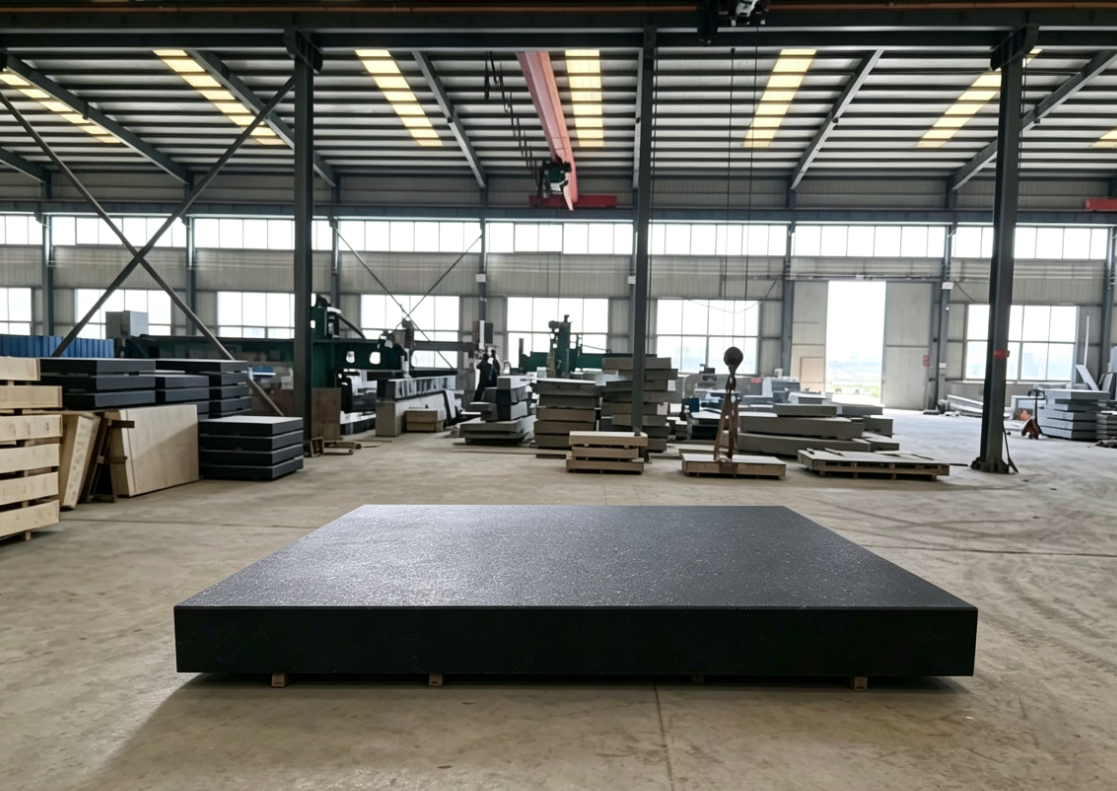
Even when using Jinan blue granite bases, grooving, guide rail mounting surfaces, threaded hole machining, and manual grinding process defects will still introduce geometric errors;
The larger the platform’s length and width, the exponentially harder it is to control cumulative geometric errors.
Conflict Between Positioning Accuracy and Repeatability
Linear motors have a prominent advantage of no screw-gap, but guide rail friction, uneven magnetic attraction, and encoder installation skew easily lead to: meeting accuracy in one direction but having repeatability deviation in the other, directly affecting continuous mass precision machining.
II. Core Dynamic Operating Accuracy Challenges (Hardest to Control During Motion)
Trajectory Errors During Motion
During constant speed / acceleration and deceleration phases, the platform generates pitch, yaw, and roll three-axis attitude tilts.
Ball guide rails experience rolling vibration at high speeds; air guide rails are expensive and require strict cleanliness; granite linear guide rails are suitable for low-speed high-precision scenarios, but lubrication and contact surface flatness directly affect motion smoothness.
Velocity Fluctuations and Servo Following Errors
Nanometer-level platforms often require low-speed micro-movements (μm/s level). At low speeds, non-linear friction and cogging effect (linear motor magnetic resistance) cause crawling phenomena, leading to trajectory jitter, which directly produces stripes and defects in laser micro-machining and optical scanning.
III. Thermal Disturbance: The Biggest Accuracy Killer for Precision Platforms
Thermal Expansion and Contraction Caused by Temperature Differences
Aluminum alloys and steel have large thermal expansion coefficients; granite has an extremely low expansion coefficient (a clear advantage), but it is not zero expansion.
Environmental temperature fluctuations, continuous heat generation from linear motors, and heat conduction from coils to the marble base form local temperature differences, causing uneven deformation.
Typical phenomenon: Equipment accuracy continuously drifts for half an hour after startup, making it impossible to maintain calibrated accuracy stably over the long term.
Temperature Gradient Problems
Internal heat sources, direct air conditioning in the workshop, and sunlight exposure form local temperature differences, causing the base to warp and deform; simple overall temperature control cannot completely solve this.
IV. Vibration Interference Challenges
External Environmental Vibration
Vibrations from factory overhead cranes, air compressors, surrounding machine tools, and low-frequency ground vibrations are directly transmitted to the motion platform. For nano-scale platforms, micron-level vibrations are sufficient to ruin machining/inspection results.
Self-Excited Vibration
Thrust fluctuations of linear motors, rolling vibrations of guide rails, cable drag tension, and cable self-weight pulling the mover trigger micro-vibrations in the platform; high-speed start-stop impacts excite base resonance.
Marble bases, with high density and high damping, can suppress some resonance compared to cast iron, but still require vibration isolation pads and optimized structural stiffness.
V. Long-term Accuracy Degradation Caused by Friction and Contact Surface Aging
Guide Rail Contact Surface Wear
Rolling guide rails undergo long-term reciprocating motion, causing rolling element wear; if granite sliding guide rails are poorly lubricated, dry friction occurs, damaging the ground surface and causing slow degradation of flatness.
Contact Surface Creep and Slow Stress Release
Residual stresses from machining and installation locking of marble components are slowly released over the long term, continuously producing tiny deformations over months to years; loosening of fastener preload causes guide rail datum shifts.
VI. Accuracy Bottlenecks in Drive, Feedback, and Control
Detection Feedback Limits
Closed-loop control relies on grating encoders, but encoder installation parallelism, gaps, and thermal deformation all introduce reading errors; ultra-high precision scenarios require vacuum gratings and precise zero-point calibration.
Servo Control Limitations
Conventional PID struggles to compensate for friction nonlinearity, magnetic reluctance, and vibration; feedforward control, disturbance observers, and vibration suppression algorithms are needed, increasing algorithmic complexity.
VII. Hidden Accuracy Risks from Cleanliness and Environmental Media
Semiconductor and optical workshops require dust-free environments: dust falling into guide rail mating surfaces scratches the ground datum; humidity changes cause slight corrosion (metal guide rails); water vapor affects grating readings.
Granite itself is corrosion-resistant and does not rust easily, making it a preferred base material for clean workshops, but guide rail pairs and seals still require strict protection.
VIII. Human Errors Introduced by Assembly and Installation
Even if the base material meets standards, the installation process easily introduces hidden hazards:
Inadequate base leveling and uneven footing load cause long-term stress deformation;
Uneven bonding/locking preload of guide rails causes rail twisting;
Parallelism deviation in mover and stator installation leads to uneven linear motor air gaps and unbalanced thrust.