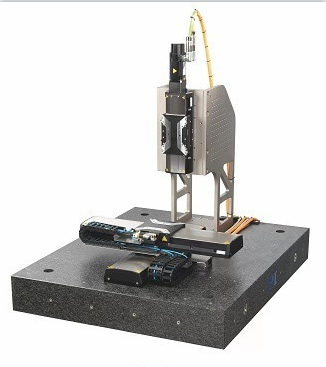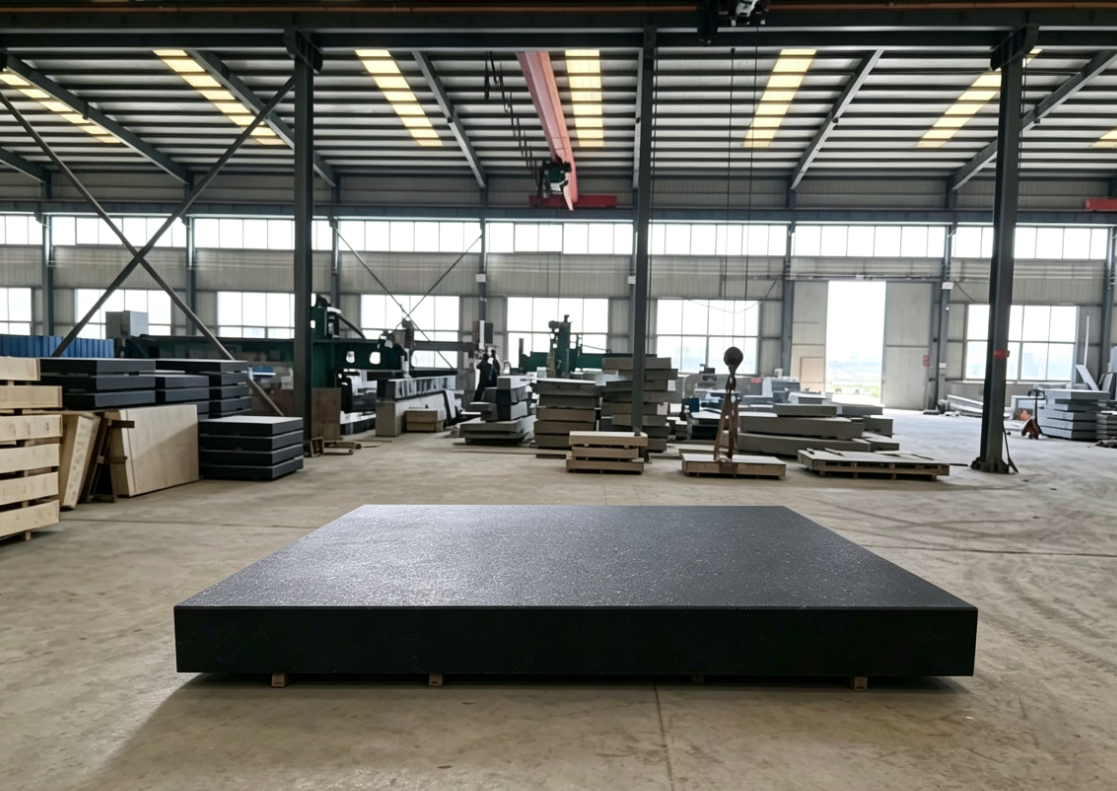
I. Positioning: High-speed precision automation motion reference carrier vibration-damping rigid framework
Ordinary steel guide rails only serve the guiding function; the integrated granite linear guide integrates the guide surface, equipment base, and crossbeam into one. It is the core foundation for high-speed linear motors, gantry automation, optical inspection, and semiconductor packaging equipment. Simultaneously, it carries four core missions: high-speed dynamic stability, constant temperature precision maintenance, long-term geometric reference, and high-frequency reciprocating durability, making it especially suitable for high-speed, high-acceleration, and nano/micron-level positioning automated production lines.
II. Five Core Functional Roles (Exclusive Value for High-Speed Scenarios)
- High-speed dynamic vibration damper, eliminating high-speed resonance and jitter (Most critical role)
The damping of the dense crystal structure inside granite is more than 10 times that of cast iron/steel. During high-speed acceleration/deceleration and high-frequency reciprocating motion, it can quickly absorb impact vibrations, motor excitations, and guide rail rolling micro-vibrations.
Pain points in high-speed working conditions: Under high-speed linear motors at 1–2m/s and high acceleration of 10–20m/s², metal machine bases are extremely prone to resonance, resulting in trajectory jitter, positioning deviation, and imaging blur;
Role of granite: Significantly suppresses amplitude, ensuring no jitter throughout the entire process of high-speed scanning, high-speed dispensing, and high-speed vision inspection, guaranteeing the stability of the high-speed motion trajectory straightness;
Applicable scenarios: High-speed optical inspection gantries, wafer cutting, PCB high-speed drilling, and fully automatic precision inspection lines for tool holders. - Constant temperature stable reference, eliminating precision drift caused by high-speed heating
The thermal expansion coefficient of granite is only 1/10 of steel. During continuous high-speed operation, the continuous heating from friction of linear motors and sliders causes metal guide rails to thermally expand and deform, leading to rapid loss of straightness and parallelism.
Role value:
The temperature deformation of the guide rail body is extremely small, controlling geometric errors within the sub-micron range during hours of continuous high-speed production;
Paired with nano-scale hand-ground guide surfaces (Ra2–8nm), the full-stroke straightness is ≤0.5μm/m, ensuring uniform precision throughout the entire high-speed movement over long strokes;
No frequent machine shutdowns for calibration are required under slight temperature fluctuations in the workshop, significantly improving the automation utilization rate. - Integrated high-precision guiding framework, ensuring geometric precision of high-speed motion
Granite guide rails are integrally formed nano-scale hand-ground, with no splicing and no assembly stress, distinguishing them from the double-layer error structure of steel guide rails locked onto cast iron bases:
The entire guide surface is a nano-mirror surface with no machining dead zones and no vibration marks, ensuring the slider/air bearing stage moves at high speed without bumps;
High rigidity and high self-weight suppress high-speed overturning moments, preventing warping and deviation during large-span high-speed gantry movements;
Straightness, parallelism, and perpendicularity remain stable over the long term, with minimal precision decay after years of equipment service. - Wear-resistant, non-magnetic, clean carrier, suitable for dust-free high-speed automated production lines
With high Mohs hardness, the nano-ground guide surface is wear-resistant. After hundreds of thousands of high-speed reciprocating cycles, the surface roughness remains almost unchanged, maintaining smooth high-speed motion over the long term;
Completely non-magnetic, it is not affected by motor magnetic fields in semiconductor and optical automation, avoiding the adsorption of metal dust that could scratch the guide rail;
Rust-free and oil-stain-free, it is suitable for dust-free workshops, wafers, and optical components in high-speed automation, significantly extending the lubrication and maintenance cycle. - Supporting high-speed direct-drive solutions to unleash the ultimate dynamic performance of linear motors
High-end high-speed automation standard configuration: granite guide rail linear motor air bearing combination:
The high-rigidity granite base eliminates structural deformation caused by thrust fluctuations of the linear motor;
The air-bearing slide floats on the nano-ground granite guide rail surface, ensuring no contact friction, no crawling, and no stick-slip effect during high-speed start-stop;
It enables high-speed constant velocity scanning and ultra-short cycle high-frequency reciprocating motion, with repeat positioning stability down to the sub-micron level, enhancing automated production efficiency and yield rate.
III. Comparison of Metal and Granite Linear Guides: Irreplaceable Differences in High-Speed Automation Scenarios
Tableau
Performance Dimension Steel / Cast Iron Linear Guide Integrated Granite Linear Guide High-Speed Automation Benefits
High-Speed Vibration Damping Poor damping, prone to resonance and vibration High damping, absorbs over 90% of vibrations Clear high-speed visual imaging, improved machining/inspection yield
Thermal Deformation High thermal expansion, precision drifts during long-term high-speed operation Extremely low thermal expansion, constant temperature stability Continuous production without frequent calibration, improved equipment utilization rate
Guide Surface Precision Mechanical grinding leaves vibration marks, poor roughness Hand-polished nano-grinding Ra2–8nm, full-area mirror finish Uniform high-speed travel resistance, minimal positioning error
Long-term Stability Metal stress release causes precision to decline annually Natural aging with no internal stress, precision stable for a decade Reduced maintenance costs over the equipment’s full lifecycle
Dust-Free Compatibility Easy to magnetize and corrode Non-magnetic, oil-free, easy to clean Dedicated for semiconductor / optical dust-free production lines
IV. Typical High-Speed Automation Application Scenarios and Corresponding Roles
High-Speed Fully Automated Precision Inspection Line (Compatible with your tool holder inspection equipment)
Granite X/Y linear guides equipped with high-speed vision modules, high-frequency reciprocating scanning of tool holder concentricity and runout; vibration damping ensures no motion blur in camera imaging, and constant temperature baseline ensures consistency of batch inspection data.
Semiconductor / Photovoltaic High-Speed Cutting and Mounting Equipment
High-speed linear motors granite air-bearing guides, high-acceleration rapid pick-and-place of wafers / glass, no resonance, no thermal deformation, micron-level high-speed positioning.
Laser High-Speed Machining and Optical Scanning Automation Gantry
Long-stroke granite guides, high-speed uniform motion, eliminates laser spot deviation caused by vibration, improves uniformity of machining patterns.
CMM and Large-Scale Gantry Measurement Automation Equipment
High-speed moving probes rely on granite guide baselines to ensure geometric precision during long-distance high-speed measurements.
V. Popular Customer Q&A in Plain Language
Q: Why not use steel guides for high-speed automation? Why must it be granite?
A: Metal guides resonate and vibrate at high speeds and high accelerations, and heat up and expand during long-term operation, causing positioning precision to continuously deteriorate; granite naturally absorbs vibrations and has extremely minimal thermal deformation. Combined with nano-ground guide surfaces, it maintains a stable trajectory throughout high-speed operation, making it suitable for 24/7 continuous automated production.
Q: How does a nano-hand-polished guide surface help with high-speed operation?
A: The mirror-finish nano-guide surface has uniform friction, ensuring the slider / air-bearing stage travels at high speeds without sticking or fluctuations, preventing local speed deviations and significantly improving high-speed positioning repeatability.
Q: Can granite guides improve automation capacity?
A: Yes. Under the same precision requirements, granite equipment can operate at higher speeds and greater accelerations, shortening the cycle time of a single station; meanwhile, it reduces calibration downtime, increasing overall production line capacity by 15%–30%.