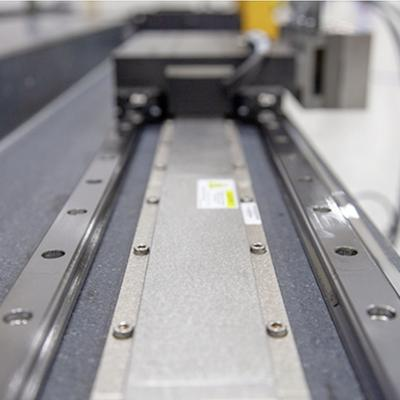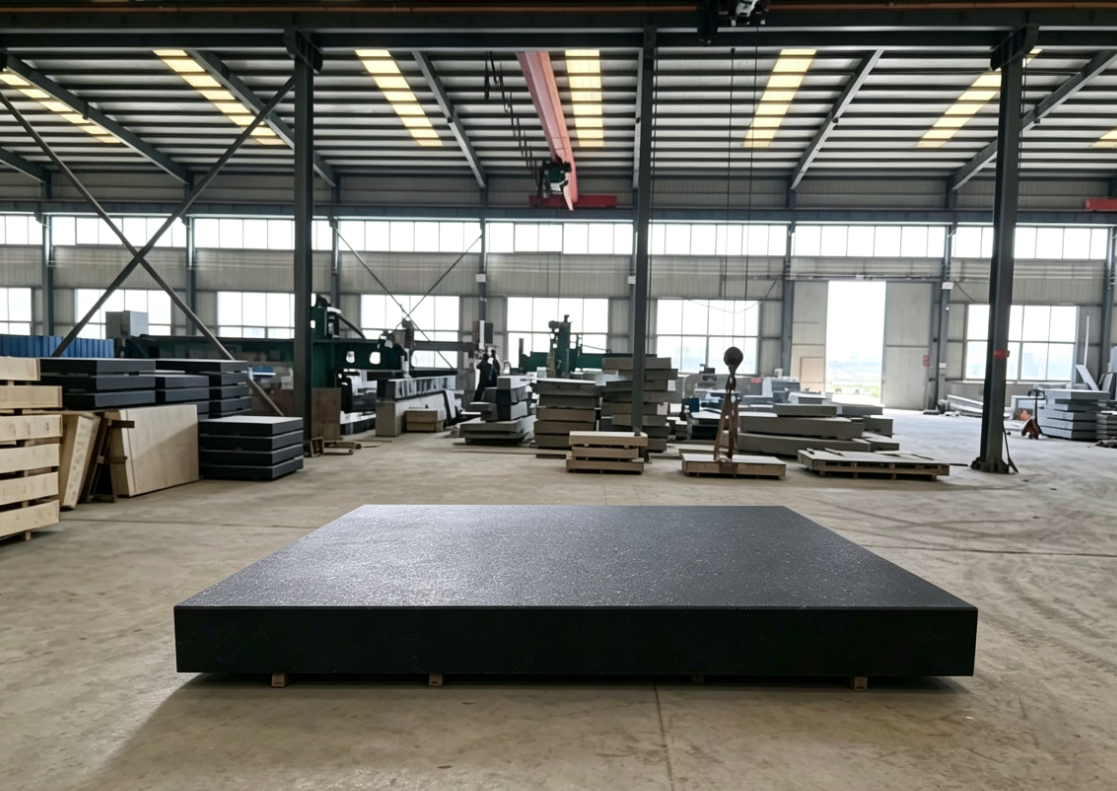
Grâce à ses quatre atouts principaux – un coefficient de dilatation thermique extrêmement faible, une grande rigidité, un excellent amortissement des vibrations et une résistance à la corrosion –, le granit est devenu le matériau de structure privilégié pour les équipements laser (en particulier ceux destinés à l'usinage de haute précision et à l'usinage micro). Il est largement utilisé dans les socles, les portiques, les composants optiques et l'outillage de précision, garantissant une stabilité à l'échelle nanométrique et une précision d'usinage à l'échelle micrométrique.
I. Avantages du matériau de base (indispensables pour les équipements laser)
Coefficient de dilatation thermique (CTE) extrêmement faible : environ (2,5 à 4,5 × 10⁻⁶/°C), soit seulement la moitié à un tiers de celui de l'acier ou de la fonte ; déformation minimale en cas de variations de température, ce qui permet de conserver la planéité à ±0,3 μm/°C, garantissant ainsi la stabilité à long terme du trajet optique et de la focalisation du laser.
Rigidité ultra-élevée et amortissement des vibrations : structure microcristalline naturelle dense, dotée d’un module d’élasticité élevé et d’excellentes propriétés d’amortissement ; l’efficacité d’amortissement des vibrations est 0% supérieure à celle de l’acier, ce qui permet d’isoler efficacement les vibrations provenant des moteurs, des pompes et du sol, et d’éliminer ainsi la dérive ponctuelle et les erreurs de positionnement.
Stabilité dimensionnelle à long terme : dureté élevée (J Black HS70~80), résistance à la compression élevée (245 N/mm²), et taux d'absorption d'eau < 0,131 TP3T ; résistant à la rouille, au fluage et aux fluides de coupe/à l'humidité, conservant sa planéité d'origine pendant dix ans avec des coûts d'entretien extrêmement faibles.
Adaptabilité à l'usinage de précision : peut être usiné pour atteindre une planéité de l'ordre du micromètre (≤ 1 μm/m), avec des trous de montage, des filetages et des rainures de vide de haute précision, répondant ainsi aux exigences d'installation rigoureuses des moteurs linéaires, des règles à réseau et des miroirs optiques.
II. Applications typiques dans les équipements laser
- Bases et portiques pour machines de découpe et de marquage laser de haute précision
Machines de découpe laser à fibre/CO₂ (par exemple, IPG LaserCube) : l'ensemble du châssis à portique de la machine est fabriqué en granit noir de Jinan ou de Taishan, ce qui garantit une précision de positionnement de ±1 μm et une rectitude ≤ 0,5 μm/m lors de mouvements à grande vitesse.
Machines de marquage laser grand format : les plateaux en granit soutiennent les pièces et amortissent les vibrations, garantissant ainsi des lignes uniformes et des contours nets lors du marquage à grande vitesse (2 000 mm/s).
- Plateformes de micro-usinage au laser pour la semi-conducteur et la microélectronique
Machines de lithographie (EUV/ArF), découpe de puces, gravure d'ITO : les bases et plateformes optiques en granit supportent les lasers, les élargisseurs de faisceau et les lentilles de focalisation, permettant un positionnement de l'ordre du nanomètre (≤ 50 nm) afin de garantir le rendement des puces.
Systèmes laser picoseconde/femtoseconde : un CTE ultra-faible et une isolation vibratoire élevée répondent aux exigences d'usinage au micromètre près pour la réalisation de micro-trous dans les domaines médical et de l'usinage des semi-conducteurs.
- Établis pour machines de gravure laser/gravure en profondeur
Gravure laser sur pierre (granit/marbre) : les plans de travail en granit sont stables et compatibles avec les lasers CO₂ (100 W) et à fibre optique ; ils permettent d'obtenir une gravure en profondeur d'une précision de 0,025 mm et un marquage à fort contraste. Plan de travail pour machine de gravure laser sur granit.
Marquage laser de pièces métalliques et de moules : les plateaux en granit sont antimagnétiques et résistants à l'usure ; ils conviennent au positionnement de haute précision de grands lots de pièces et à une production stable sur le long terme.
- Plateformes de référence pour les équipements d'inspection et de mesure par laser
Interféromètres laser, profilomètres, scanners 3D : les plateformes de référence en granit offrent une base stable avec une planéité de 0,5 μm/m, garantissant ainsi des données d'inspection précises et reproductibles.
III. Sélection des matériaux courants (couramment utilisés dans l'industrie du laser)
Jinan Green (Shandong) : CTE ≈ 3,5 × 10⁻⁶/°C, grande dureté, taches noires uniformes, privilégié pour les bases et les portiques d'équipements laser haut de gamme.
Taishan Green (Shandong) : performances proches de celles du Jinan Green, excellent rapport qualité-prix, utilisé pour les machines de découpe et de gravure laser de moyenne et grande taille.
Noir indien / Noir sud-africain : couleur uniforme, bonne aptitude au polissage, convient aux tables de travail des machines de marquage laser et aux plateformes optiques décoratives.
IV. Comparaison avec les matériaux traditionnels (acier / fonte / alliage d'aluminium)
Acier « Performance Granite » / Fonte / Alliage d'aluminium
Coefficient de dilatation thermique Extrêmement faible (1/3 de celui de l'acier) Élevé
Amortissement des vibrations : Optimal (amortissement élevé) Moyen Médiocre
Rigidité / Stabilité : extrêmement élevée (aucune déformation) ; sujet au fluage / à la rouille pouvant entraîner une déformation
Précision Stable pendant une décennie (à l'échelle du μm) Dégradation en 1 à 2 ans Dégradation à court terme
Coût global : Moyen (faibles coûts d'entretien à long terme) Faible (à court terme) Moyen
V. Tendances en matière de candidatures
Haute précision : les lasers picosecondes et femtosecondes, ainsi que la lithographie EUV à semi-conducteurs, permettent d'améliorer la stabilité du granit jusqu'à l'échelle nanométrique.
Grande échelle : les équipements laser ultra-grand format de 6 m × 3 m sont dotés de socles monolithiques en granit afin de réduire les erreurs d'assemblage.
Intégration fonctionnelle : plates-formes en granit intégrant des canaux d'aspiration sous vide, des dispositifs antistatiques et des canaux de refroidissement, adaptées aux lignes de production automatisées.