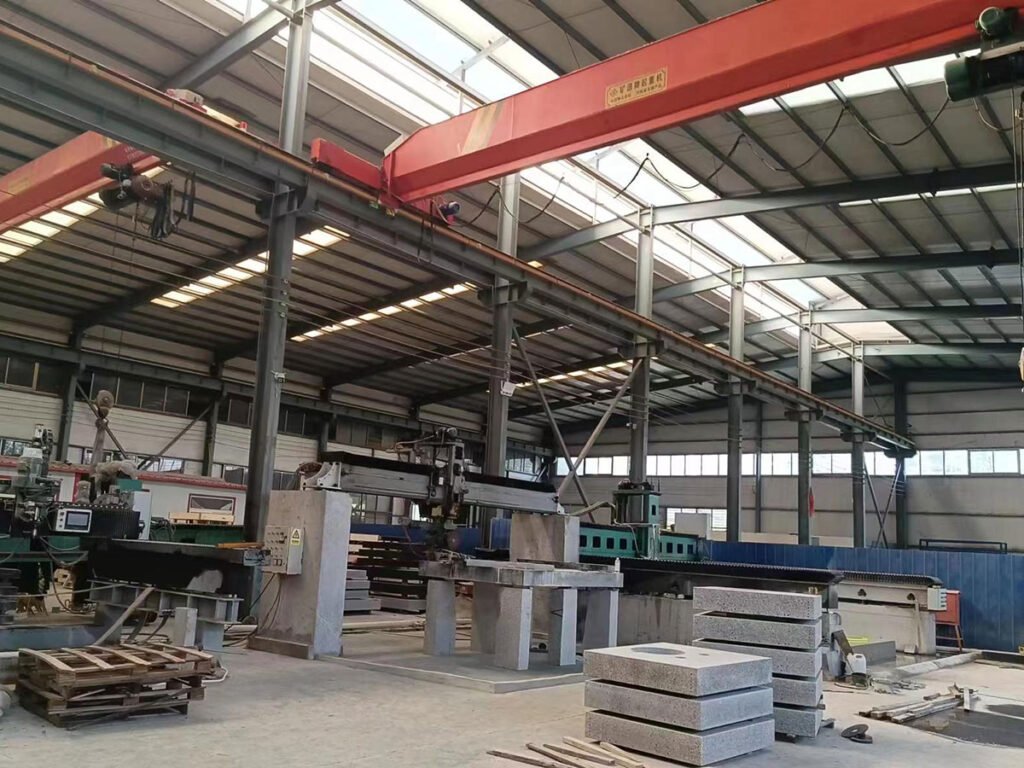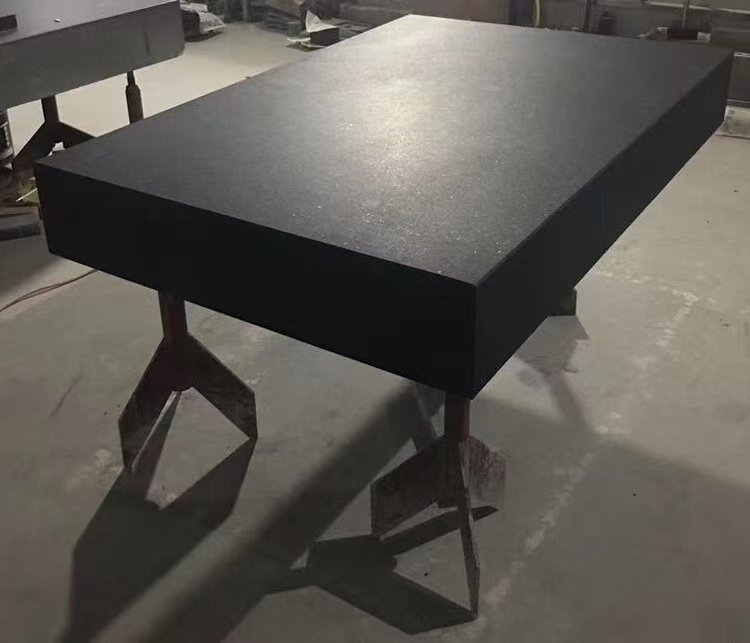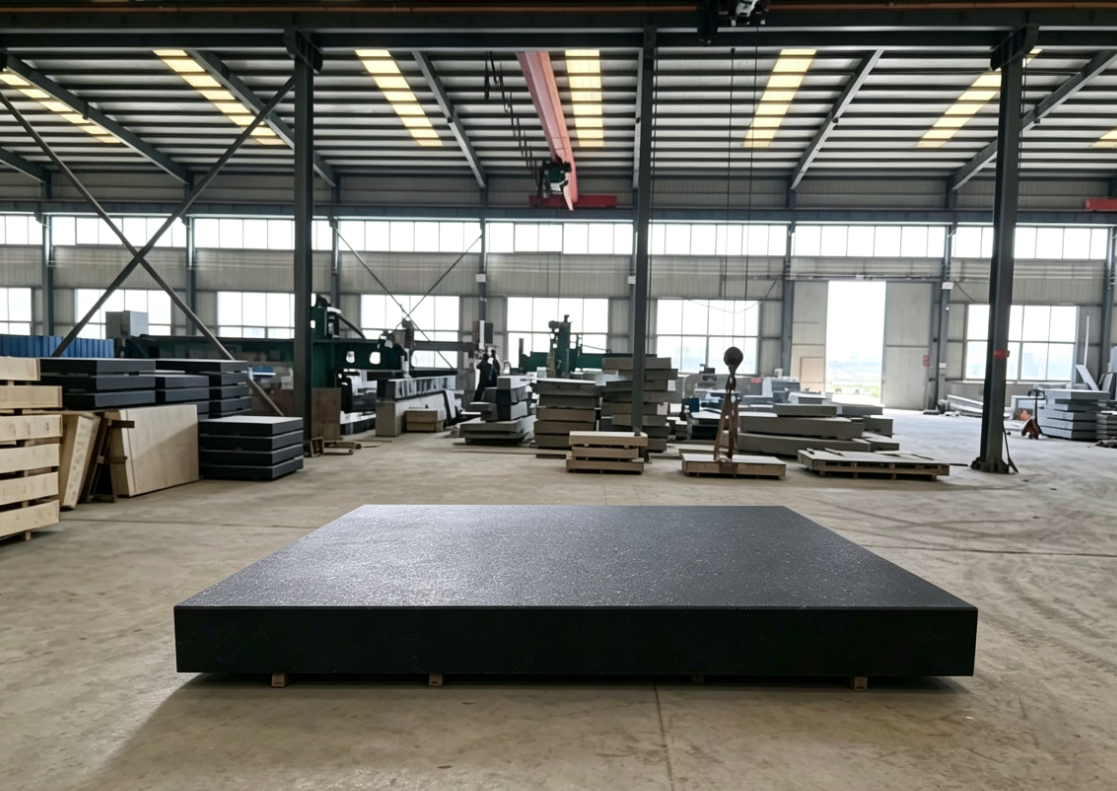
Ensuring the quality of the production process for precision granite components centers on establishing a full-process, traceable, and closed-loop quality control system. From the source to delivery, the requirements for “precision, stability, and consistency” must be implemented in every process. Below is a ready-to-implement quality assurance plan.
I. Source Quality Control: Raw Material Inspection (Preventing defects at the root)
Raw Material Grading and Acceptance System
Establish ledgers by mine source, batch, and grade, and perform the following on each batch of raw materials:
Visual Inspection: No cracks, no pinholes, no weathered layers;
Density / Water Absorption Testing: Water absorption rate ≤0.1%, to avoid later liquid seepage and deformation;
Ultrasonic Flaw Detection: Eliminate internal micro-cracks and hidden cracks to prevent cracking and scrapping during processing.
Unqualified raw materials are isolated immediately and strictly prohibited from entering the processing stage.
Aging Process Standardization
Mandatory execution of “Three-Stage Aging”: Raw material resting → Constant temperature resting after rough processing → Artificial aging after semi-precision processing;
Set up record cards for each stage, specifying start and end times and ambient temperature to ensure full release of internal stress.
II. Inter-process Quality Control: Mandatory Testing at Key Nodes
- Rough Processing Stage (Raw Material → Blank)
Control Objective: Remove excess material, ensure basic dimensions and flatness, and lay the foundation for subsequent processing.
Inspection Items:
External Dimensions: Tolerance ±0.5mm;
Flatness / Parallelism: ≤0.1mm/m;
Appearance: No chipped edges, no large-area chipped corners.
Control Measures: First-piece triple inspection system (self-inspection, mutual inspection, and professional inspection); mass production can only proceed after qualification. - Semi-precision Processing Stage (After Milling / Grinding)
Control Objective: Complete the main structure, reserve precision grinding allowance, and ensure the foundation for geometric tolerances.
Inspection Items:
Dimensional Tolerance: ±0.02mm;
Straightness / Parallelism of Guide Rail Mounting Surface: ≤0.01mm/m;
Hole / Step Position Tolerance: ≤0.01mm;
Surface Roughness of Key Surfaces: Ra≤1.6μm.
Control Measures: Use tools such as laser interferometers, spirit levels, and micrometers. Unqualified workpieces must be reworked or scrapped and are strictly prohibited from entering the next process. - Precision Processing / Polishing Stage (Ultra-precision Reference Surface)
Control Objective: Achieve final precision indicators and ensure long-term stability.
Inspection Items:
Reference Surface Flatness: ≤2–5μm/m (Ultra-precision grade ≤1μm/m);
Geometric Tolerance (Perpendicularity / Parallelism): ≤2–3μm/m;
Surface Roughness: Ra≤0.2μm (Ultra-precision surface ≤0.02μm);
Hole Position Accuracy: Position tolerance ≤0.005mm, hole diameter tolerance H7/H8.
Control Measures:
Constant temperature workshop inspection (20±0.5℃) to eliminate temperature errors;
Key surfaces are inspected using flat crystals, white light interferometers, and coordinate measuring machines (CMM), with data archived.
III. Equipment and Tooling Quality Assurance: Ensuring Stable Hardware Output
Regular Equipment Calibration and Maintenance
Processing Equipment (Gantry Milling Machines, Grinding Machines): Regularly calibrate guide rails and lead screws to ensure positioning accuracy;
Inspection Equipment (Laser Interferometers, CMMs, Flatness Testers): Calibrate according to the metrology cycle and issue verification certificates;
Establish equipment maintenance ledgers to avoid batch quality issues caused by equipment errors.
Standardization of Tooling and Fixtures
Regularly inspect general tooling and positioning blocks for wear, and replace them immediately if they exceed tolerances;
Use fixed tooling for the same series of products to reduce clamping errors and ensure consistency.
IV. Process Stability Control: Reducing Human and Environmental Fluctuations
Solidification of Process Parameters
Establish processing process cards for different materials and accuracy requirements, specifying:
Tool/abrasive model and grit size;
Feed rate, grinding pressure, and rotational speed;
Allowance allocation for each process step.
Strictly prohibit arbitrary changes to process parameters; any adjustments must be approved by the technical/quality department.
Control medioambiental
Fine Machining / Grinding / Inspection Areas: Constant temperature (20±0.5℃), constant humidity, and dust-proof;
Hardened floors anti-vibration treatment to avoid vibration affecting machining accuracy;
Establish workshop environmental records, recording temperature and humidity daily, and adjusting promptly if they exceed standards.
Personnel Skills and Training
Personnel for critical processes (grinding, inspection) must be certified to work;
Regularly train on process standards and quality requirements to unify operating methods;
Establish a mechanism linking skill levels with quality performance to incentivize stable operations.
V. Final Inspection and Delivery Quality Assurance: Zero-Defect Finished Products
Full-Item Final Inspection
Perform 100% full-item inspection according to drawings/customer requirements: dimensions, geometric tolerances, surface quality, and appearance;
Take photos of critical accuracy data for archiving to form complete quality records.
Protection and Packaging
Apply protective agents to fine-machined surfaces to prevent moisture and contamination;
Secure with soft foam wooden boxes, ensuring anti-vibration and anti-collision packaging;
Perform a final appearance inspection before shipment to confirm no chipped edges or scratches.
Quality Traceability System
Establish a unique ID for each product, linking: raw material batch, processing equipment, operator, and inspection data;
Enable rapid traceability to specific processes, equipment, and personnel when problems occur for timely correction.
VI. Continuous Quality Improvement: PDCA Closed-Loop Management
Quality Statistics and Analysis
Regularly calculate non-conforming product rates, rework rates, and scrap rates, and analyze main defect types (e.g., flatness out of tolerance, chipped edges, scratches);
Form special improvement teams for high-frequency problems to formulate corrective and preventive measures.
Customer Feedback Closed-Loop
Collect customer usage feedback, especially regarding later accuracy drift, surface contamination, etc.;
Reverse-optimize processes (e.g., aging, protection, packaging) to form a “production – inspection – usage – improvement” closed loop.
VII. Key Quality Indicators Reference (Can be directly used for assessment)
Cuadro
Indicator Control Target
First-pass yield ≥95%
Sc rate ≤3–5%
Critical dimension pass rate 100%
Final inspection pass rate 100%
Customer complaint rate ≤0.5%
-process accuracy drift (1 year) ≤1μm