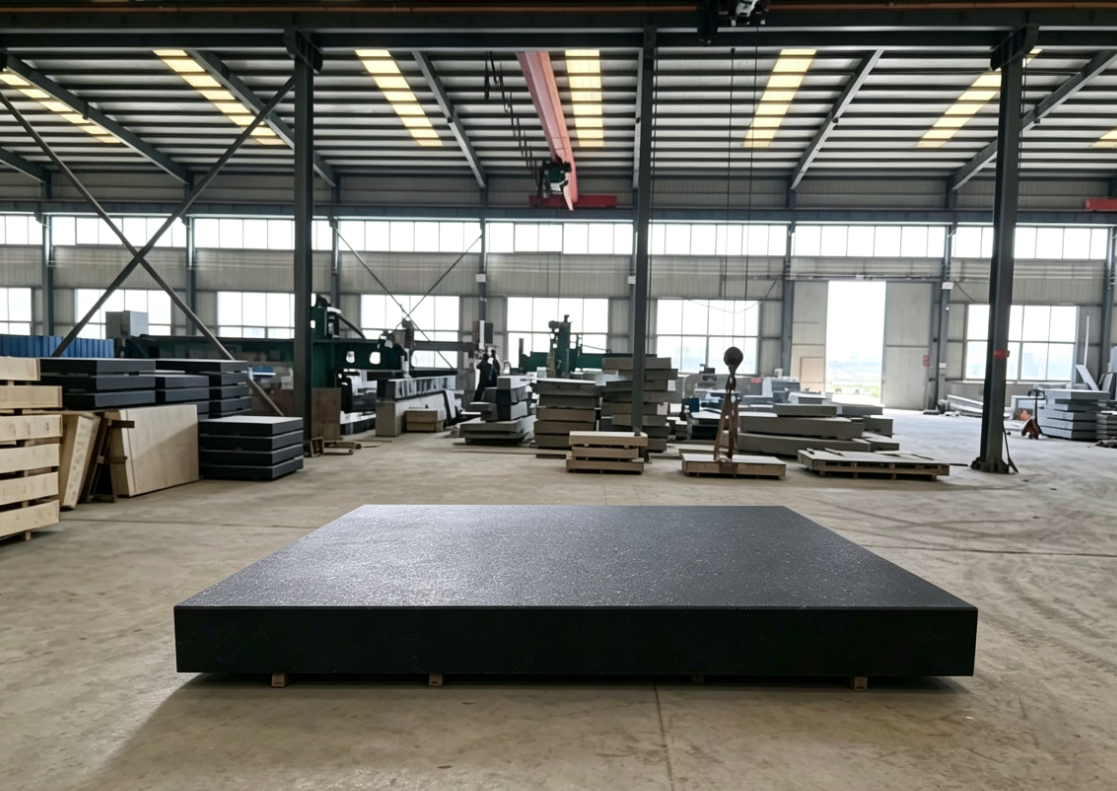
For the worktable of high-precision Coordinate Measuring Machines (CMMs), the preferred material is high-qualision granite (mainly Jinan Black); industrial ceramics can be selected for ultra-high precision scenarios; and aluminum alloy is suitable for general or mobile types.
I. Preferred: Precisin Granite (Jinan Black) — The Standard for 95% of Metrology CMMs
Core Advantages (Best for Worktables)
Extremely strong stability: Aged naver millions of years, internal stress fully released, no deformation over the long term
Good thermal stability: Coefficient of thermal expansion ≈ 1/2 oteel, 1/4 of aluminum, minimizing the impact of temperature fluctuations
High rigidity and good anti-vibration: Strong damping capability, absorbs ground and workpiece vibrations, ensuring stable measurement
Easy ee precision: Precision grinding can achieve flatness ≤ 2 μm/m, wear-resistant, rust-proof
Full machine thermal matching: Worktable, crossbeam, and guides made of the same material, consistent thermal deformation
Desventajas
Heavy weight, high brittleness, vulnerable to severe impact
High cost and complex transportation/installation for large ps
Applicable Scenarios
Fixed bridge, gantry, and high-precision metrology room CMMs
Workshop sites, environments with large temperature fluctuations
Benchmark measurement equipment requirigh long-term stability
II. Alternative: Industrial Ceramic (High-end / Ultra-precision)
Ventajas
Extremely high specific stiffness (rigidity/weight): Approximately 6 tt of granite, 4 times that of aluminum alloy
Extremely low coefficient of thermal expansion, lightweight, fast dynamic response
Wear-resistant, corrosion-resistant, long-term stability clos to granite
Desventajas
Difficult to process, expensive
High brittleness, strict design and installation requirements
Applicable Scenarios
Ultra-high precision, high-speed canning CMMs (mostly mobile bridges/crossbeams, rarely full worktables)
III. Alternative: Aluminum Alloy (Lightweight / Mobile / Economical)
Ventajas
Lightght, easy to process, lower cost
Flexible structural design (can be hollow or complex structures)
Desventajas
High coefficient of thermal expansion (≈ 4 times that of granite), temperature
Low hardness, poor wear resistance, long-term stability inferior to stone
Applicable Scenarios
Portable, cantilever, small/economical CMMs
Constantenvironments, scenarios with moderate precision requirements
IV. Material Comparison (Worktable)
Cuadro
Characteristics Precision Granite Industrial Ceramic Aluminum Alloy
Long-term ability ★★★★★ Best ★★★★★ ★★★☆☆
Thermal stability ★★★★★ ★★★★★ ★★☆☆☆
Rigidity / Antvibration ★★★★★ Good ★★★★★ ★★★☆☆
Surface precision ★★★★★ Easy to reach sub-micron ★★★☆☆
Weight Heavy Light Lightest
Cost Medium-high Extremely high Low
V. Purchase Recommendations
High precision / Metrology room / Workshop site → Chooranite (most reliable, most universal)
Ultra-high speed / Ultra-high precision → Ceramic (crossbeam / moving parts)
Portable / Small / Economical → Aluminum alloy
Suary: For CMM worktables, precision granite is the first choice, offering the best overall combination of stability, precision,