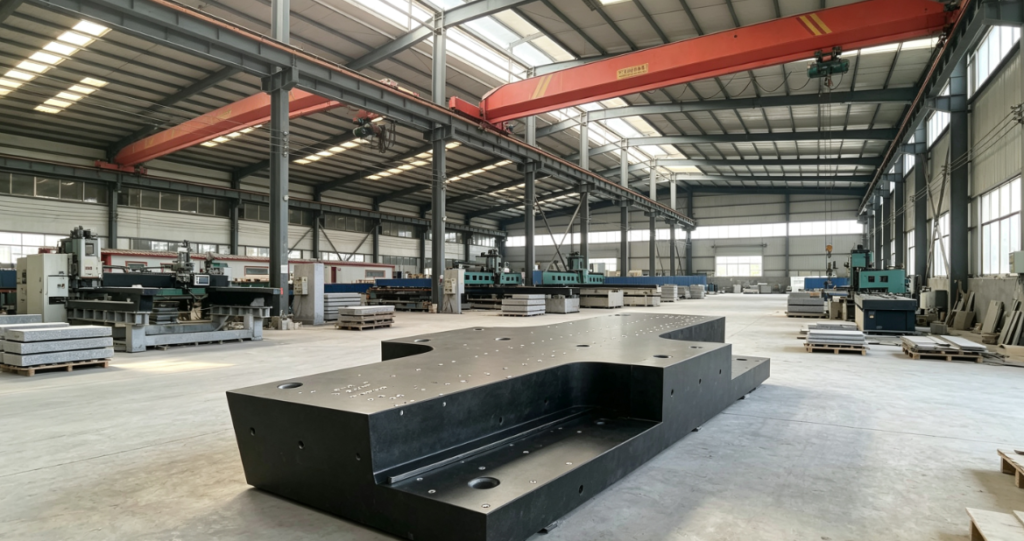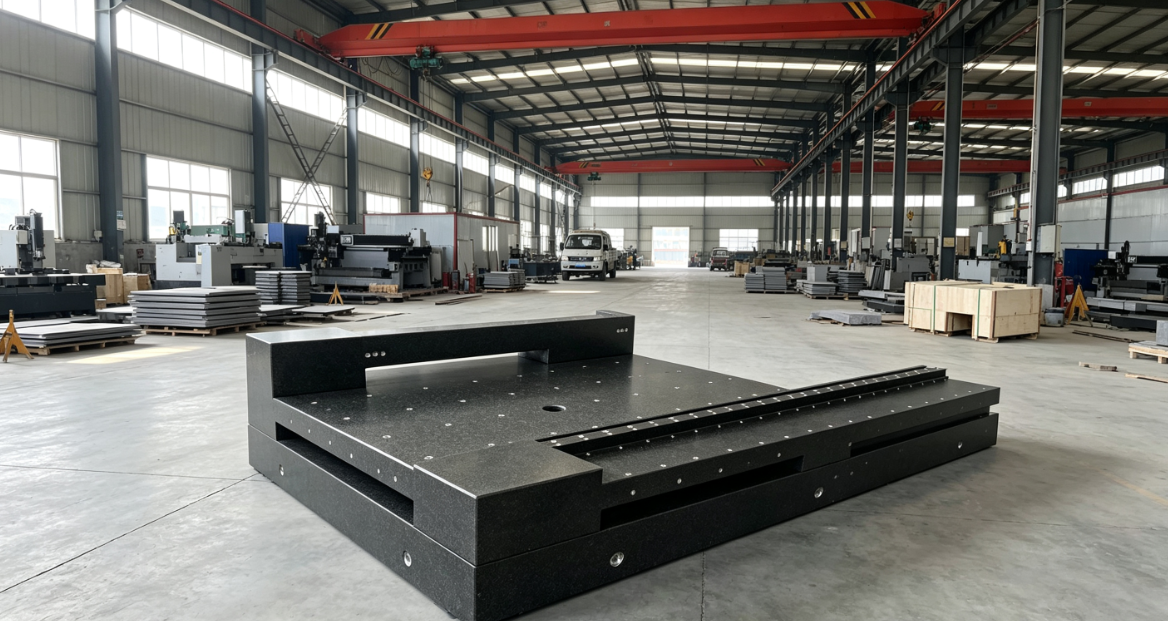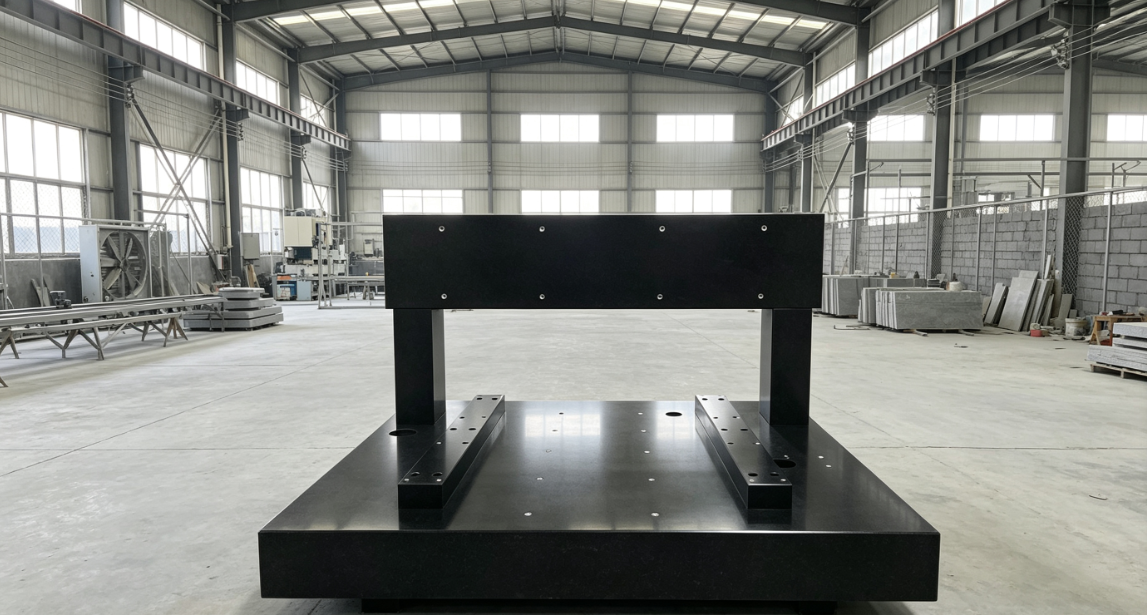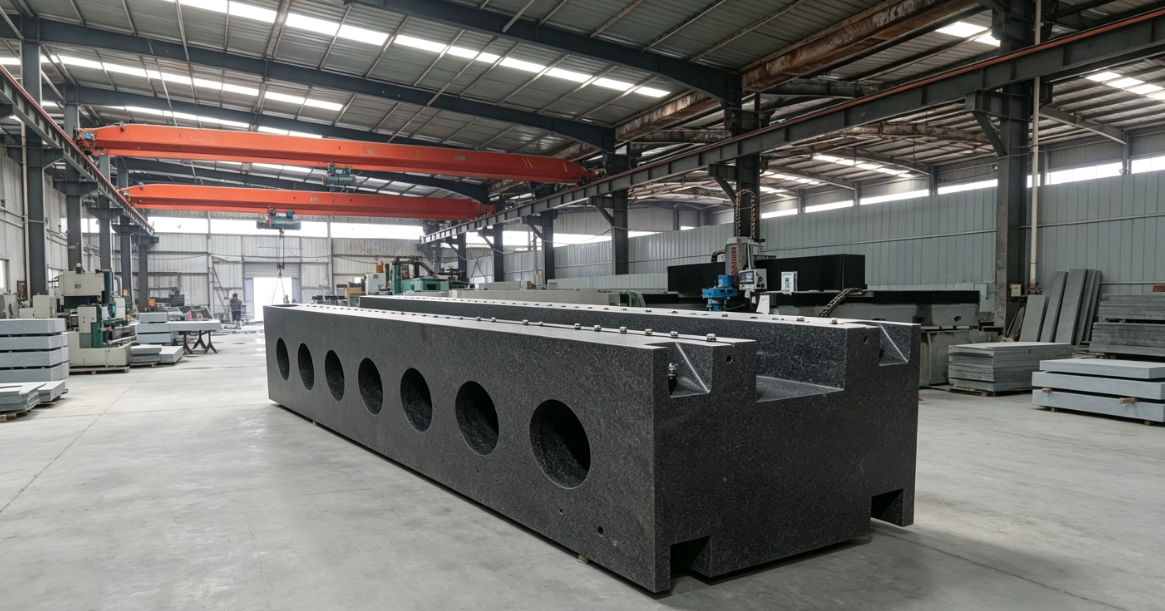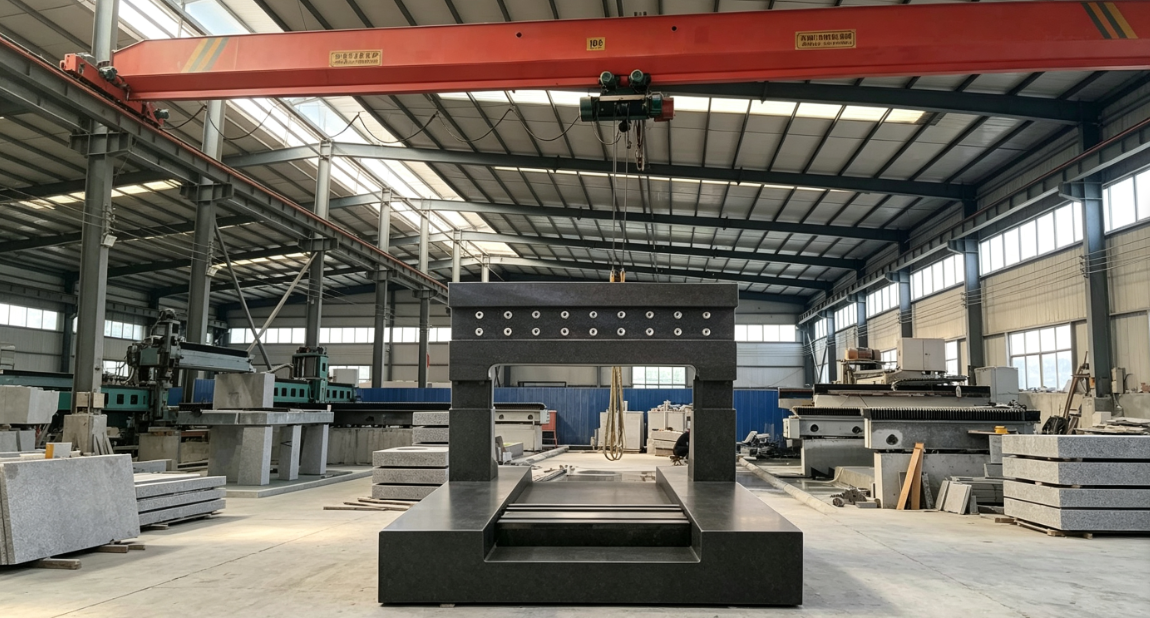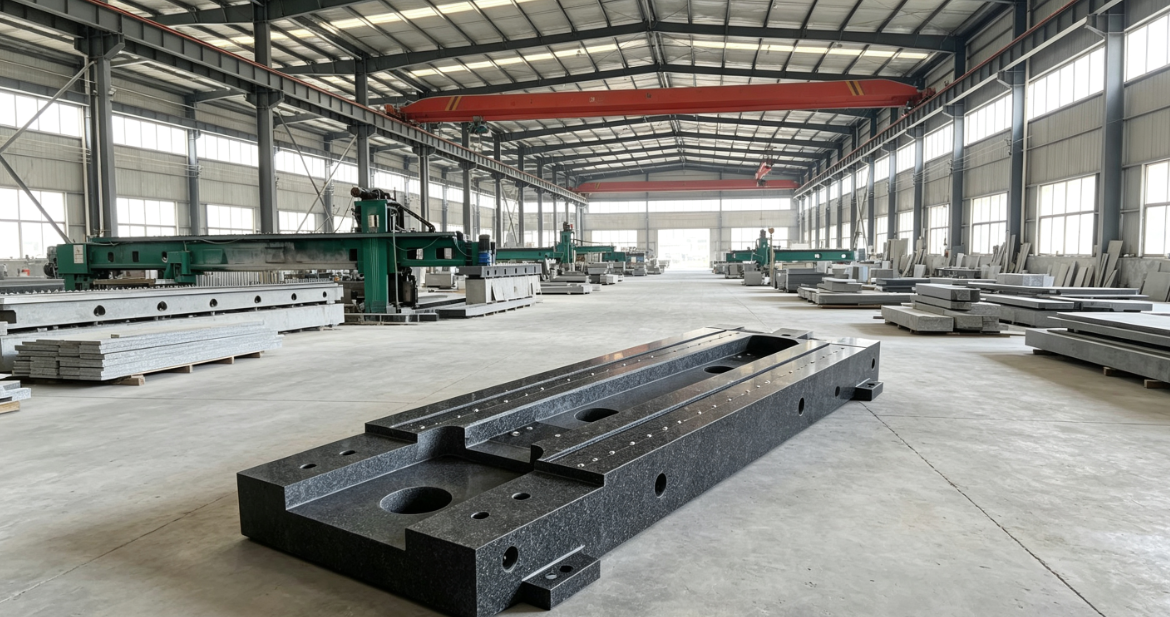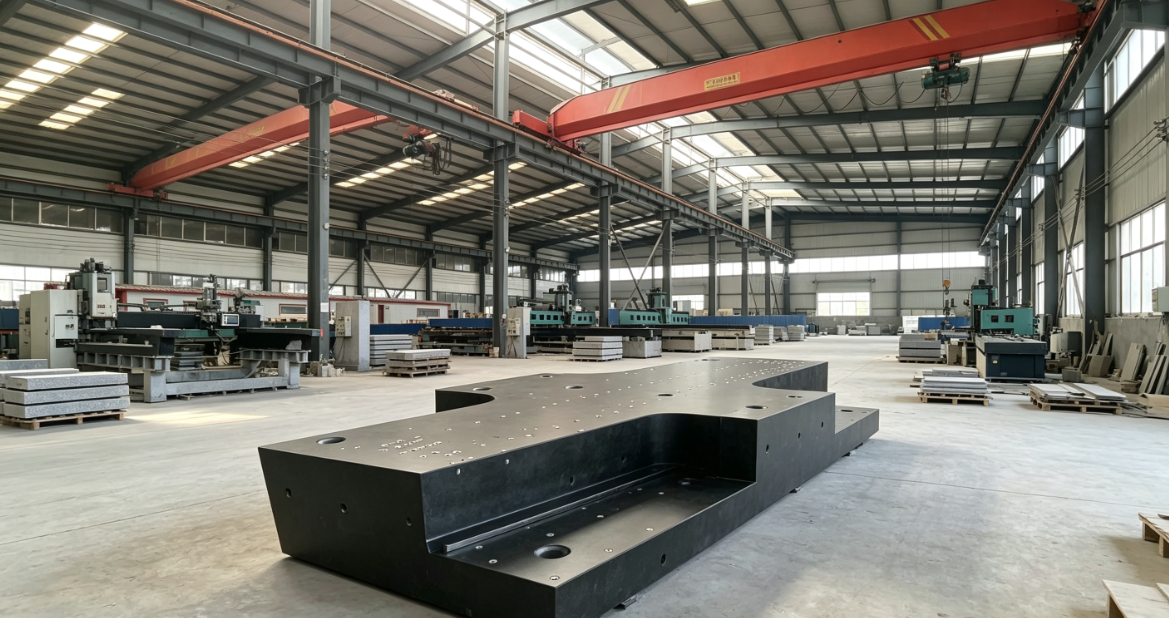
How to determine whether the raw materials for granite platforms meet the requirements
The later-stage deformation and precision deviation of granite platforms often stem from defects in the stone billets. The judgment of raw materials is divided into document verification, visual inspection, simple on-site screening, laboratory testing, and ultrasonic flaw detection to check for internal defects, consisting of two parts: manufacturer-provided documentation and self-verification at the delivery site.
Key point: 00, 000-grade high-precision platforms must use whole stone blocks; spliced billets are strictly prohibited. Splicing is only allowed for ordinary Grade 1 tooling platforms.
I. Written documents requested from the supplier (the first gatekeeper)
Do not just look at the certificate of conformity; you need to request material-related documents:
Physical property test report of the stone
Key indicators (reference for high-quality raw materials like diabase / Jinan Green)
| Artículo | High-precision 00/000-grade qualification threshold | Description |
|---|---|---|
| Densidad | ≥2.95 g/cm³ | Low density indicates loose grains and poor stability |
| Water absorption rate | ≤0.15% | The higher the water absorption rate, the greater the expansion and deformation due to temperature and humidity changes; a core indicator |
| Linear expansion coefficient | ≤4.5×10⁻⁶/℃ | The smaller the value, the smaller the deformation caused by temperature changes |
| Shore hardness HS | ≥70 | Low hardness is prone to scratching and microscopic creep |
| Compressive strength | >240 MPa | Resistance to load and internal micro-cracking |
| ⚠️Note: The report should ideally correspond to the current batch of stone blocks; do not accept generic sample reports. | ||
| Ultrasonic flaw detection report | ||
| Internal cracks, layers, and porous looseness in granite cannot be seen with the naked eye. 00/000-grade platform billets must undergo ultrasonic flaw detection to confirm the absence of internal dark cracks and weak layers. | ||
| Many small factories skip flaw detection. Micro-cracks inside the billet are invisible during processing, but after a period of use, stress release will cause warping and deformation. | ||
| Description of the stone block source | ||
| Confirm it is diabase (Jinan Green is typical); reject granite with well-developed bedding or high mica content. | ||
| Mica is a major hidden danger: mica has a flaky structure, absorbs water, and is prone to creep. Stone containing a large amount of mica will have very poor long-term stability, no matter how much it is ground. | ||
| II. On-site visual inspection simple tool preliminary check (without laboratory equipment) | ||
| This can only screen for obvious defects; internal cracks and accurate physical parameters cannot be determined by the naked eye. |
- Color and grain
1) High-quality diabase (Jinan Green): Overall black-gray with uniform color; fine and dense grains, appearing small and uniform to the naked eye, without large white or shiny flaky particles (mica).
A large number of shiny flaky spots = high mica content, unsuitable for high-precision platforms.
Appearance of large white spots, light-colored bands, or bedding stripes: Indicates the presence of compositional layers; reject immediately.
2) Distinction:
✅ Fine-grained diabase: Small, dense grains, producing a crisp and loud sound when tapped.
❌ Coarse-grained granite: Large grains, producing a dull sound when tapped, poor stability, only suitable for ordinary tooling. - Surface defect inspection (prioritize checking at the billet / semi-finished stage, as finished products will be ground to cover them)
Not allowed: Cracks, through-cracks, dense sand holes, honeycomb pores; patching with glue or putty on the working surface is strictly prohibited.
A small number of small pores on the sides or non-working surfaces may be allowed, but if the working surface requires patching, it indicates defects in the billet material.
Check the cross-section: If there is a cut cross-section, observe that it is dense, without loose pores or delamination. - Simple Tapping Method (Auxiliary, Qualitative)
Lightly tap the perimeter and center of the platform with a small copper hammer:
Crisp sound, long echo: The material is dense and intact;
Dull, hoarse sound, or significantly different sound in certain areas: High probability of internal cracks or looseness.
Only for preliminary screening, cannot be used as a basis for determining qualification. - Simple On-site Water Absorption Self-test (Qualitative)
Drop clean water on the non-working surface of the stone:
Water droplets remain spherical and do not quickly soak in or spread: Indicates low water absorption;
Water quickly seeps in and leaves a wet mark: Indicates loose material and high water absorption, unsuitable for high precision.
Qualitative only, cannot replace laboratory testing.
III. Common Pitfalls
Appearance is black ≠ Material is qualified
Many black granites look beautiful but have high mica content and high water absorption. They may have good factory precision but slowly deform after a year of use; color is only for reference, physical parameters must be checked.
Spliced slabs masquerading as whole blocks
Observe the sides and bottom to find splice seams and glue lines; for large-size high-precision platforms, if the price is significantly low, prioritize checking for splicing. Spliced platforms are strictly prohibited for use as 00 or 000 grade metrology bases.
Finished grinding masking slab defects
The working surface of finished platforms is ground to a shine, and pores or fine cracks are filled with glue. If conditions permit, prioritize viewing photos of the raw block before processing and the rough-ground semi-finished product; these reflect the true state of the raw material better than the finished product.
IV. Advanced Verification (Recommended for important equipment projects)
Third-party testing: Take a small sample from the same batch of slabs and send it to a testing agency to re-test density, water absorption, linear expansion coefficient, and compressive strength.
Ultrasonic re-inspection: After delivery, commission a third party to perform ultrasonic re-inspection of the slab interior to rule out hidden cracks.
V. Typical signals of unqualified raw materials, avoid immediately if encountered
Unable to provide physical performance reports, or refusing to provide ultrasonic testing records;
Large amounts of mica glitter on the stone surface, or light-colored interlayer stripes;
Repairs or glue traces on the working surface;
Water droplets quickly penetrate the stone;
Dull or hoarse sound when tapped locally;
Large-size high-precision platforms are spliced structures.
Brief Summary of the Practical Process
Before signing: Require the manufacturer to provide material reports ultrasonic testing records raw block photos, and include physical indicators in the procurement contract as acceptance terms;
Initial inspection upon arrival: Check appearance for grains, mica, and interlayers; perform water dripping and tapping for preliminary screening;
High-value projects: Third-party sample testing ultrasonic re-inspection.