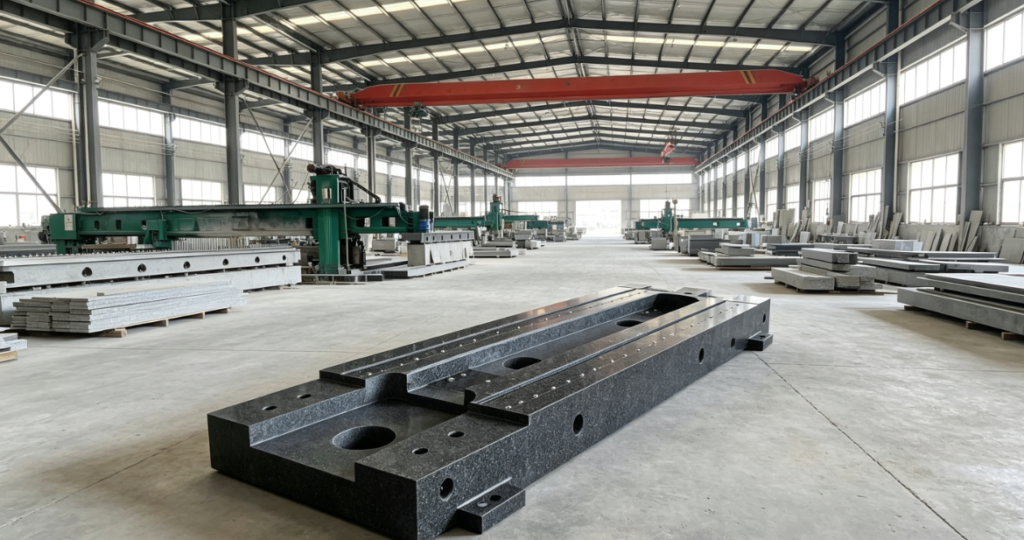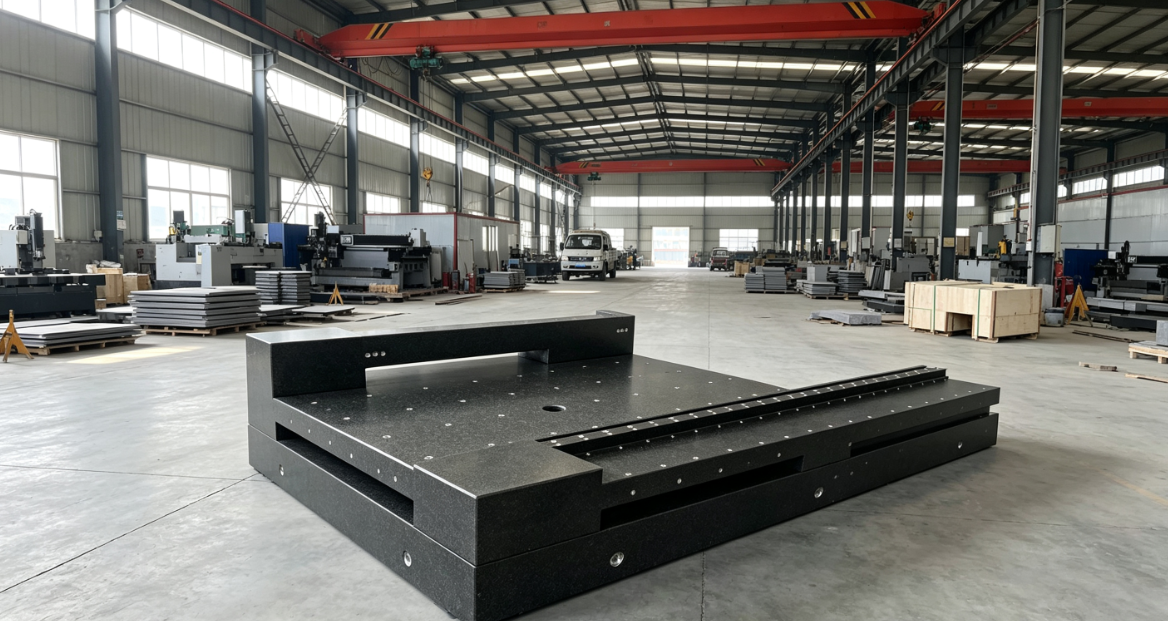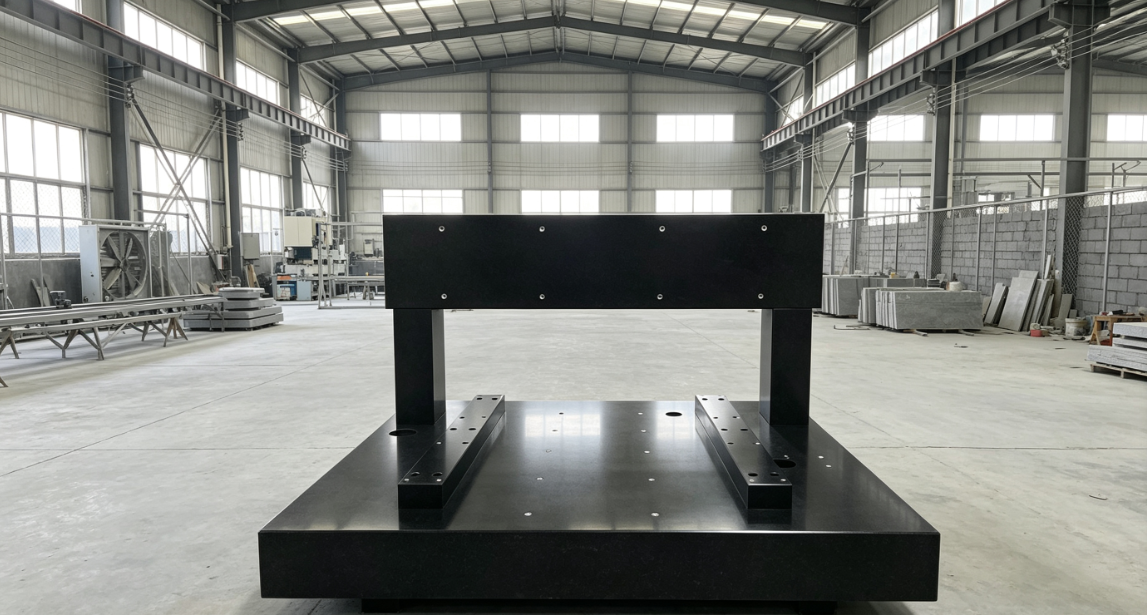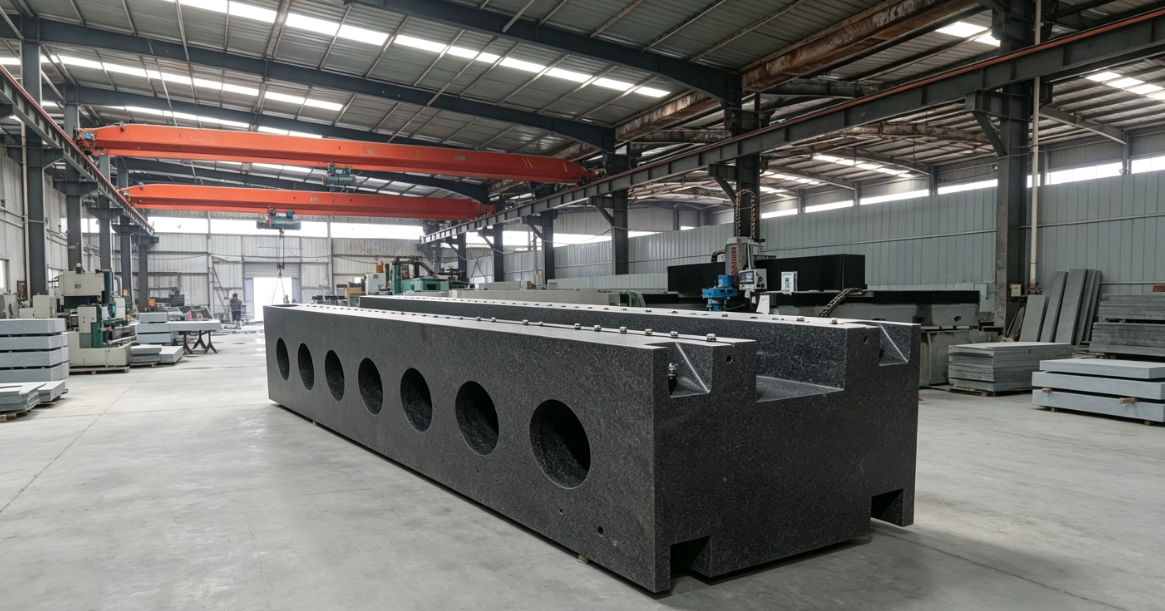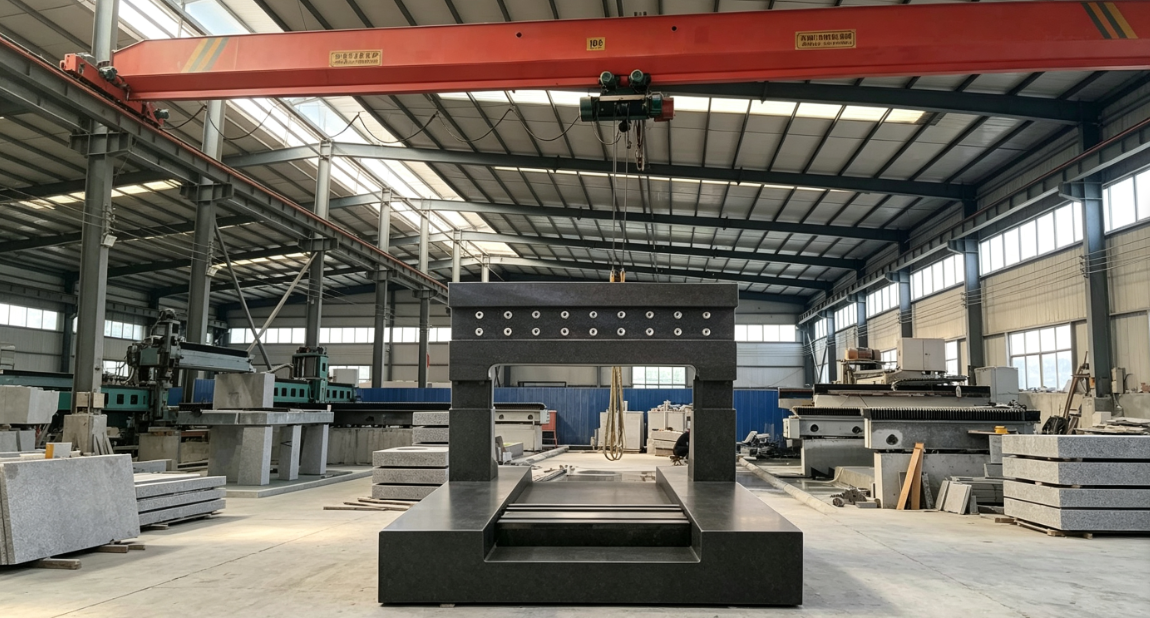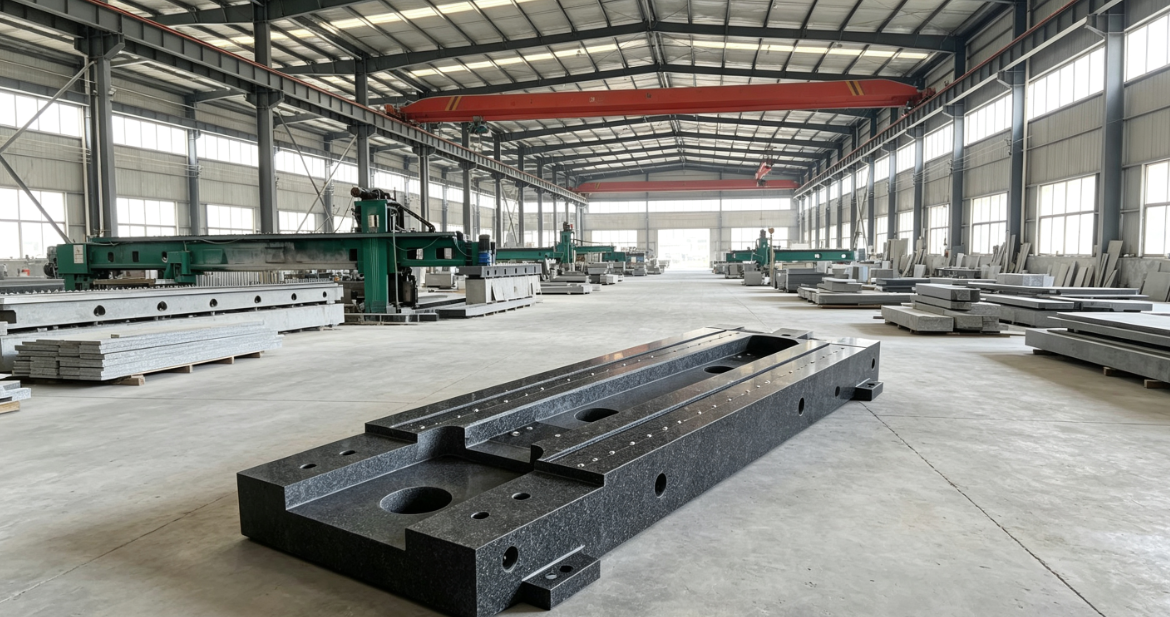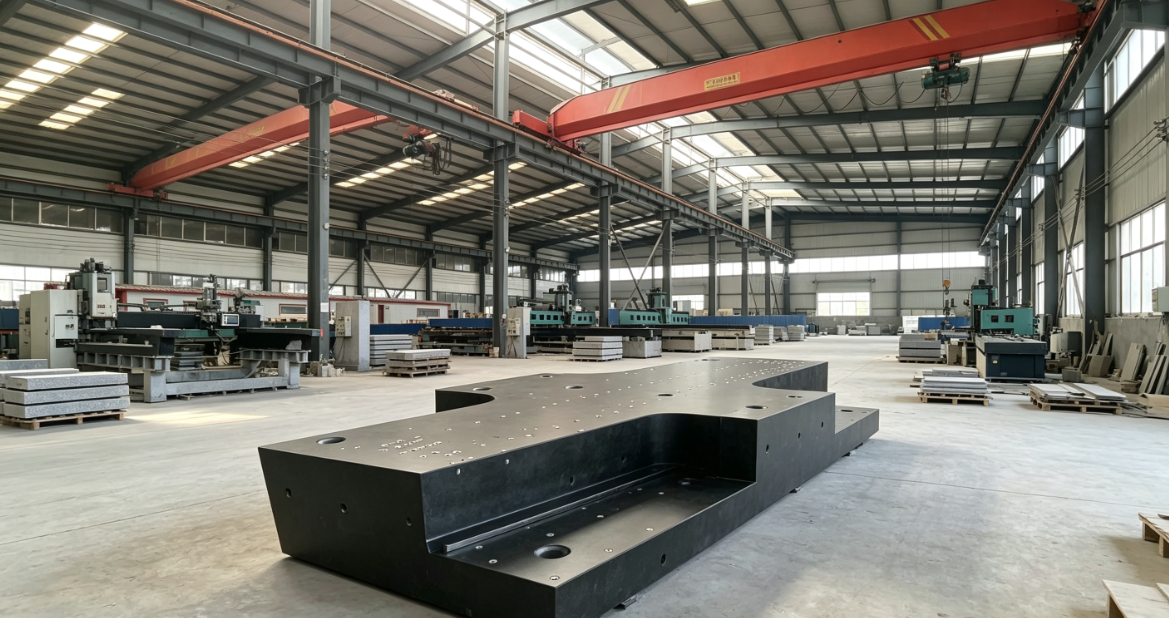
The Impact of Granite Platform Processing Technology on Accuracy and Stability
The initial flatness of a granite platform at the time of delivery is determined by the grinding process, while its long-term stability is determined by the full-process stress control. No matter how good the raw material is, if the processing technology is unreasonable, it may pass the factory inspection but warp and experience flatness drift after a few months to 1-2 years of use. The processing is divided into: raw material cutting → rough machining → aging treatment → semi-precision machining → secondary aging → slotting / bushing → precision grinding → ultra-precision grinding; every step affects the final performance.
- Cutting Process
Impact points: Introduction of initial thermal stress and microscopic micro-cracks.
✅ Qualified process: Water-cooled diamond saw blades / diamond wire cutting, sufficient cooling, smooth feed rate, reducing cutting surface burning and micro-cracks.
❌ Poor process: Dry cutting, high-speed violent cutting, insufficient cooling.
Consequences: Invisible micro-cracks and residual stress are generated on the cutting surface; subsequent grinding removes part of the surface, but the internal stress is sealed inside the blank, slowly releasing later, causing the platform to warp and deform.
Key point: After cutting, it cannot be sent directly to the grinding machine; the cutting-burned altered layer must be removed before entering rough grinding. - Rough Machining (Rough Milling, Rough Grinding)
The purpose of rough machining is to remove a large amount of allowance and form the general shape, holes, and slotting allowances.
Process risks: Excessive depth of cut, single grinding depth too deep, the stone surface bears compression, generating a large amount of grinding residual stress.
✅ Correct practice: Small depth of cut, multiple passes, water-cooled; reserve 0.5–1 mm of precision grinding allowance for slotting and threaded hole positions, do not process to the final position in one go.
❌ Incorrect: Rough slotting and drilling with large depth of cut, generating micro-cracks around the slot edges and altering the overall stress field.
After rough machining is completed, the first aging is the most important node. Many manufacturers skip it and go directly to semi-precision grinding, which is the main cause of later deformation. - Aging Process —— [The core process determining long-term stability]
Granite deformation is mostly not due to material failure, but because the processing residual stress has not been released. Aging is not an optional decorative process.
① Natural Aging
After rough machining is completed and most of the machining allowance is removed, place it flat in a constant-temperature workshop, and flip it periodically to rest.
000/00 grade high-precision platforms: Rest for several weeks to several months. Let the grinding stress generated by rough machining slowly release.
Aging raw material blanks in open-air quarries has a better effect, but the cycle is very long and the cost is high.
② Artificial Hot-Cold Cycle Aging
Cycle the workpiece between high and low temperatures to accelerate stress release, suitable for Grade 0 platforms; it cannot completely replace long-term natural aging and can only serve as an auxiliary.
❌ Major pitfall: Rough machining → direct semi-precision grinding, precision grinding. Stress is sealed inside the workpiece, the factory accuracy is very good, but as the operating environment temperature fluctuates, the stress gradually releases, the platform slowly warps, and the flatness grade degrades.
Supplement: If the platform has slotting or large holes, it is recommended to perform another round of short-term aging after slotting is completed, as slotting will re-disturb the internal stress of the stone. - Semi-precision Machining (Semi-precision Grinding)
Further reduce the allowance and correct the geometric shape.
Key points: Control the grinding amount to avoid re-introducing excessive grinding stress;
After semi-precision grinding is completed, some high-end processes arrange a secondary short-term aging before entering the final precision grinding.
- Machining processes for holes, slots, and metal inserts
Slotting, drilling, and inserting are high-frequency failure locations.
Slotting: Slots cut through the continuous matrix of the stone, altering the stress distribution; the more deep slots, the worse the overall rigidity and stability of the platform.
Process requirements: Aging after slotting, then precision grinding the working surface; direct precision grinding after slotting is prohibited.
Threads: Granite cannot be tapped directly; metal inserts must be used.
✅ Qualified: Reasonable clearance left for the insert hole, low-stress adhesive used, bonding does not generate compressive stress; the insert is slightly lower than the working surface.
❌ Defective: Forced interference fit of the insert, adhesive curing shrinkage generates local compressive stress, causing local bulging of the working surface; local accuracy drifts after a period of use.
Many linear motor granite platforms experience local bulging on the guide rail mounting surface later on, which is caused by the adhesive stress of the inserts. - Precision grinding and ultra-precision lapping processes (determining instantaneous flatness and surface quality at the factory)
GB/T20428 rock surface plates, grade 00/000 cannot rely solely on single-side grinding by CNC grinders.
CNC single-side grinding: High efficiency, but prone to “saddle-shaped” or “bowl-shaped” systematic errors, only capable of achieving grade 0 and below.
Manual mutual lapping: Grade 00 and 000 metrology-grade plates must undergo multi-plate mutual lapping and flipping to continuously correct the shape and eliminate the inherent errors of the grinder.
Surface roughness: High-precision plates have Ra≤0.2μm, with surface micropores closed to reduce the impact of humidity-induced water absorption and expansion.
If the surface is rough and porous, water vapor in the air penetrates the micropores of the stone, and humidity changes cause slight expansion, affecting measurement repeatability.
⚠️ Note: Lapping can only correct the current geometric shape, not eliminate the residual stress inside the blank.
Even if a perfect grade 000 flatness is lapped, if the initial stress is not released, it will still deform later.
Simple understanding: Lapping is “shaping”, aging is “stress relief”; shaping without stress relief will lead to spring-back deformation over time. - Post-finishing treatment and environmental control
After precision grinding, the workpiece needs to fully equilibrate in a constant-temperature workshop before flatness verification; the temperature of the workpiece and the verification instrument must be consistent.
It is not recommended to perform extensive drilling and slotting after precision grinding, as it will introduce new stress and destroy the already achieved accuracy.
Protective coating: High-precision metrology plates generally do not use thick resin coatings; thick coating curing shrinkage will bring surface stress; only a thin anti-seepage treatment is applied. - Summary of typical failure phenomena caused by machining process defects
الجدول
Failure phenomenon Corresponding machining process issue
Passes factory inspection, but warps slowly over months of use Lack of aging after rough machining, residual grinding stress is sealed in
Local accuracy drift and bulging around slots No aging after slotting; compressive stress from adhesive curing in inserts
Local small ripples or saddle shape appears on the platform Only CNC single-side grinding, no flipping and mutual lapping for shape correction
Chipping at slot edges, later micro-crack propagation Excessive depth of cut during slotting, generating machining micro-cracks
Humidity changes, measurement repeatability worsens Poor lapping roughness, open surface micropores absorb water
How to write machining processes into technical requirements during procurement (ready to use)
Raw blocks must be water-cooled cut, dry cutting is prohibited; remove the cutting alteration layer after rough machining.
Perform aging treatment after rough machining; additional aging after slotting / large hole machining.
The final process for grade 00/000 plates must use flipping and mutual ultra-precision lapping.