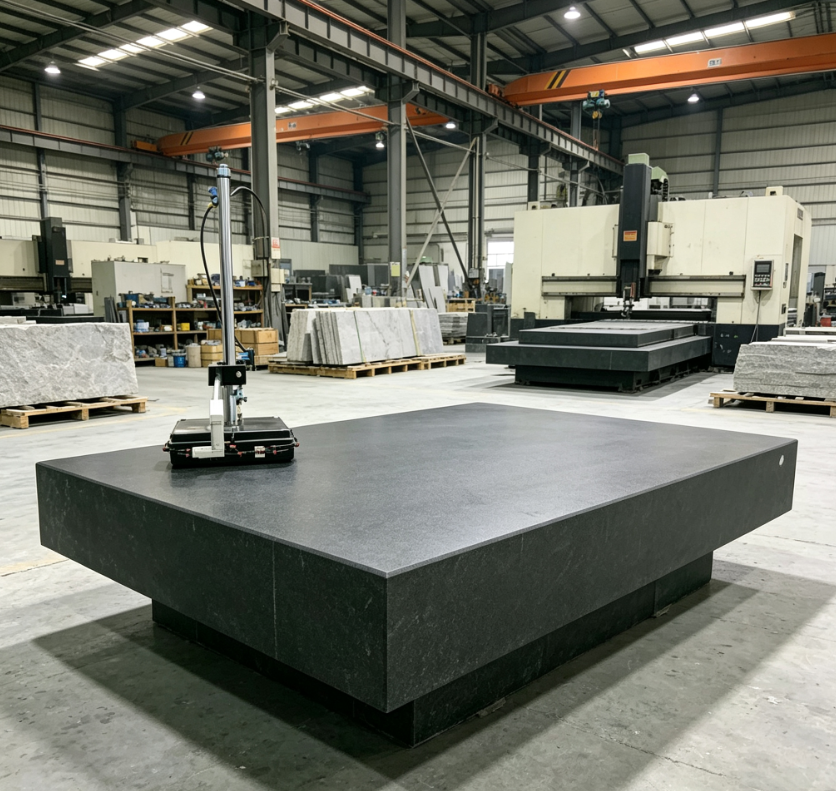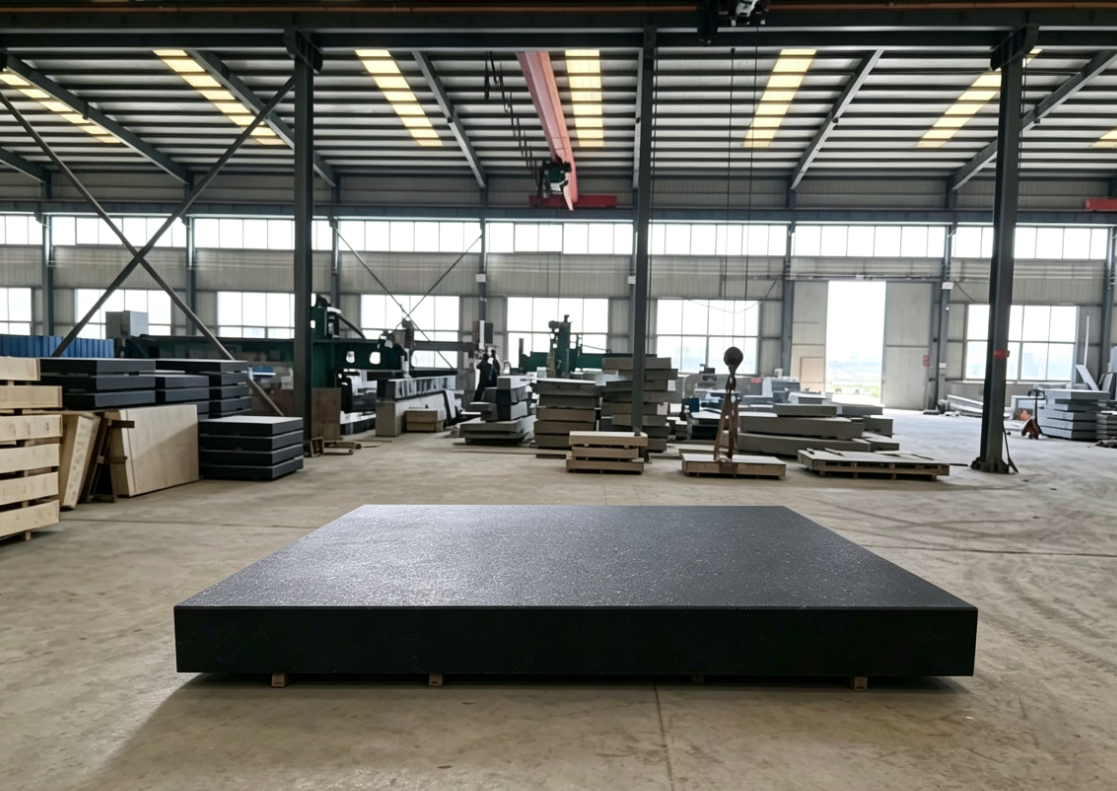
Core Advantages of Semiconductor Lithography Machine Granite Bases
I. Ultimate Thermal Stability, Eliminating Nan-Scale Thermal Drift (Core Requirement for Lithography)
The dedicated semiconductor granite has an extremely low coefficient of thermal expansion, only 1/4 of steel and 1/ of aluminum alloy. Under minute temperature fluctuations, its deformation is minimal, preventing lithography overlay offset and pattern misalignment, ensuring alignment accuracy for advanced 3nm/2nm processes.The stone material has high thermal inertia, buffering instantaneous temperature fluctuations in cleanrooms. Combined with built-in water-cooling channels, it can balance the base temperature field and eliminate local caused by local heating from motors and light sources.
The material has no water-absorption expansion characteristics, making it immune to pure water and lithography cleaning solutions in the workshop. will not undergo dimensional changes due to water vapor over long-term use.
II. Natural High Damping Vibration Reduction, Isolating Full-Spectrum Micro-vibrations in Workshop
Internal friction within the dense crystals can rapidly dissipate vibration energy and is not prone to resonance. Compared to metal bases, it can significantly weaken micro-vibrations generated by fans, vacuum, floor foot traffic, and drive motors.
When paired with air springs and active vibration isolation systems, the vibration transmission rate can be suppressed to an extremely low level, avoiding optical path offset wafer positioning jitter caused by vibration, meeting the stringent vibration limit requirements of EUV lithography machines.
III. Zero Creep and Long-Term Dimensional Stability, Maintaining Precision a Decade Without Degradation
Granite has undergone hundreds of millions of years of geological stress release, followed by factory multi-stage cold-hot and vibration composite aging, avoiding the aging and creep deformation issues of metal materials.
Operating continuously 24 hours a day, 365 days a year, the annual dimensional deformation is less than 0.μm. The equipment does not require frequent shutdowns for baseline calibration over the long term, significantly reducing production line maintenance costs and improving capacity utilization.
IV. Completely Non-Magnetic and Ins, Avoiding Electromagnetic Interference Risks
It contains no ferromagnetic components, does not interfere with electron beams, laser interferometers, or high-precision grating displacement sensors, and does not generate electromagnetic that causes measurement errors.
It is compatible with the internal RF power supplies, magnetic levitation/air bearing motion modules of lithography machines, and will not generate additional magnetic fields that wafers and precision optical components, making it a mandatory substrate requirement for high-end lithography equipment.
V. Ultra-High Hardness, Wear and Corrosion Resistance, Suitable for DustFree Cleanrooms
Its Mohs hardness is higher than steel. The reciprocating friction of air-bearing rails and stages will not damage the reference plane over the long term, maintaining ultra- flatness.
The structure is dense with an extremely low water absorption rate. After vacuum pore sealing treatment, it is not prone to dust accumulation or particle precipitation, meeting Class 110 ultra-high cleanroom standards; it is resistant to acid, alkali, and photoresist cleaning agents, with the surface not rusting or powdering.
VI. Integrated Molding, Eliminating Assembly Cumulative Errors
Guide rail grooves, water-cooling channels, high-precision threaded mounting holes, and optical reference positioning surfaces can be machined as a single unit, with the entire set of equipment sharing the same reference.
Flatness, perpendicularity, and parallelism can reach the DIN876 000 ultra-precision. The assembly of multi-axis optical and stage modules has no cumulative geometric errors, improving the overall machine’s positioning repeatability.
VII. High Rigidity and Low Load Deflection, Deformation Under Heavy Loads
Granite has a high elastic modulus and high density. At the same thickness, its bending resistance is far superior to cast iron and aluminum. Under full- operating conditions, the base deflection is controlled at the sub-micron level, ensuring the reference flatness throughout the movement of large-sized wafers.
VIII. One-stop customized matching, compatible with all categories of lithography equipment
Customizable according to requirements: ultra-large EUV g bases, medium-sized ArF/KrF equipment bases, and small laboratory calibration platforms (e.g., 300×200×60mm calibration tables
Supports pre-embedded temperature-controlled water channels, anti-static coating application, and customized installation screw holes; simultaneously provides precision inspection certificates, vibration isolation brackets, and export- shockproof packaging, delivering a complete turnkey solution.
IX. Lower long-term comprehensive operating costs
Long precision warranty period, no need to replace the base for over a decade; bases lose precision within 2-3 years, incurring high replacement costs.
Simple maintenance, requiring only wiping with a cleanroom cloth, with no extra maintenance processes such as rust prevention,, or repainting, saving long-term operation and maintenance expenses for chip factories.