6 Core Reasons Why the Semiconductor Industry Highly Depends on Precision Granite Bases
Advanced semiconductor processes (7nm/3nm/EUV lithography, wafer inspection, probe stations, optical metrology) require nanometer-level positioning accuracy. Metal materials (steel, cast iron, aluminum) cannot meet extreme operating conditions. Granite, with its unique natural comprehensive physical properties, has become an irreplaceable benchmark base. Its core advantages are as follows:
I. Extremely low coefficient of thermal expansion, eliminating nanometer-level precision drift caused by temperature changes
The linear thermal expansion coefficient of granite is only 2.5~8×10⁻⁶/℃, which is only 1/3 of cast iron/steel and 1/5 of aluminum alloy;
A 1-meter granite platform deforms by less than 0.5μm under a 1℃ temperature difference, whereas a metal base deforms by 3~8μm under the same conditions;
Equipment motors and light sources in wafer fabs continuously generate heat, and cleanrooms have subtle temperature gradients. Even a 1nm deformation can cause lithography overlay errors and a sharp drop in inspection yield. Granite can maximize the suppression of thermal expansion and contraction, ensuring the long-term stability of the optical path and air-bearing platform benchmark.
II. Natural super-strong vibration damping, isolating workshop micro-vibration interference
Granite’s dense crystal structure formed over hundreds of millions of years allows internal friction at crystal interfaces to rapidly dissipate vibration energy, with a damping ratio far higher than that of metals; steel vibrations will continuously “ring” and resonate, with weak vibrations continuously amplifying;
Vacuum pumps, transmission modules, floor foot traffic, and fans in the workshop all generate low-frequency micro-vibrations of 1~100Hz. Lithography machines allow a substrate vibration speed of <10μm/s; granite’s high density and high damping, combined with air spring isolators, can suppress the vibration transmission rate to an extremely low level, preventing wafer exposure pattern shifts and optical inspection spot drifts;
Air-bearing linear motors, optical lenses, and interferometers rely entirely on the stability of the base; vibration will directly destroy nanometer-level positioning accuracy.
III. Hundreds of millions of years of natural aging, no internal stress, no long-term deformation
Granite has undergone hundreds of millions of years of geological stress release underground, so it has almost no creep, aging deformation, or metal fatigue after leaving the factory; cast iron/steel will slowly bend and its precision will drift year by year under long-term load-bearing;
Industry data: A granite base used for 15 years has an annual flatness change of only 0.1~0.3μm; a metal base will exhibit micrometer-level deformation in 2~3 years, failing to meet the 5~10 year high-precision service requirements of semiconductor equipment;
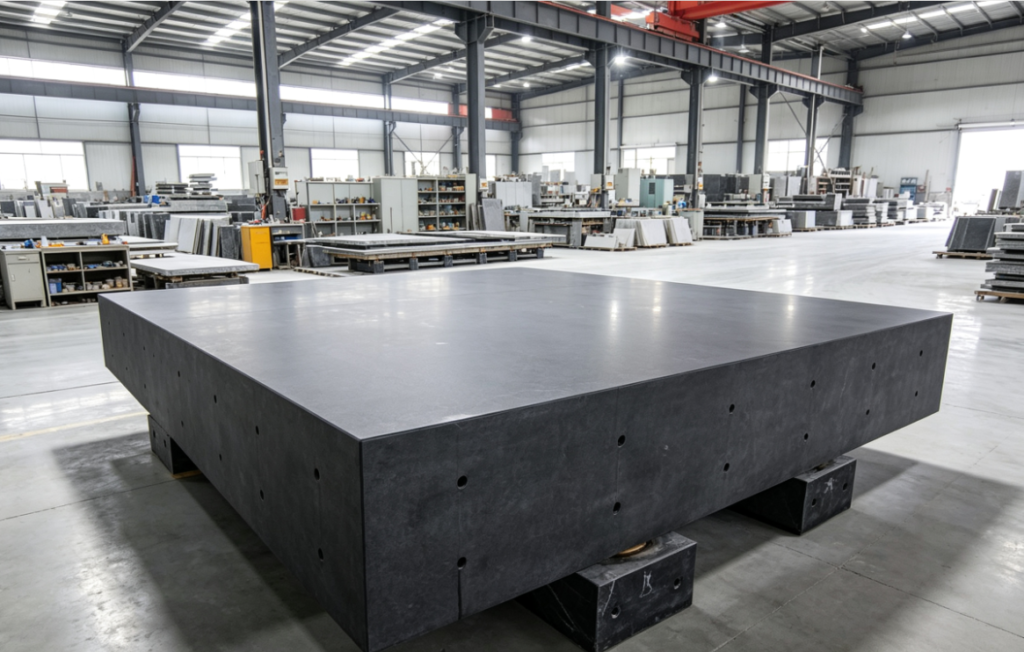
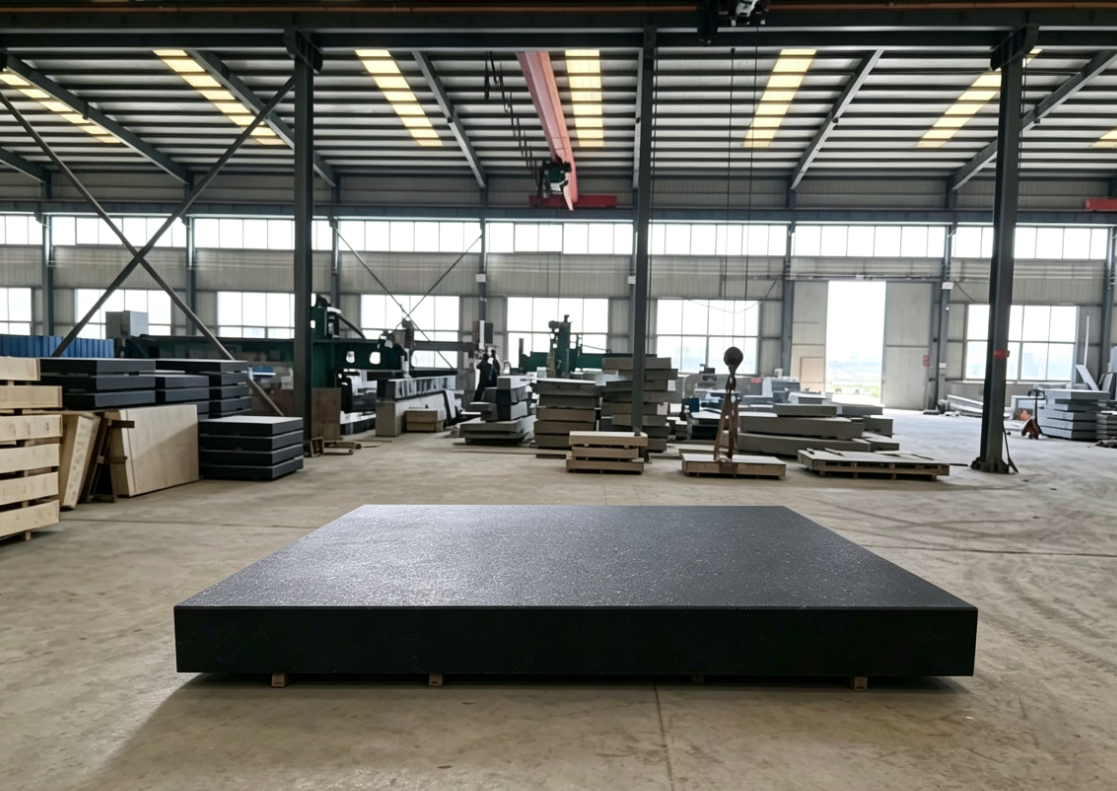
Ultra-large integrated granite bed frames (lithography machine gantry, 6-meter class inspection platforms) maintain a non-shifting reference surface under long-term load-bearing and day-night temperature cycles.
IV. Completely non-magnetic and non-conductive, avoiding electromagnetic interference (a core requirement for semiconductors)
Steel and cast iron are ferromagnetic materials that will interfere with electron beams, laser gratings, Hall sensors, and high-precision displacement reading heads, causing measurement errors and circuit noise;
Granite is non-metallic, non-magnetic, and non-conductive. It can isolate EMI (electromagnetic interference) generated by internal equipment motors and RF power supplies, protecting the weak signals of lithography optical systems and wafer probes. It is a mandatory requirement for EUV and electron beam inspection equipment;
It is compatible with magnetic levitation and air-bearing non-magnetic motion platforms, without generating additional magnetic field contamination for the wafers.
V. Ultra-high hardness, wear-resistant, and corrosion-resistant, suitable for the clean environment of dust-free workshops
Mohs hardness 6-7, higher than steel; long-term friction from slides, base plates, and fixtures will not cause indentations, and the reference plane permanently maintains micron/sub-micron flatness;
Water absorption <0.1%, acid and alkali resistant, rust-proof, and oxidation-proof; photoresist, cleaning agents, and pure water sprays in wafer cleanrooms will not corrode the surface;
The surface can be ground to a mirror finish with Ra <0.005μm, pore-free and resistant to dust accumulation, suitable for Class 100/10 cleanrooms, easy to clean and maintain, and will not generate metal dust pollution for chips.
VI. High rigidity, capable of integrated precision machining, suitable for ultra-precision module integration
High elastic modulus; under the same weight, its bending and deformation resistance far exceed cast iron, with minimal deflection under heavy loads;
Can be integrally milled and ground with threaded holes, vacuum suction slots, air bearing guide installation references, and optical reference slots; the entire equipment shares the same reference, ensuring unified flatness, perpendicularity, and parallelism;
Capable of stably processing Grade 000 ultra-high precision platforms (1-meter flatness ≤0.8μm), serving as the standard bearing base for CMMs, 2.5D optical inspection instruments, probe stations, lithography machines, and laser repair equipment.
Typical semiconductor application scenarios
Lithography equipment: Granite gantry base for EUV/ArF lithography machines;
Metrology equipment: Wafer profilers, optical defect inspection machines, Atomic Force Microscope (AFM) platforms;
Packaging equipment: Precision motion bases for probe stations, die bonders, and wire bonders;
Quality inspection laboratories: Grade 00/000 granite reference platforms (the same material system as the Dasqua granite platform you purchased).
Comparison Summary (Why not use metal)
الجدول
Performance Granite Cast Iron / Steel Semiconductor Impact
Thermal expansion Extremely low High Temperature changes cause nanometer-scale errors, reducing yield
Vibration damping Excellent Poor, prone to resonance Vibration causes exposure pattern shifts
Long-term deformation Almost no creep Deforms annually Equipment accuracy scrapped after 2-3 years
Magnetism Non-magnetic Ferromagnetic Interferes with sensors and electron beam optical paths
Wear and corrosion resistance Excellent Easy to scratch and rust Reference surface damage, dust pollution of wafers