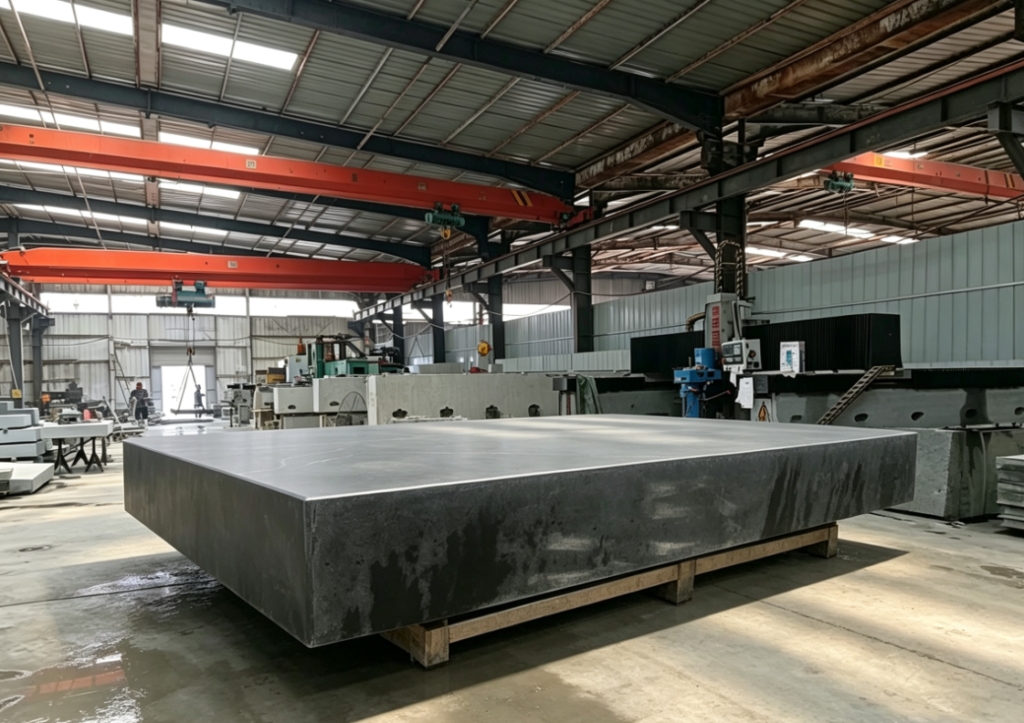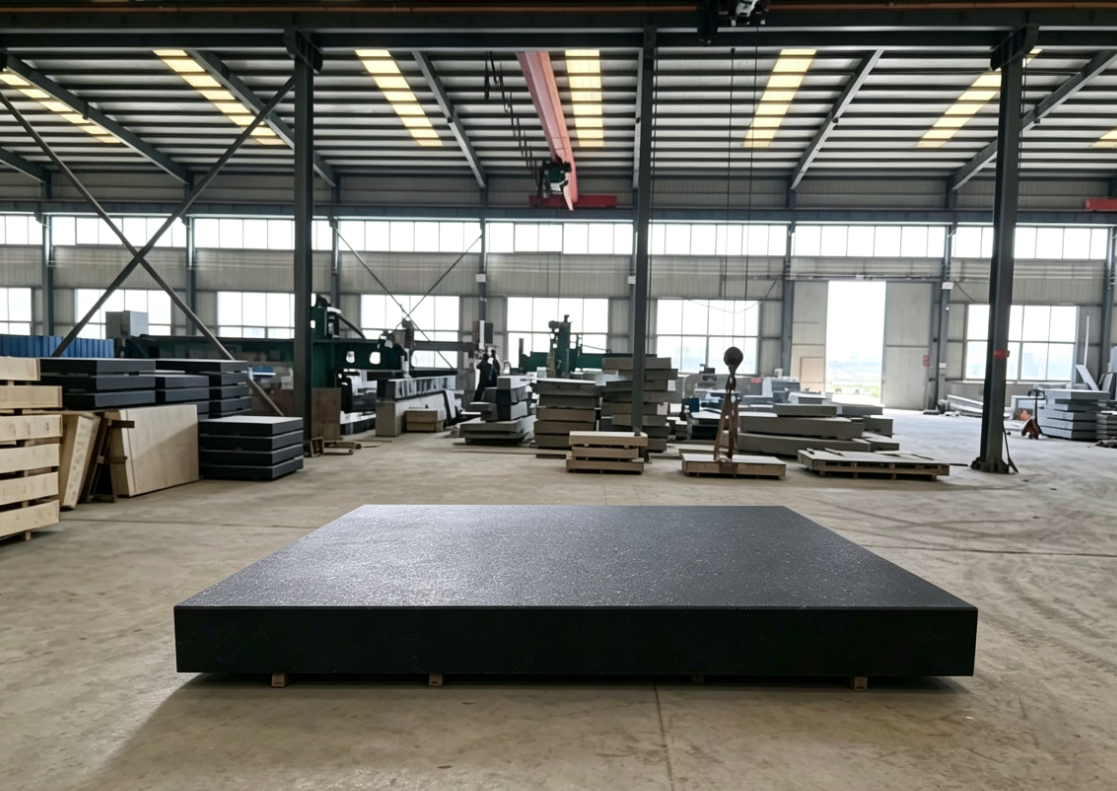
High-Precision Machine Tool Granite Structural Components (Bed, Base, Crossbeam, Worktable)
Natural granite (mainly Jinan Green) is the core foundational structural component for ultra-precision machine tools, air-bearing machine tools, CMMs, diamond lathes, and semiconductor testing equipment. Relying on extremely low thermal expansion, high damping vibration reduction, zero internal stress, non-magnetic, and rust-free properties, it achieves long-term micron-to-sub-micron level precision maintenance.
I. Core Material Physical Properties (Jinan Green)
Table
| Item | Parameter | Comparison with Cast Iron |
|---|---|---|
| Specific Gravity | 2.97-3.07 t/m³ | Cast Iron 7.2 t/m³ |
| Compressive Strength | 245-254 MPa | Slightly lower than cast iron |
| Elastic Modulus | 127 GPa | Close to gray cast iron |
| Coefficient of Linear Expansion | 4.6-6.3×10⁻⁶/℃ | About 1/2 of cast iron |
| Water Absorption Rate | ≤0.01% | Almost impermeable |
| Shore Hardness | HS89-100 | About 3 times cast iron |
| Damping Loss Coefficient | 0.5-0.6 | 3-10 times cast iron, high-frequency vibration decays rapidly |
✅ Advantages:
- Excellent Vibration Reduction: Suppresses vibration marks during high-speed cutting, improves workpiece surface finish, and protects linear motors, grating scales, and tool life;
- Small Thermal Deformation and Isotropic: Temperature changes do not cause distortion, making thermal compensation simple and effective;
- Natural Geological Aging over Hundreds of Millions of Years: The raw material has almost zero original internal stress;
- Non-magnetic, Corrosion-resistant to Cutting Fluids, and Rust-free: No anti-rust coating required;
- Impact Damage Only Causes Local Chipping: No metal burrs are generated, and no plastic deformation occurs; local areas can be repaired and reground to restore precision.
⚠️ Disadvantages:
High brittleness, poor impact and shear resistance; cannot be tapped directly, must use embedded stainless steel thread inserts; high procurement cost for large single-piece components; large-span crossbeams are limited by bending strength; vulnerable to severe impacts.
II. Common Structural Component Types and Application Scenarios
- Machine Tool Bed / Base: Vertical ultra-precision grinders, high-speed precision milling machines, diamond lathes, semiconductor equipment, CMMs; supports guide rails, linear motors, grating scales, and spindle units.
- Granite Crossbeam: Gantry precision machine tools, gantry CMMs; focus on controlling bending deformation, cross-sections must be thickened, and single-piece stone should be used as much as possible to reduce bonding and splicing.
- Moving Worktable: Air-bearing moving table, serves directly as the moving reference surface, 00/000 grade precision.
- Column, Z-axis Base: Small-scale ultra-precision equipment, ensuring verticality reference.
Note: Heavy-duty, heavy-cutting (large depth of cut, high torque) machine tools are generally not suitable for all-granite beds; they are better suited for high-speed light cutting, mirror machining, and inspection equipment.
III. Complete Process Flow
Material selection and acceptance → Raw block cutting → Rough machining (milling profile, reserving hole positions, weight-reduction cavities) → Aging treatment (critical) → Rough grinding → Drilling / Counterboring → Embedding stainless steel threaded inserts → Glue curing for over 72h → Semi-precision grinding → Precision grinding in constant temperature workshop / Manual fitting and polishing → Geometric accuracy inspection (flatness, perpendicularity, parallelism) → Finished product constant temperature static aging → Factory inspection report (flatness, geometric tolerances) → Export packaging (fumigated wooden crates).
Two Aging Methods
- Natural aging: Exposed outdoors for 6-12 months after rough machining to release machining stresses; high cost and long cycle;
- Artificial hot-cold cycle aging: Cycling between -20°C and 80°C to shorten the cycle; both methods are used in combination for high-end orders.
IV. Key Process Precautions (Production & Drawing Stage)
1. Material Selection
- Must be free of cracks, inclusions, obvious quartz veins, and loose pores; high quartz content results in high hardness but is prone to edge chipping;
- Semiconductor equipment requires low-iron stone to avoid magnetic and particulate contamination;
- Ordinary construction granite is prohibited; its mineral grains are coarse and stresses are unstable, failing to meet machine-tool grade requirements.
2. Embedded Threaded Inserts (Most Prone to Issues)
- Sequence: Drill and embed after rough grinding, then perform precision grinding after curing is complete; strictly forbidden to drill and embed after precision grinding, as it will damage the reference surface accuracy;
- Sleeves: 304/316 stainless steel, wall thickness ≥2mm; thin iron sheets and brass sleeves are prohibited;
- Hole edge distance ≥50mm, hole-to-hole spacing ≥100mm to prevent stone cracking;
- The top surface of the sleeve must be 0.3-1mm lower than the stone working surface; it must absolutely not protrude and lift the guide rail;
- Epoxy glue must be fully filled without air bubbles, pressed in vertically for positioning; cure at room temperature for ≥72h to eliminate glue shrinkage stress;
- After curing, check the position accuracy of the threaded hole within ±0.1mm, and control the sleeve height difference at the micron level.
3. Grinding and Accuracy
- Precision grinding must be completed in a 20±1°C constant temperature workshop;
- Accuracy grades: Grade 0, Grade 00, Grade 000; Grade 000 is mostly used for metrology and semiconductors; Grade 00 is the mainstream for machine tools;
- Flatness follows GB/T 22362 and DIN876 standards; flatness increases with diagonal length;
- The installation band of the reference guide rail must be ground to the same height, without local high or low spots.
4. Structural Design Key Points
- Wall thickness cannot be too thin; the base plate thickness is recommended to be ≥80-120mm; weight-reduction cavities must not be excavated too close to the edges;
- All hole openings must be chamfered to prevent edge chipping during handling and assembly;
- For large-span beams, the bending deflection of the granite must be checked; if deflection exceeds the standard, either thicken the cross-section or switch to a granite-steel composite structure;
- Joint bonding: Prioritize single-piece materials; if joints are necessary, use back-bonding (bonding on the back, keeping the working surface as a single piece), fully grind the bonding surface, and use specialized granite structural adhesive; joints pose long-term stability risks and should be avoided for high-end equipment.
5. Assembly and Installation Key Points
- A 3-5mm rubber/silicone buffer pad must be placed between the granite and the metal frame; direct steel-to-stone contact is prohibited to avoid electrochemical corrosion and localized stress cracking of the stone;
- Fastening bolts must not be rigidly locked tight; use flexible clamping positioning pins for alignment;
- Support should prioritize three-point positioning, with other auxiliary supports; use matching vibration-damping feet, and high-precision applications can be equipped with air spring isolators;
- Lifting must not involve direct steel wire rope contact with the edges and corners; use soft pads for protection to prevent edge chipping and cracks.
6. Use and Maintenance
- Resistant to cutting fluids, but avoid long-term soaking in strong alkaline solutions;
- Do not strike with a sledgehammer; for minor local chipping, use specialized stone repair adhesive followed by re-polishing;
- Do not arbitrarily drill or tap holes on the finished surface.
V. Simple Comparison with Cast Iron and Mineral Castings (Artificial Granite)
- Natural Granite: Excellent vibration damping, good thermal stability, highest long-term accuracy; brittle, threads must be embedded, limited for large raw blocks; suitable for ultra-precision inspection and air-bearing machine tools.
- Gray Cast Iron: Good toughness, can be tapped, strong load-bearing capacity for heavy cutting; low damping, prone to vibration marks, contains casting stresses, prone to rusting; mainstream for traditional general-purpose machine tools.
- Mineral Casting (Artificial Epoxy Granite): Better vibration damping than natural granite, can cast complex internal cavities; subject to polymer creep, long-term accuracy slightly inferior to natural granite, suitable for some high-speed CNC machine tools.