Full Solution for Granite Semiconductor Lithography Machine Base
I. Solution Overview
This solution is designed for EUV extreme ultraviolet lithography machines, ArF immersion lithography machines, and KrF lithography equipment. It utilizes a semiconductor-grade 000-level high-density diabase (Jinan Green / Indian Black) integrated granite base, paired with precision structural design, multi-stage aging processes, active vibration isolation, and an integrated constant temperature system. It addresses four core pain points of advanced 3nm/2nm process nodes: sub-nanometer overlay accuracy, long-term thermal drift, workshop micro-vibrations, and cleanroom compatibility. It serves as the unique stable reference carrier for the lithography machine’s optical system, wafer stage, and interferometry module.
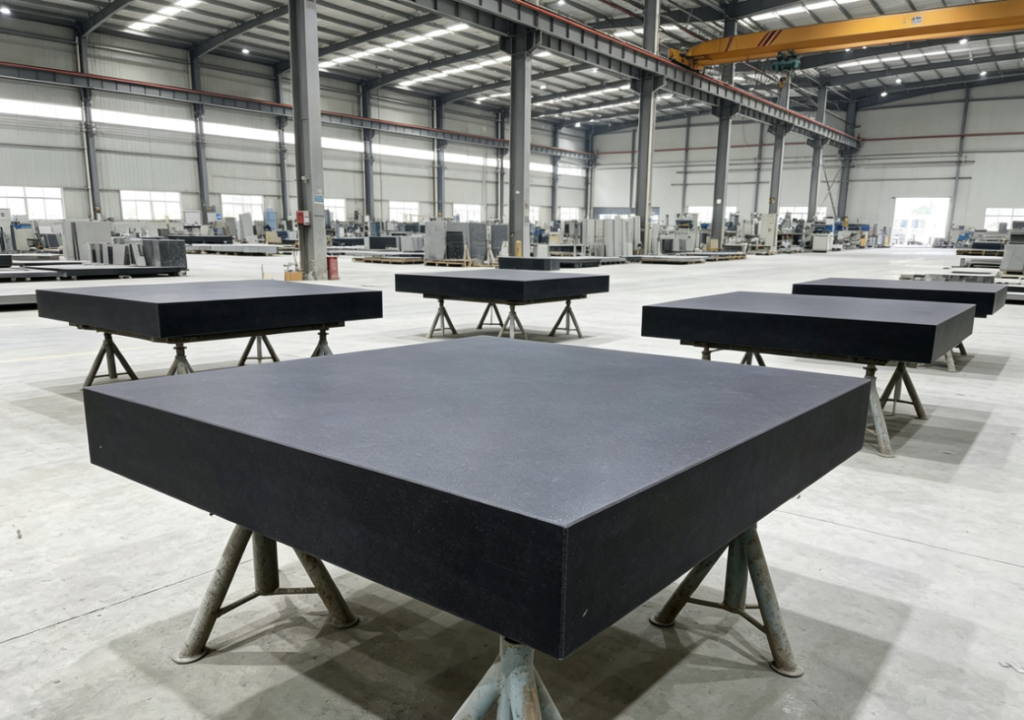
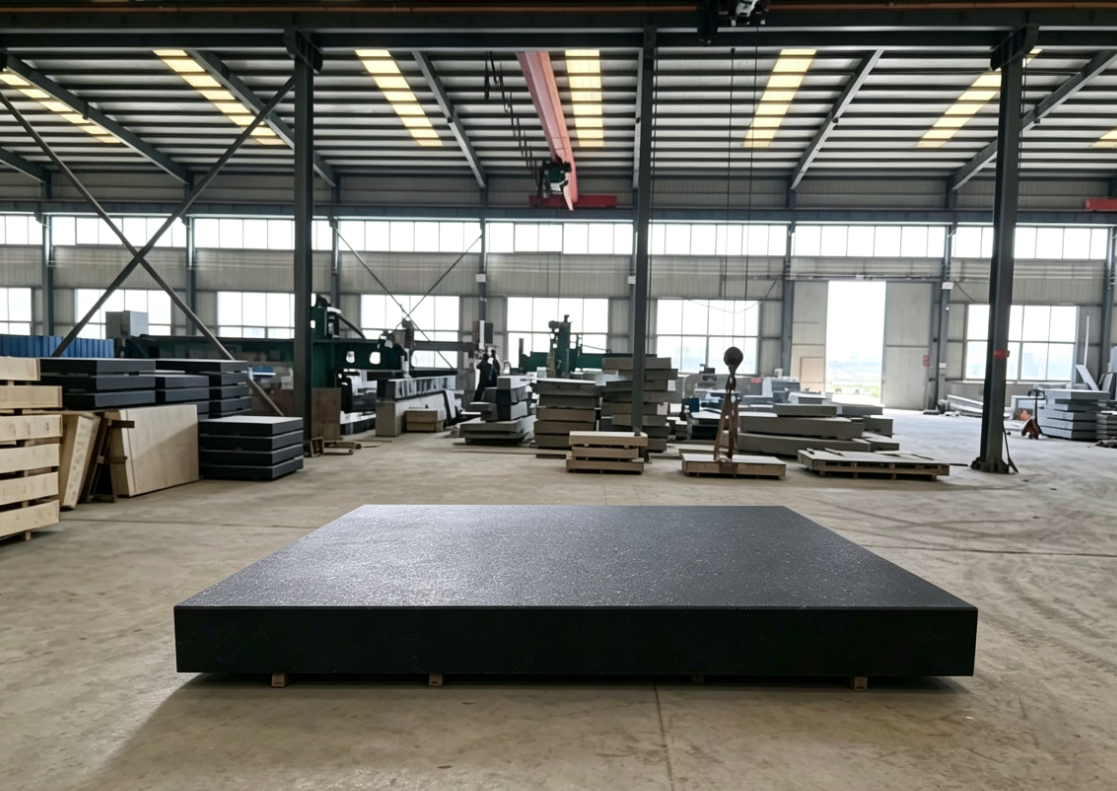
Integrated Granite Base for Lithography Machines
II. Core Material Selection and Key Performance (Lithography-Specific Indicators)
- Substrate: High-purity black diabase (semiconductor-grade granite)
Table
Core Parameter Technical Indicator Value for Lithography Machines
Coefficient of Thermal Expansion (CTE) 2.5~3.8×10⁻⁶/℃ Only 1/3 of cast iron, 1/6 of aluminum alloy; deformation <0.4μm for a 1m base with a 1℃ temperature difference, eliminating thermal overlay offset
Density ≥3100kg/m³ High density and high damping, rapidly absorbing 1~100Hz workshop micro-vibrations, vibration transmission rate < -20dB
Precision Grade DIN876 000 level (semiconductor exclusive) 1m flatness ≤1.5μm, verticality/parallelism ≤0.0015mm/m
Mohs Hardness 6.5~7 Higher than steel, no indentations from long-term friction with air-float guide rails, reference accuracy stable for ten years
Water Absorption Rate <0.1%, vacuum impregnation sealing Non-absorbent, no dust precipitation, compatible with Class 1/10 cleanrooms, resistant to lithography acid/alkali cleaning solutions
Magnetism Completely non-magnetic, insulating Does not interfere with electron beams, laser gratings, or displacement sensors; no EMI electromagnetic error
Long-term Creep Geological natural aging of hundreds of millions of years, annual deformation <0.3μm Equipment can run continuously 24h for 10 years without re-calibrating the reference - Irreplaceability Compared to Metal Materials
Cast Iron: High thermal expansion, easy to magnetize, creep deformation in 2~3 years, only suitable for ordinary machining, prohibited for EUV use;
Aluminum Alloy: Extremely high expansion coefficient, tiny temperature changes cause 200nm deformation, unable to meet nano-lithography requirements;
Steel: Significant resonance, prone to rusting and generating metal dust, contaminating the wafer’s optical path.
III. Complete Manufacturing Process (Exclusive to Lithography Machine Bases, Lead Time > 6 Months)
Raw Material Screening
Ultrasonic non-destructive testing to reject raw stones with cracks or uneven quartz distribution; select only low-anisotropy high-purity mineral materials, controlling the three-axis thermal expansion difference to ≤0.3×10⁻⁶/℃.
Multi-stage Composite Aging (Core Process)
3-month natural resting to release geological stress;
20 cycles of thermal aging with temperature cycling from -5℃ to 40℃;
Low-frequency vibration aging to eliminate machining residual stress;
Mitigate risks of thermal stress cracking and datum drift during long-term equipment operation.
Integrated CNC Machining
Milling and grinding of guide rail mounting slots, vacuum suction channels, water-cooling embedded channels, and M8/M12 precision threaded mounting holes in a single process; hole position accuracy ±0.008mm, using a single datum for the entire machine to eliminate cumulative geometric errors.
Multi-stage Precision Grinding Manual Super-finishing
Rough grinding → Semi-precision grinding → Precision grinding → Manual mirror polishing, surface roughness Ra≤0.008μm; 000-grade flatness control, local flatness error of large-area gantry bases <0.5μm/㎡.
Vacuum Sealing and Clean Treatment
Vacuum impregnation with epoxy resin to seal stone micropores, preventing dirt accumulation and moisture adsorption, meeting cleanroom low-particle emission standards.
CMM Full-item Inspection Original English Measurement Certificate
Issuance of a complete set of inspection reports for flatness, perpendicularity, parallelism, thermal expansion, and vibration damping, matching the entry standards of overseas semiconductor equipment manufacturers.
IV. Integrated Structural Design Solutions (Three Categories of Lithography Machine Bases)
Solution 1: EUV Lithography Machine Full-Machine Gantry Granite Base (Ultra-Large Integrated)
Dimensions: 4000×2200×350mm monolithic cast granite gantry;
Built-in: Distributed microfluidic cooling channels to dissipate heat from light sources and linear motors;
Functions: Supports exposure optical modules, wafer XY air-bearing stage, and interferometry system;
Precision Requirements: Z-axis drift ≤±0.3nm during 72h continuous operation, overlay accuracy stability <1.5nm.
Solution 2: ArF/KrF Dry/Immersion Lithography Platform (Medium-Sized Split Base)
Modular split granite structure, dual independent reference for optical bench wafer stage;
Bottom reserved for active isolator installation, side reserved for temperature sensor embedding slots;
Compatible with 200/300mm wafer production lines, flatness Class 000, load deflection <2μm.
Solution 3: Lithography Auxiliary Small-Scale Metrology Reference Platform (300×200×60mm, extension of your company’s current models)
Specifications: 300×200×60mm Class 000 semiconductor calibration platform;
Applications: Lithography lens calibration, wafer flatness spot checks, displacement sensor calibration;
Accessories: M6/M8 standard threaded holes, original factory inspection certificate, compatible with cleanroom brackets.
V. Thermal Stability System Supporting Solutions (Core Solution for Temperature-Induced Drift)
Substrate Low Thermal Expansion Foundation Guarantee
Selection of specialized syenite with CTE ≤3.8×10⁻⁶/℃ to compress the upper limit of thermal deformation from the material level.
Built-in Water-Cooled Constant Temperature Circuit in Base
Integrated cooling channels embedded in the large gantry base, externally connected to a ±0.01℃ precision chiller to dissipate equipment heat in real-time and suppress local temperature gradients.
Cleanroom Environment Collaborative Temperature Control
Matching the 20±0.01℃ constant temperature standard of lithography workshops, utilizing the high thermal inertia of granite to buffer instantaneous temperature fluctuations.
Distributed Multi-point Temperature Measurement Compensation
High-precision thermistor probes embedded in the base to collect real-time temperature fields, allowing equipment software to dynamically compensate for residual nanometer-scale thermal drift.
VI. Integrated Vibration Damping and Isolation System (Mandatory Vibration Control Requirements for Lithography Machines)
Lithography machines allow base vibration velocity ≤10μm/s, granite base multi-stage isolation combination solution:
First-stage Damping: High-damping granite matrix itself
High-density stone rapidly attenuates 10~1000Hz high-frequency airflow and motor vibrations.
Second-stage Passive Isolation: High-damping air springs
Precision air-bearing isolation mounts at the base bottom to isolate ground pulsations and low-frequency vibrations from vacuum pumps.
Third-stage Active Vibration Control (AVC) Module
High-end EUV solutions equipped with acceleration feedback active vibration damping, reducing vibration transmissibility in the 1~50Hz frequency band to below -25dB, offsetting continuous disturbances from foot traffic and fans.
VII. Cleanroom Compatibility Solutions (Mandatory Requirements for Semiconductor Production Lines)
Mirror-polished surface vacuum-sealed holes, no micro-pores for dust accumulation, particle generation meets Class 1 cleanroom standards;
Entirely iron-free components, all stainless steel / titanium alloy fasteners, preventing iron rust dust from contaminating wafers;
Surface resistant to HF, photoresist stripper, and pure water spray corrosion, no discoloration or powdering over long-term use;
Compatible with anti-static coatings, suitable for electrostatic-sensitive lithography optical components.
VIII. Delivery and Supporting Services
Delivery Documents: Original factory Class 000 precision inspection report, thermal expansion coefficient test certificate, vibration damping test report, English material data sheet;
Packaging: Fumigated solid wood anti-shock crate, fully wrapped in internal foam, suitable for ocean FOB export;
Warranty: 5-year precision warranty for the granite body, lifetime guarantee for temporal stability;
Customization Services: Integrated customization of dimensions, openings, water-cooling channels, threaded holes, anti-static coating, and active vibration isolation mounts.
IX. Summary of Core Solution Values
Extreme Thermal Stability: Low thermal expansion integrated water cooling, solving nanometer-scale thermal drift in advanced processes and improving chip yield;
Ultra-Stable Vibration Isolation Base: High-damping granite active vibration isolation, isolating all-frequency workshop micro-vibrations to ensure exposure pattern alignment precision;
Permanent Dimensional Stability: Natural aging of hundreds of millions of years, no creep deformation, significantly reducing annual equipment calibration and maintenance costs;
Dust-free and Magnetic-compatible: Suitable for lithography cleanrooms, no electromagnetic interference, protecting optical and wafer precision modules;
Integrated Assembly: One-time molding of guide rails, water cooling, and installation base, reducing cumulative errors from multi-component assembly.