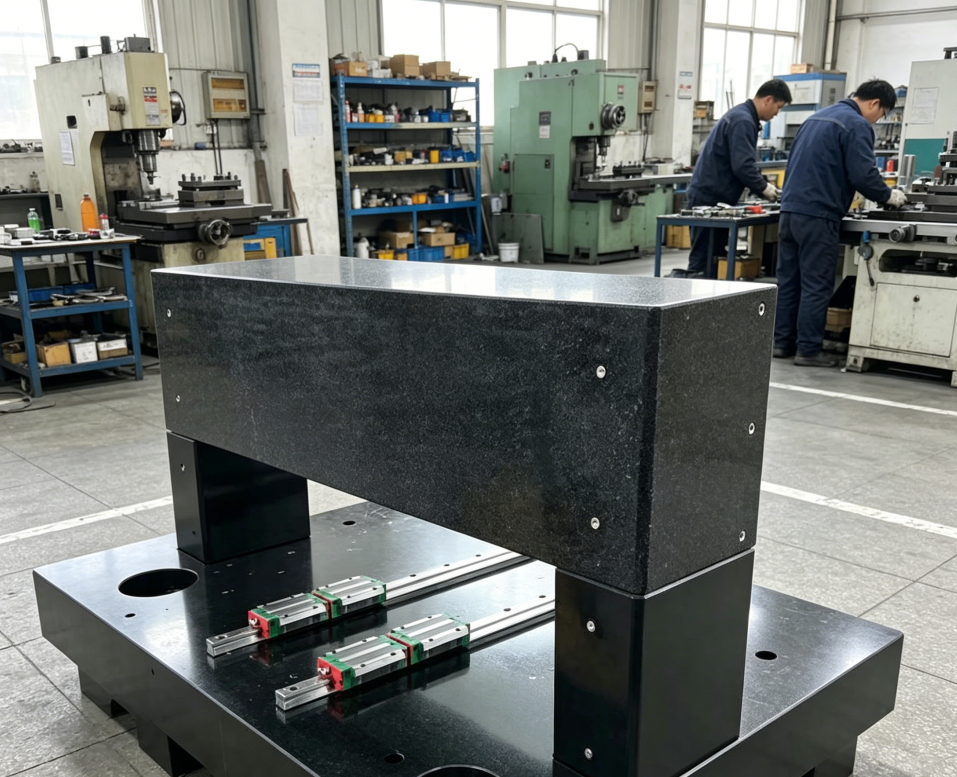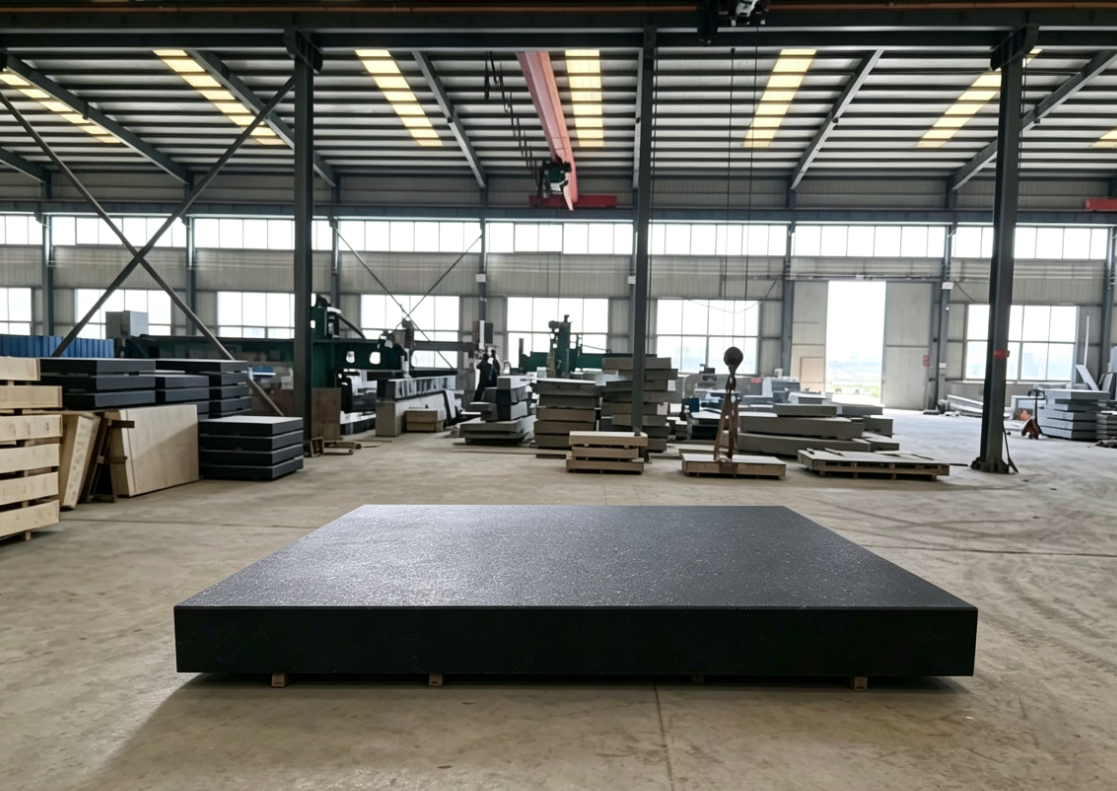
The core of machining precision granite components lies in an ultra-precision control process spanning “from raw material screening to closed-loop precision,” requiring strict control over parameters, equipment, and environment at every stage to ultimately achieve micron and even sub-micron level accuracy. The following are 8 core processes, each supplemented with industry standard data, equipment parameters, and precision requirements to ensure detailed descriptions and accurate data, meeting the production needs of precision components (such as CMM bases, roundness instrument tables, and precision inspection platforms).
I. Raw Material Selection (Basic Process, Determines Component Stability Ceiling)
Core Objective: Screen for defect-free, structurally uniform granite raw materials with minimal internal stress to avoid deformation or precision failure during subsequent processing; this is a prerequisite for precision machining.
- Raw Material Requirements: Select high-quality granite with dense structure, uniform grain size (0.1-0.3mm), no cracks, no pinholes, and no impurities. Prioritize Jinan Qing (Gabbro) and Indian Black Gabbro, followed by Zhangqiu Black Granite. Density must reach 2.9-3.3g/cm³ (Jinan Qing: 3.07-3.3g/cm³, Indian Stone: 2.9-3.0g/cm³); water absorption rate ≤0.1%; Shore hardness ≥80HSD; linear expansion coefficient ≤4.5×10⁻⁶/℃.
- Screening Equipment: Use ultrasonic flaw detectors (detection accuracy 0.1mm, capable of identifying internal micro-cracks), density testers (error ±0.01g/cm³), and stress detectors to conduct comprehensive testing on the raw blocks.
- Processing Requirements: Screened raw blocks must undergo natural aging treatment with an aging cycle ≥6 months (≥12 months for large component raw blocks) to eliminate natural internal stress. Post-aging internal stress value ≤2MPa to avoid deformation after subsequent processing.
II. Cutting and Material Preparation (Rough Machining, Controlling Allowance Precision)
Core Objective: Cut qualified raw blocks into blanks approaching finished dimensions, reserving reasonable machining allowances to reduce subsequent grinding workload while avoiding crack generation during cutting.
- Equipment Parameters: Use CNC diamond circular saws with blade diameter Φ800-Φ1200mm, diamond grit size 80-120 mesh, cutting speed 2-5m/min, and spindle speed 1200-1800r/min.
- Cutting Precision: Post-cutting blank dimensional deviation ≤±0.5mm, flatness ≤3mm/m, perpendicularity ≤0.3mm/m, with no chipping or cracks (chipping size ≤0.2mm is considered acceptable).
- Allowance Control: Determine machining allowance based on component size. For small components (≤500mm×500mm), allowance is 8-10mm; for medium components (500mm×500mm-1000mm×1000mm), allowance is 10-15mm; for large components (>1000mm×1000mm), allowance is 15-20mm. Allowance uniformity deviation ≤0.3mm.
III. Rough Grinding and Shaping (Semi-rough Machining, Preliminary Dimension Calibration)
Core Objective: Remove cutting marks from the blank surface, preliminarily calibrate the dimensions, flatness, and parallelism of the component, lay the foundation for subsequent semi-precision and precision grinding, and further eliminate machining stresses.
- Equipment Parameters: CNC granite-specific grinding machine, using diamond grinding discs (grit size 46-80 mesh), grinding head speed 1500-2200 r/min, feed rate 5-10 mm/min, grinding pressure 0.3-0.5 MPa.
- Machining Accuracy: After rough grinding, component flatness ≤0.5 mm/m, parallelism ≤0.6 mm/m, dimensional deviation ≤±0.1 mm, surface roughness Ra ≤1.6 μm, with no obvious grinding marks.
- Auxiliary Treatment: Stress relief is required after rough grinding, using vibration aging treatment (vibration frequency 20-50 Hz, vibration time 30-60 min) to eliminate internal stresses generated by rough grinding, with residual internal stress ≤1.5 MPa.
IV. Semi-Precision Grinding (Transition Process, Improving Surface Quality and Accuracy)
Core Objective: Eliminate grinding marks left by rough grinding, further improve the flatness, parallelism, and perpendicularity of the component, bring surface quality up to precision grinding requirements, and reduce the workload of precision grinding.
- Equipment Parameters: High-precision CNC grinding machine, diamond grinding disc grit size 120-200 mesh, grinding head speed 2200-3000 r/min, feed rate 2-5 mm/min, grinding pressure 0.1-0.3 MPa, using water cooling (water temperature controlled at 20±2°C to avoid stress caused by overheating during grinding).
- Machining Accuracy: After semi-precision grinding, flatness ≤0.1 mm/m, parallelism ≤0.15 mm/m, perpendicularity ≤0.12 mm/m, dimensional deviation ≤±0.05 mm, surface roughness Ra ≤0.8 μm, with no scratches or chipping on the surface.
- Quality Inspection: Use a level (accuracy 0.02 mm/m) and dial indicator (accuracy 0.001 mm) to inspect flatness and parallelism; non-conforming areas must be re-ground until they meet the standards.
V. Precision Grinding (Core Process, Achieving Micron-Level Precision)
Core Objective: Through high-precision grinding, ensure that the dimensions, flatness, parallelism, and perpendicularity of the component meet design requirements, with precision stabilized at the micron level. This is the key process determining the final precision of the component.
- Equipment Parameters: Ultra-precision CNC grinding machine (positioning accuracy ±0.001mm), diamond grinding wheel grit size 300-500 mesh, grinding head speed 3000-4000 r/min, feed rate 0.5-2 mm/min, grinding pressure 0.05-0.1 MPa, using a constant temperature grinding environment (ambient temperature 20±1℃, humidity ≤60%).
- Processing Precision: Based on the component’s precision grade, post-grinding precision is divided into 3 levels:
- Grade 000 (Highest): Flatness ≤0.5μm/m, parallelism ≤0.6μm/m, perpendicularity ≤0.6μm/m, dimensional deviation ≤±1μm, surface roughness Ra ≤0.2μm;
- Grade 00 (High-end): Flatness ≤1μm/m, parallelism ≤1.2μm/m, perpendicularity ≤1.2μm/m, dimensional deviation ≤±2μm, surface roughness Ra ≤0.4μm;
- Grade 0 (Mid-range): Flatness ≤2μm/m, parallelism ≤2.4μm/m, perpendicularity ≤2.4μm/m, dimensional deviation ≤±3μm, surface roughness Ra ≤0.8μm.
- Precautions: During precision grinding, grinding temperature must be monitored in real-time to avoid deformation caused by excessive heat. Stop for 5 minutes of cooling after every 10 minutes of grinding to ensure stable grinding precision.
VI. Super Precision Lapping (Polishing, Enhancing Surface Finish)
Core Objective: Eliminate fine grinding marks left by precision grinding to achieve mirror-like surface finish, while further improving precision stability to meet the requirements of high-precision inspection and positioning scenarios (such as optical instrument bases, CMM tables).
- Equipment Parameters: Ultra-precision lapping machine, using diamond micro-powder lapping agent (grit size 800-1200 mesh), lapping plate speed 1000-1500 r/min, lapping pressure 0.02-0.05 MPa, lapping time 30-60 min per surface, constant temperature environment (20±1℃).
- Processing Precision: After polishing, surface roughness Ra ≤0.05μm (mirror level), flatness can be improved to 0.3-0.5μm/m (Grade 000 components), with no scratches or pits on the surface, and glossiness ≥85° (mirror gloss).
- Lapping Agent Requirements: Use water-soluble diamond micro-powder lapping agent, concentration 5%-8%, particle uniformity deviation ≤5%, to avoid impurities affecting surface finish.
VII. Precision Slotting/Drilling/Custom Machining (Customized Processes, Adapted to Actual Usage)
Core Objective: Perform customized machining based on the actual application scenarios of the machine parts (such as T-slots, threaded holes, locating holes, guide surfaces, etc.) to ensure the parts fit installation and positioning requirements, maintaining machining precision consistent with the main body precision.
- Equipment Parameters: CNC Gantry Milling Machine, Precision Drill Press; Spindle positioning accuracy ±0.001mm; Drilling speed 2000-3000 r/min; Slotting feed rate 0.1-0.5 mm/min; Diamond tools used.
- Machining Precision:
- Drilling: Hole diameter deviation ≤±0.01mm; Hole perpendicularity ≤0.005mm/m; Hole spacing deviation ≤±0.01mm;
- Slotting: Slot width deviation ≤±0.01mm; Slot depth deviation ≤±0.01mm; Slot parallelism ≤0.005mm/m; Slot surface roughness Ra ≤0.1μm;
- Custom Machining: Contour dimension deviation ≤±0.02mm; Contour ≤0.01mm; Surface free of chipping and burrs (burr size ≤0.01mm).
- Processing Requirements: After custom machining, the machined area requires secondary polishing to remove burrs and machining marks, ensuring surface roughness is consistent with the main body, while performing local stress relief (vibration aging 15-30min).
VIII. Precision Inspection and Aging Treatment (Closed-loop Process, Ensuring Long-term Stability)
Core Objective: Comprehensive inspection of all precision indicators of the machine parts, elimination of residual stresses from final machining, ensuring the parts do not deform and precision does not degrade during long-term use; this is a critical step before finished products leave the factory.
- Precision Inspection:
- Flatness, Parallelism, Perpendicularity: Inspected using laser flatness meter (precision 0.001μm/m) and electronic level (precision 0.001mm/m);
- Dimensional Precision: Inspected using Coordinate Measuring Machine (CMM) (measurement precision ±0.001mm) and micrometer (precision 0.001mm);
- Surface Quality: Inspected using surface roughness tester (precision 0.001μm) and microscope (magnification 100x), ensuring no scratches or impurities;
- Internal Stress: Inspected using stress tester; Residual internal stress ≤1MPa, ensuring no deformation during long-term use.
- Final Aging Treatment: After passing inspection, final vibration aging treatment is performed (vibration frequency 30-60Hz, vibration time 60-90min) to completely eliminate internal stresses generated during machining; large machine parts require an additional natural aging period of 3-6 months to ensure long-term precision stability (annual deformation ≤0.1μm/m).
- Factory Standards: All precision indicators must comply with GB/T 20428-2006 “Granite Measuring Plate” standard; inspection reports must record parameters in detail; non-conforming products must be reworked until they meet the standards.