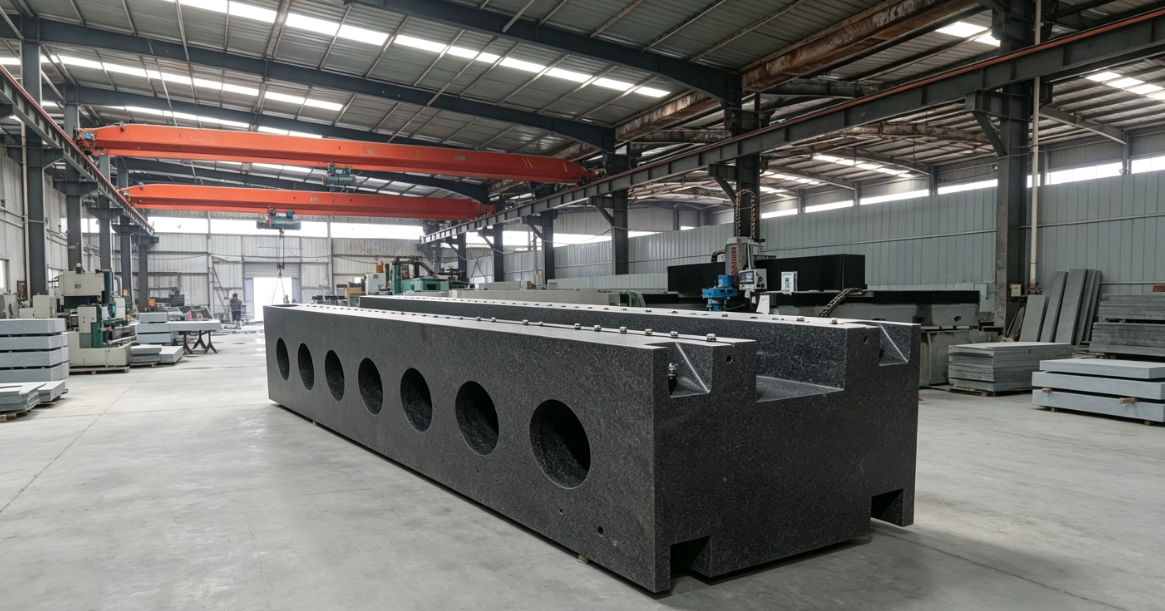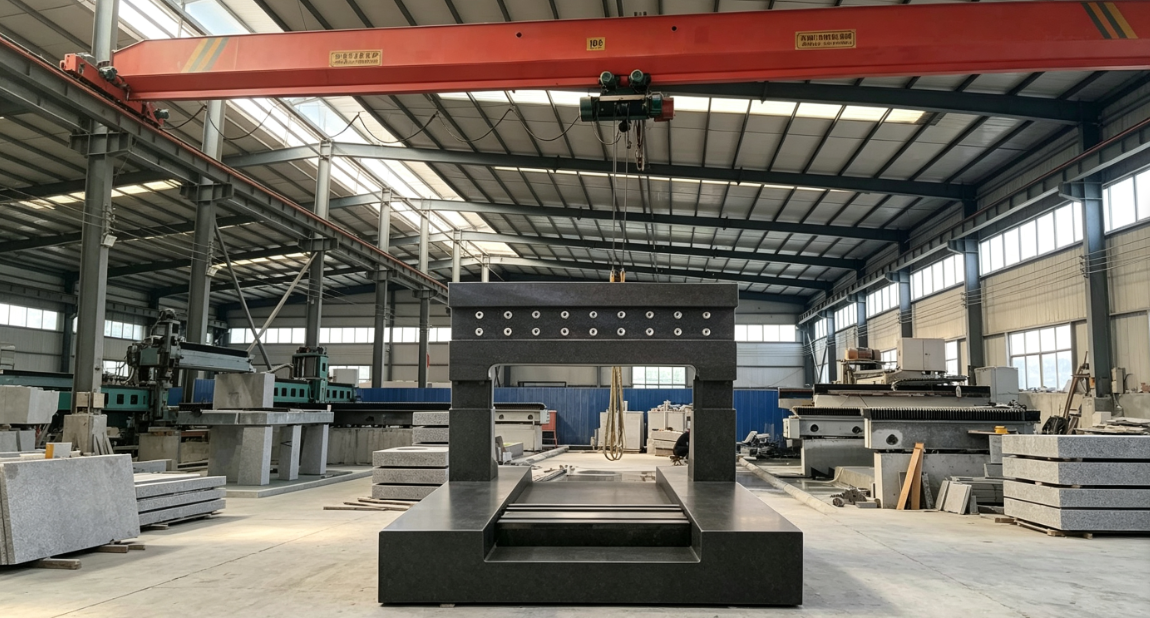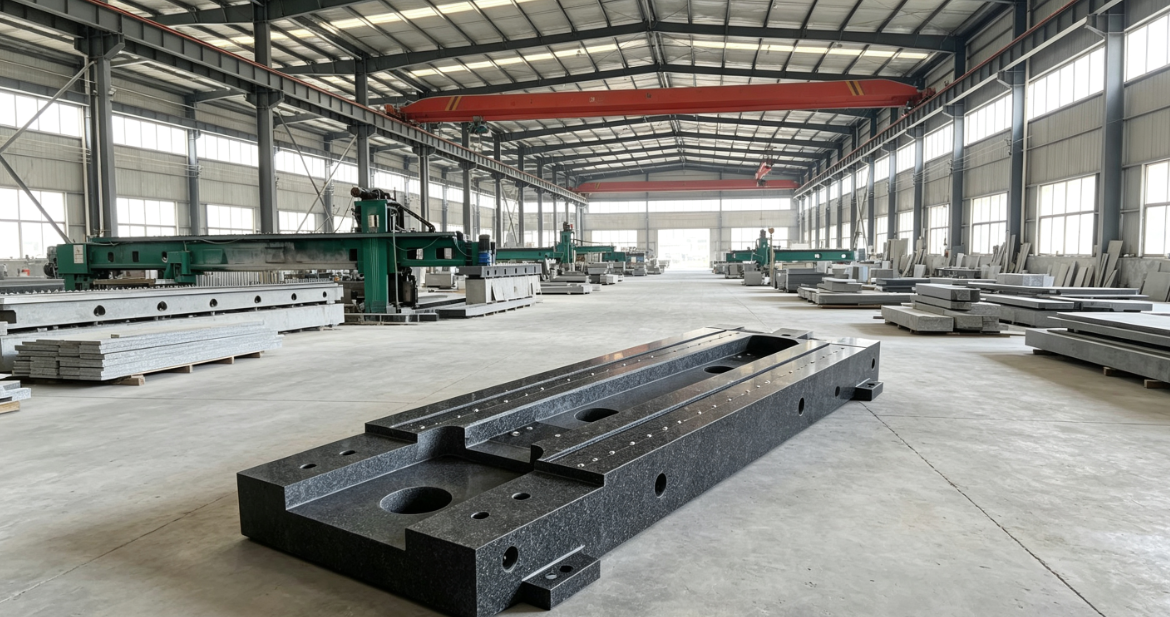
Specific Factors Affecting the Precision Variation of Granite Platforms
It is divided into six major categories: raw material factors, production process factors, structural design factors, installation and support factors, usage environment factors, and usage and operation damage, each with quantified impacts, suitable for technical documents and foreign trade bidding.
I. Raw Material Factors (Root Causes)
- Stone Type and Grain Structure
Fine-grained oligoclase (Jinan Green) has a dense and uniform grain structure, offering the best long-term dimensional stability; coarse-grained granite with obvious bedding and mica soft layers will undergo slow microscopic creep, causing the flatness to deteriorate year by year.
Impact: Drift of inferior mixed stone can reach 8-15μm/m over 1-2 years; drift of high-quality Jinan Green is <0.5μm/m.
- Physical Performance Indicators
- High water absorption: Repeated absorption and desorption cycles cause the stone to expand and contract, leading to continuous precision drift; requirement is ≤0.13%.
- Large coefficient of linear expansion: Environmental temperature fluctuations cause greater dimensional changes.
- Insufficient compressive strength: Under long-term loads, microscopic plastic deformation occurs, resulting in permanent depressions.
- Internal Native Defects
Internal dark cracks, pores, and loose areas. Loads and vibrations cause micro-cracks to expand slowly, gradually deteriorating precision; ultrasonic flaw detection can screen these in advance.
II. Production and Manufacturing Process Factors
- Whether Natural Aging of the Block is Sufficient
After the block is mined and cut, residual internal geological stresses are released; if processed directly without resting, the finished product will slowly deform later.
High-precision Grade 000 requires the block to rest for 3-6 months.
- Whether Residual Stress from Processing is Eliminated
Sawing, rough grinding, and fine grinding introduce grinding stresses. Without vibration aging and constant-temperature resting of the finished product, stresses will slowly release after leaving the factory, causing the tabletop to arch or sink.
- Grade 00: Constant-temperature aging ≥14 days
- Grade 000: Constant-temperature aging ≥28 days, 90 days for large sizes
- Grinding and Processing Quality
Unreasonable grinding processes lead to uneven stress distribution in the surface layer; even if it passes factory inspection, later stress release will change the flatness. - Sealing and Protection Treatment
Without penetration sealing with wax, water vapor and cutting fluids seep into the stone, causing local expansion and contraction.
III. Structural Design Factors
- Insufficient Slab Thickness (Most Common Low-Price Pitfall)
Insufficient thickness causes bending deflection due to self-weight; the larger the size, the higher the thickness requirement. Irreversible bending occurs under long-term self-weight. - Unreasonable Layout of Holes and Slots
T-slots and large weight-reduction holes too close to the edges or concentrated in the center destroy the stone’s rigidity, causing local deformation under load. - Threaded Sleeve and Embedded Structure Design
Directly tapping threads into the stone causes micro-cracking around the holes under load; stainless steel threaded sleeves must be embedded to disperse the stress.
IV. Installation and Support Methods (Many precision changes stem from installation, not the product itself)
- Incorrect Number and Position of Support Points
Granite platform standard: Three-point support, with support points set at 20% of the slab length from the edge.
- Two-point support, four-point rigid support, offset support positions, or local overhangs → The platform is forcibly twisted over the long term, producing permanent deformation.
- Insufficient Rigidity of the Support Frame
A soft frame that wobbles easily transmits continuous vibrations to the platform, which will exacerbate stress changes over time, while simultaneously affecting measurement accuracy.
- Excessive Forced Leveling
Over-tightening the leveling bolts applies mechanical forced twisting force to the platform. While it may pass short-term inspection, the stress is slowly released over the long term, causing the flatness to gradually drift.
Granite can only be leveled using “stress-release leveling”; the platform surface cannot be forcibly bent by bolts.
V. Environmental Factors
- Temperature Changes
- Uniform constant temperature change: Generates reversible thermal expansion and contraction; precision recovers once the temperature returns to normal;
- Temperature Gradient (top surface hot, bottom surface cold / one side exposed to sunlight): Inconsistent temperatures between top/bottom or sides cause the surface to bend; it can bounce back after the temperature recovers, but long-term repeated gradient thermal cycling will accelerate the expansion of micro-defects.
- Humidity and Liquid Corrosion
Long-term exposure to flowing or soaking cutting fluids, acids, bases, and water vapor seeps into the stone pores, causing local expansion and contraction; the problem worsens after ordinary sealing wax fails. - Vibration Effects
Continuous strong vibrations from nearby punching machines, air compressors, etc., will amplify the expansion of internal micro-cracks and accelerate precision deterioration. - Direct Sunlight and Proximity to Heat Sources
Local heating forms a temperature gradient, which is a factor easily overlooked in laboratories and workshops.
VI. Usage, External Forces, and Damage Factors
- Long-term Localized Concentrated Load
Single-point heavy pressure without a spreader plate to distribute the pressure exceeds the local compressive safety threshold, causing permanent local indentation. - Impact and Bumping
External impacts do not produce visible cracks to the naked eye, but internal micro-cracks are generated, which gradually expand over time and load, causing the flatness and perpendicularity to deteriorate step by step. - Incorrect Handling and Storage Methods
Long-term side-standing or inclined placement causes long-term bending stress due to self-weight; it must be placed flat. - Work Surface Wear and Scratches
Direct dragging of hard workpieces causes microscopic wear on the work surface; over years of accumulation, the accuracy of the reference plane decreases.