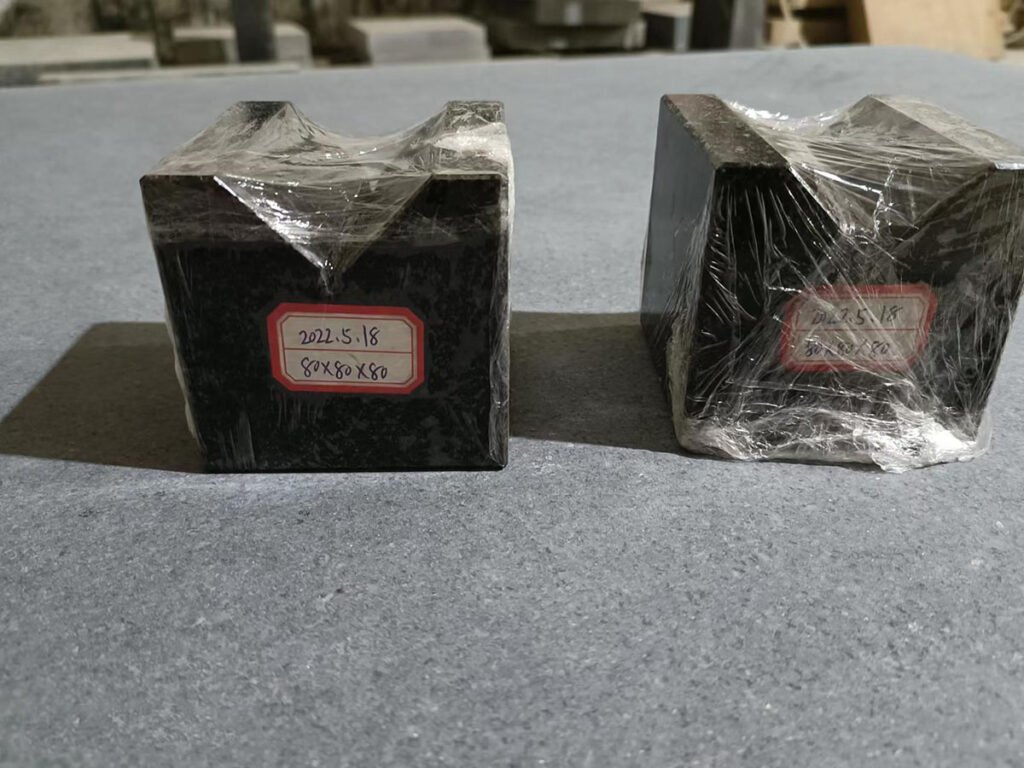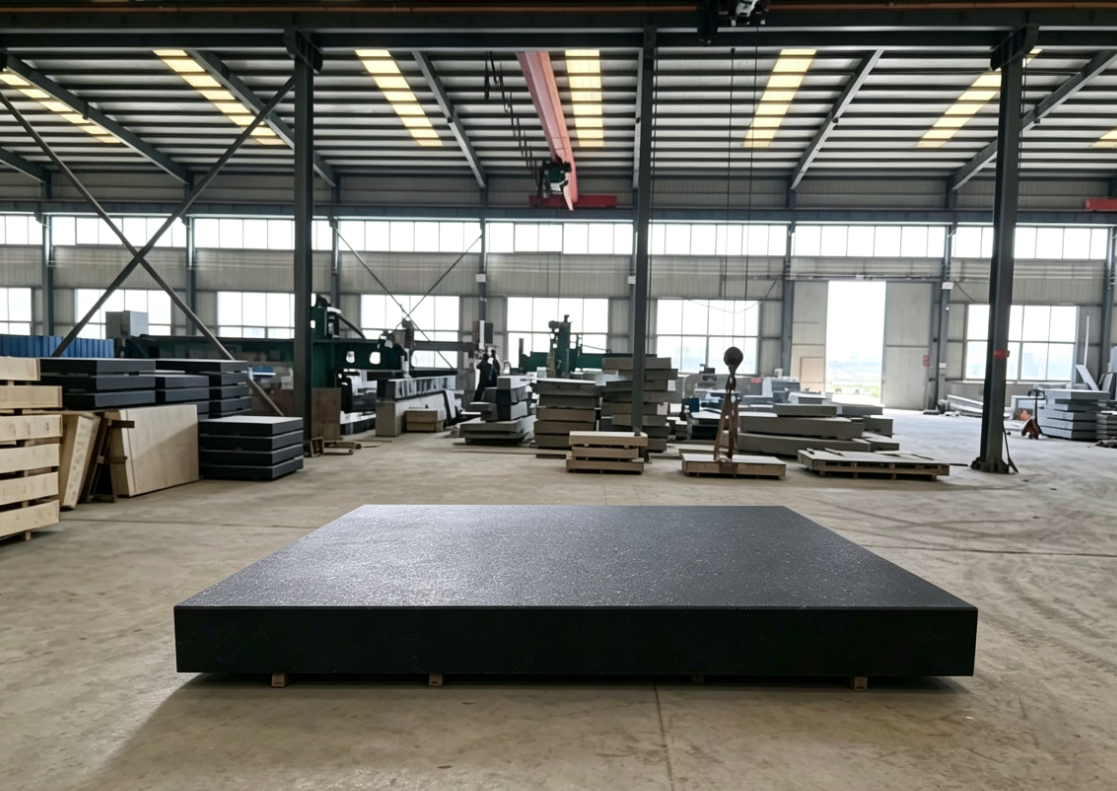
Granite V-blocks (also known as granite V-blocks) are core reference tools for precision manufng and metrology inspection. Their core value lies in ultra-high stability, non-magnetic insulation, wear resistance, long service life, and micron-level positioning, significantly enhancing the precision, istency, and reliability of precision machining and inspection.
I. Core Performance Value (Why use granite)
Extreme stability, no deformation: Naturally aged over millions of years with completely released internal star expansion coefficient of only 4.6×10⁻⁶/°C, almost no deformation under room temperature/temperature differences, maintaining precision over the long term.
Hirdness, wear resistance: Mohs hardness 6–7, far exceeding cast iron/steel; hand-finished, working surface profile ≤1μm, minimal precision degradation with lg-term use.
Non-magnetic insulation, anti-interference: Natural stone is non-conductive and non-magnetic; does not interfere with precision equipment such as laser interferometers, electronmicroscopes, and lithography machines, suitable for high-sensitivity scenarios like semiconductors and aerospace.
Corrosion resistance, long life: Resistant to acids and ais, does not rust or oxidize; no calibration required for 10 years under normal use, with extremely low maintenance costs.
High rigidity, good vibration damping: Dense crystalline, vibration damping rate <0.05%, no plastic deformation under heavy loads, suitable for heavy-duty and high-frequency inspection.
II. Core Application Value (Where used, what proems solved)
- Precision Inspection (Metrology Room / Quality Control)
Centering and coaxiality inspection of shafts/cylindrical par20° standard V-grooves, three-point contact self-centering, repeat positioning accuracy within ±1μm; paired with dial indicators/CMMs to inspect roundness coaxiality, parallelism, and perpendicularity, ensuring geometric precision of precision shafts, motor rotors, and cutting tools.
Precision scribing and reference positioning: Accurately algning shafts/tubes/sleeves on a flat plate, drilling center holes, and scribing symmetrical lines; replaces magnetic V-blocks to avoid magnetizing workpieces and refer.
Instrument calibration and support: Provides stable, non-magnetic reference for laser interferometers, optical lenses, and sensors, ensuring calibration precision and long-term consistency. - Mechanicalhining (Workshop / Tooling)
Lathe/grinder/milling machine clamping reference: Used in pairs to stably support shaft workpieces, ensuring machining coaxiality and sm, reducing clamping errors, and improving batch processing consistency.
New energy/aerospace precision part machining: High-precision dynamic balance testing and support for motor rotors, aeros shafts, and semiconductor rollers, with repeatability up to ±2μm.
Welding/assembly positioning: Provides stable positioning for cylindrical part docking, reducing welding deformation and improvssembly coaxiality and sealing. - High-end Manufacturing (Semiconductors/Optics/Aerospace)
Semiconductor equipment: Non-magnetic stable support for lithography machin objectives, wafer shafts, and inspection probes, avoiding electromagnetic interference and vibration effects to ensure nanometer-level precision.
Optical instruments: Ultra-low vibration support for optical lenses,lens groups, and laser components, ensuring optical path stability and imaging precision.
Aerospace: High-precision inspection and assembly of engine shafts, gyroscopes, and precision bearings,ing to harsh temperature, humidity, and vibration environments.
III. Economic and Efficiency Value
Precision retention, reduced calibration costs: One precision grinding, calibration-free for 3–5s, long-term stable precision, reducing downtime and calibration costs.
Reduced scrap, improved yield: Micron-level positioning and stable reference reduce clamping/inspection errors, reduce scrap rework, and improve batch yield.
Adaptable to harsh environments
III. Economic and Efficiency Value
Precision retention and reduced calibration costs: One-time precision grinding ensures calibration-free operation f5 years with long-term stable accuracy, reducing downtime and calibration expenses.
Reduced scrap and improved yield: Micron-level positioning and stable datum reduce clamping/detection errors, minimize p and rework, and enhance batch yield.
Adaptability to harsh environments and expanded application boundaries: Non-magnetic, insulating, corrosion-resistant, and vibration-damping properties cover hih-precision, high-sensitivity scenarios where traditional cast iron/steel V-blocks are inadequate.
IV. Comparative Value (Granite vs. Cast Iron/Steel V-blocks)
Precisioity: Granite remains deformation-free over the long term; cast iron/steel is prone to thermal deformation and stress release, leading to rapid accuracy drift.
Magnetism: Granite is on-magnetic; cast iron/steel is easily magnetized, interfering with precision equipment and attracting metal chips.
Wear resistance: Granite has a Mohs hardness of 6–7 a highly wear-resistant; cast iron/steel has low hardness, wears easily, and experiences rapid accuracy degradation.
Service life: Granite requires no maintenance for over 10 yearst iron/steel requires calibration every 3–6 months and is prone to rust and corrosion.
Summary
Granite V-blocks are not merely “fixtures/gauges,” but the coof precision in manufacturing. With ultra-high stability, non-magnetic insulation, wear resistance, and longevity, combined with micron-level positioning, they address the three major pain points ofdatum drift, electromagnetic interference, and wear/deformation in precision inspection and machining. This significantly improves product precision, consistency, and reliability while reducing lifecycle costs, making them an indispensable core daool for high-end equipment, semiconductors, aerospace, and other fields.