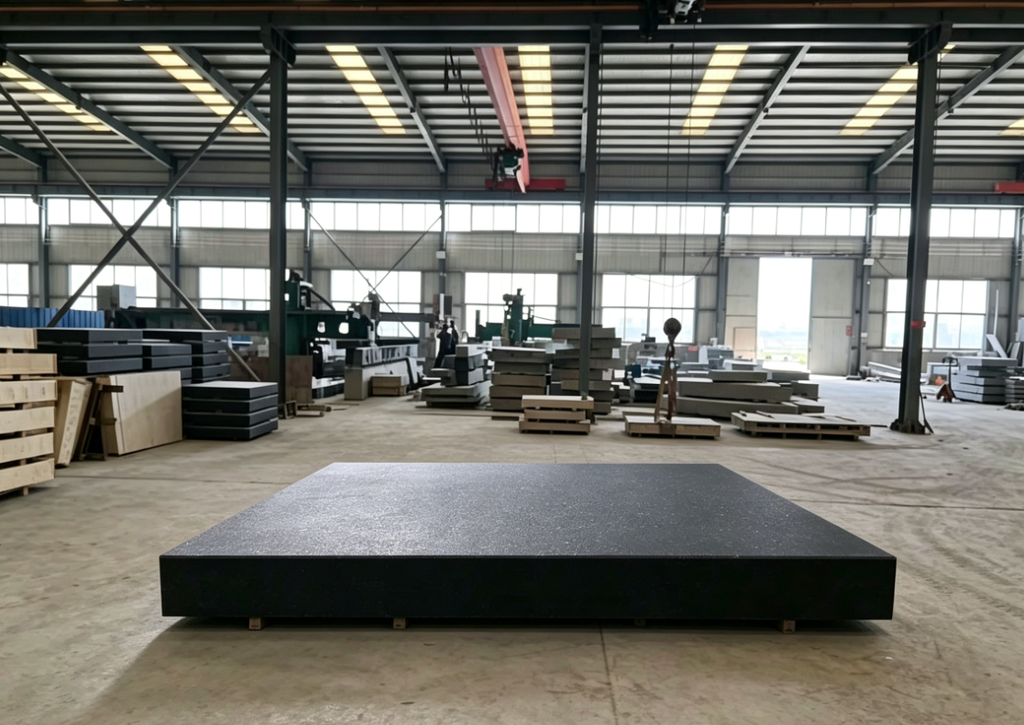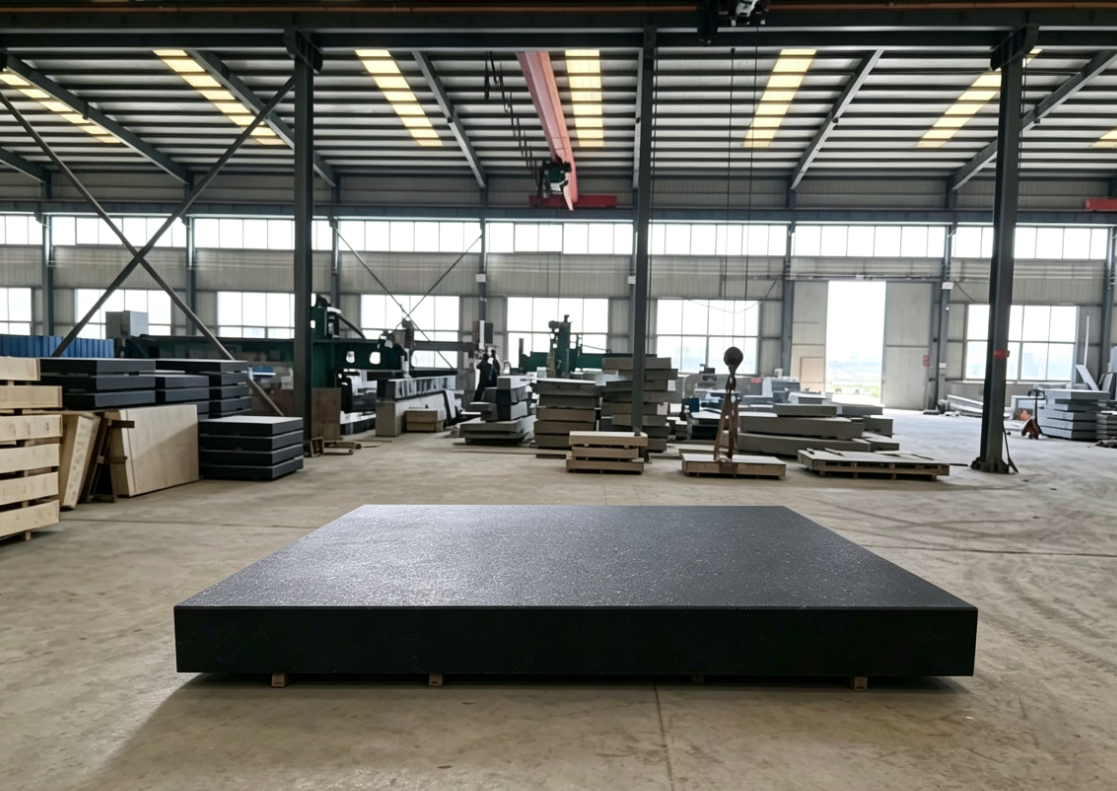
Natural granite is a deep-seated acidic igneous rock, primarily composed of tightly interlocked and interwoven high-hardness mineral crystals such as quartz (Mohs hardness ≈ 7) and feldspar (Mohs hardness ≈ 6), with extremely low internal porosity and a dense grain structure. After high-quality natural granite blocks are processed into granite plates through cutting, grinding, drilling, and slotting, they fully inherit the inherent material properties of the stone, providing the plate with exceptional wear resistance.
From a material mechanism perspective: As the framework mineral of granite, quartz has a hardness far exceeding that of ordinary cast iron and carbon steel. When measuring instruments, workpieces, and probes slide and rub against the working surface of the plate, it is difficult to generate scratches; the dense, non-loose crystal structure makes it difficult for surface particles to detach, resulting in an extremely low wear rate. Meanwhile, the stone does not rust or oxidize, eliminating the additional wear issues caused by the corrosion and flaking of cast iron plates. The entire slab has a uniform material composition, ensuring consistent wear resistance across all parts of the working surface.
Relying on its excellent wear resistance, granite plates are widely used in various precision manufacturing scenarios:
- Metrology and Inspection Laboratories: As a reference platform, it is repeatedly used to place height gauges, dial indicators, and gauge blocks, maintaining long-term planar reference accuracy and extending calibration cycles;
- CMM Bases / Precision Fixture Bases (such as the custom plates in your picture with guide grooves and threaded mounting holes): They support sliding tables and fixtures, withstand reciprocating sliding friction, and ensure the long-term measurement stability of the equipment;
- Machining Workshop Quality Inspection Stations: For flatness and geometric tolerance inspection of parts after they come off the line, frequent loading and unloading of workpieces will not easily scratch the reference surface;
- Automated Equipment, Semiconductor Inspection Equipment: For precision assembly and inspection tooling, a stable and wear-resistant reference can reduce the frequency of equipment calibration and maintenance.
Technical Note: Granite is wear-resistant and scratch-resistant, but the material is hard and brittle. While it has excellent resistance to sliding friction, heavy impacts or drops will cause chipping of edges and corners. Impact loads must be avoided during use.