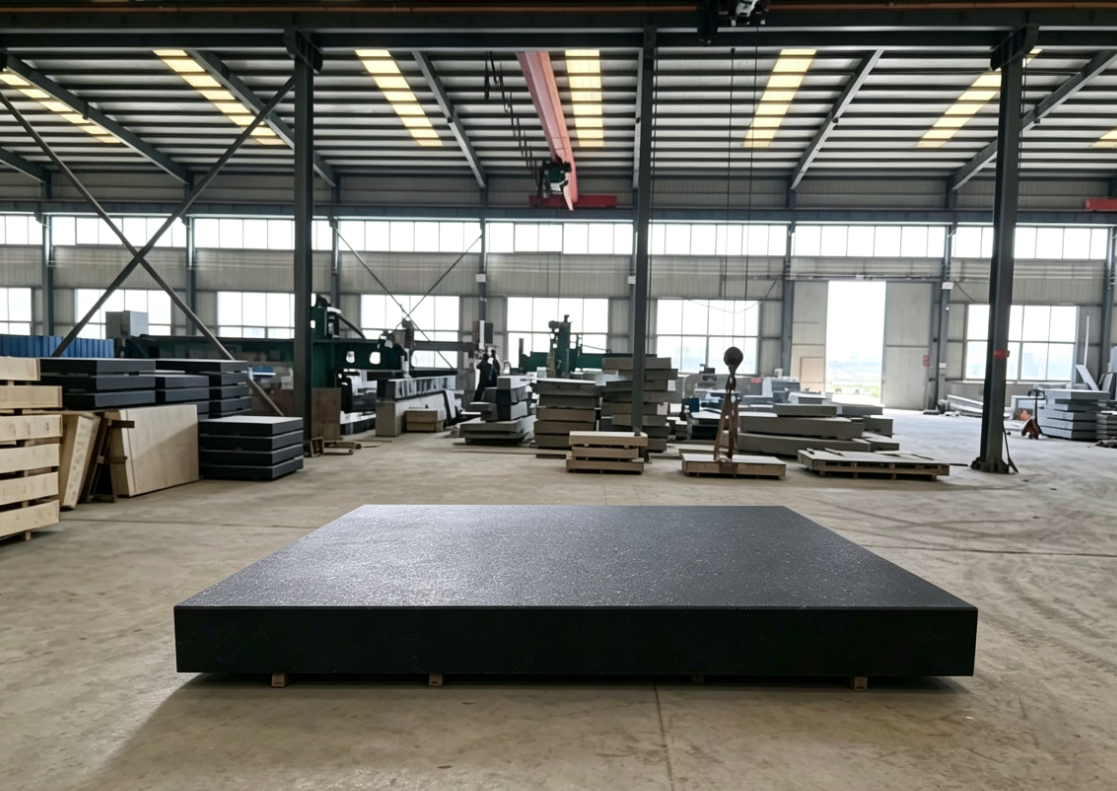
Why granite machine beds are preferred for improving machine tool precision and performance (compared to cast iron / steel beds)
To achieve high precision and stability, machine tools must address four core pain points: vibration, thermal deformation, long-term deformation, and wear/corrosion. Granite perfectly compensates for the shortcomings of metal beds. The core logic is explained below.
I. Extremely strong vibration damping, directly improving machining finish and eliminating chatter marks
Metal (gray iron, cast steel) has slow vibration decay. Vibrations generated by high-speed spindle cutting and tool feed will continue to oscillate:
Cast iron has a very low damping coefficient, making tools prone to chatter, resulting in tool marks and waves on the workpiece;
Granite’s damping is 3 to 8 times that of cast iron due to its dense crystalline structure. Vibrations dissipate quickly, with almost no resonance.
This leads to machine tool performance improvements:
High-speed precision milling, mirror machining, and diamond turning are free of chatter marks, significantly improving surface roughness;
High-speed spindles and linear motors run more smoothly, extending the life of tools, guideways, and scales;
Heavy cutting and high-speed reciprocating motions do not amplify vibration errors, making repetitive positioning accuracy more stable.
II. Extremely low thermal expansion coefficient, minimizing dimensional errors from temperature changes
Day-night temperature differences in the workshop, spindle heating, and coolant temperature rise are the biggest precision killers for precision machine tools:
Steel thermal expansion: ~11 μm/m·℃; ordinary cast iron: ~8 μm/m·℃;
High-quality black granite is only 2 to 4 μm/m·℃, and top-tier stone is as low as 0.5 μm/m·℃.
Example: With an ambient temperature difference of 5°C on a 1-meter-long bed:
Cast iron deformation ≈ 40 μm, directly ruining precision;
Granite deformation is within 10 μm, and in temperature-controlled workshops, it is even controlled to nanometer-level drift.
Advantages: During long-term continuous machining, the reference dimensions of the X/Y/Z axes do not drift, ensuring high dimensional consistency in batch processing without frequent machine stops for calibration.
III. No internal stress, no creep, ensuring precision does not degrade over long-term use
Cast iron beds inherently have residual casting stresses. Even after years of artificial aging, they will still slowly release:
After 2 to 5 years of use, the bed slowly warps and the guideway flatness deviates;
High-precision machine tools require annual scraping and calibration, resulting in extremely high maintenance costs.
Granite has undergone billions of years of geological compression, completely releasing its internal stress:
After finishing, it almost never slowly deforms, maintaining stable flatness and straightness for ten years.
For long-term mass production of precision parts, it does not require repeated overhauls, and the long-term precision retention rate of the equipment is far higher than that of cast iron beds.
IV. High hardness, rust-proof, corrosion-resistant to cutting fluids, and permanently wear-resistant reference surfaces
Wear-resistant and difficult to scratch
The Mohs hardness of granite is much higher than that of cast iron. It is easy to install guide rails and clamp/drag workpieces on the reference surface for a long time without generating dents or scratches; cast iron is prone to wear and burrs, causing rapid failure of the reference surface.
Completely rust-proof, resistant to acidic and alkaline cutting fluids
Cast iron rusts when exposed to emulsion, grinding fluids, or humid air, and rust spots directly destroy the parallelism of the guide rails; granite does not oxidize or corrode with cutting fluids, eliminating the need for anti-rust paint.
Extremely low water absorption rate (<0.01%), will not absorb oil or water and expand, ensuring stability in harsh machining environments.
V. Non-magnetic, no interference with precision inspection and grating sensors
Cast iron and steel are magnetic. Built-in grating, displacement sensors, visual inspection, and magnetic fixtures in machine tools will be affected by magnetic field interference, leading to reading drift.
Granite is non-ferromagnetic, suitable for:
Semiconductor ceramic, silicon carbide, and optical component machining machine tools;
Ultra-precision machine tools equipped with vision, laser probes, and high-precision gratings.
VI. High rigidity and heavy self-weight, suppressing high-speed motion overturning and bending
Granite has high density and self-weight, acting as a natural counterweight for the machine bed:
Gantry and long-stroke machine tools are less likely to shake or overturn during high-speed rapid movement;
Under the same load, bending deformation is much smaller than that of thin steel structure beds;
When paired with linear motors and high-speed modules, it delivers better dynamic accuracy performance.
Simple Comparison Summary (Core Differences in Machine Tool Selection)
Tableau
Indicator Cast Iron Bed Granite Bed Impact on Machine Tool Accuracy
Vibration Damping Poor, prone to chatter Excellent, no vibration marks Granite provides higher machining surface finish
Thermal Deformation Large, significant error from temperature differences Extremely small, dimensionally stable Strong dimensional consistency in mass production
Long-term Deformation Stress release causes deviation over years Almost no deformation No major overhaul or calibration needed for years
Rust and Fluid Resistance Prone to rust and corrosion Corrosion-resistant and non-oxidizing Reference surface remains intact for a long time
Magnetism Magnetic, interferes with sensors Non-magnetic Suitable for optical / semiconductor precision machining
Applicable Machine Tool Scenarios (Must use granite bed)
Ultra-precision diamond lathes, optical mold CNCs, wafer cutting machines, silicon carbide machining equipment, CMM integrated machines, high-precision grinders, laser micromachining equipment.