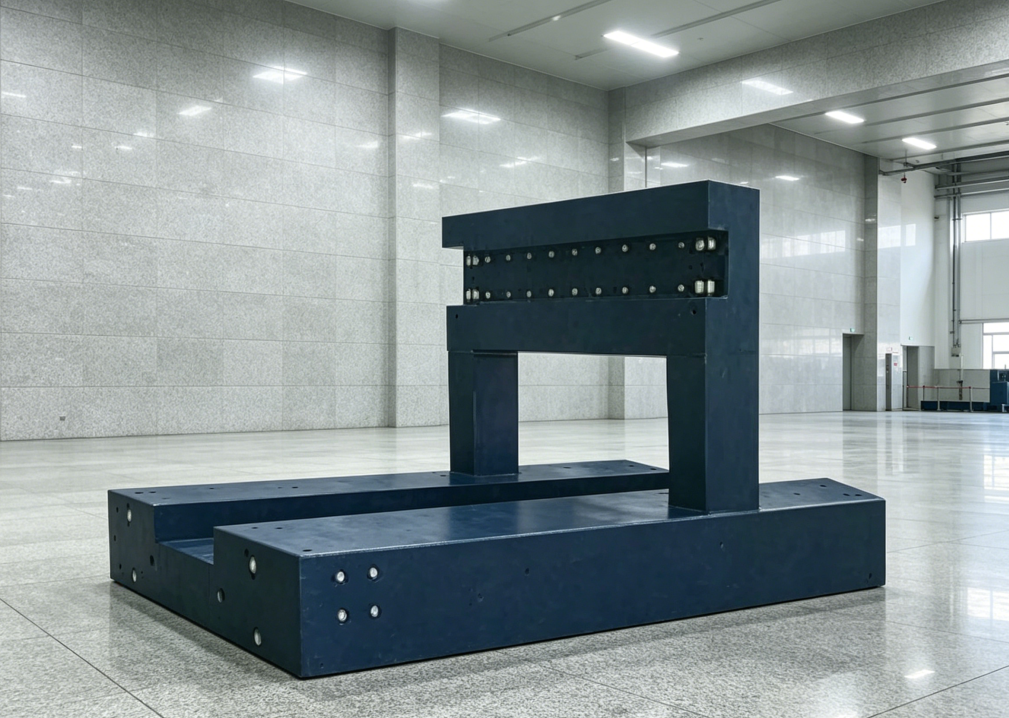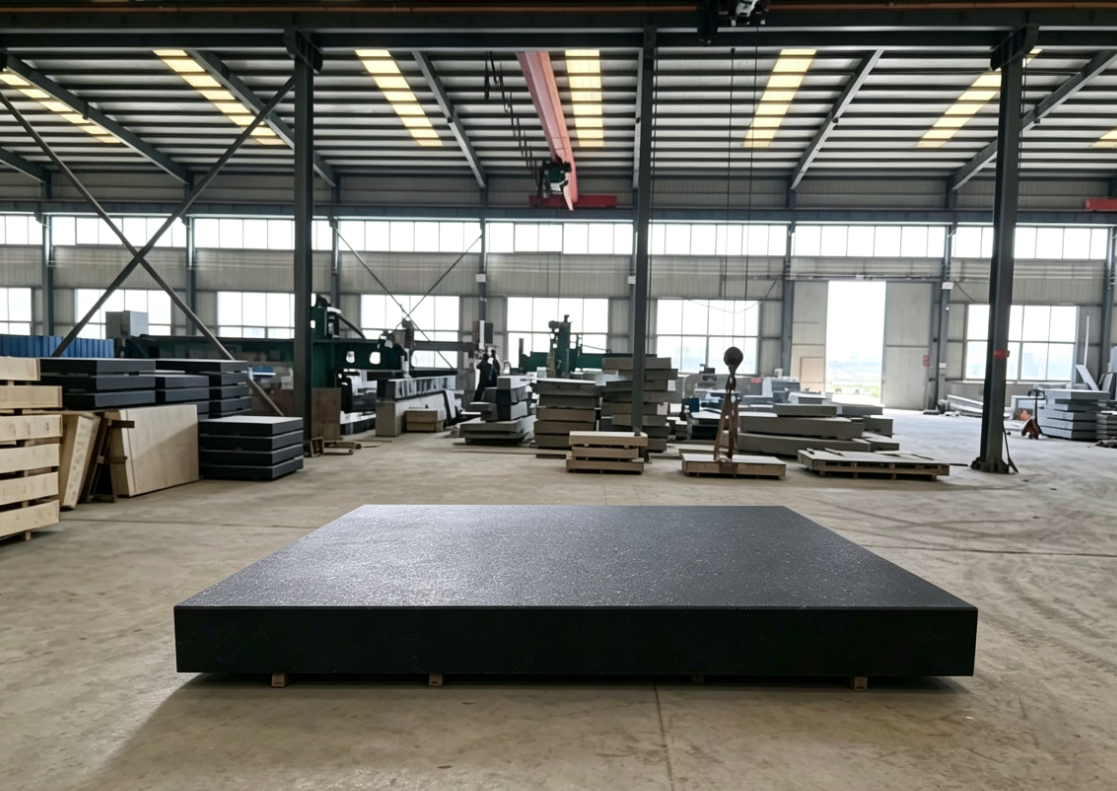
The price of high-precision granite platforms is primarily influenced by seven key factors: material grade, dimensions and thickness, precision grade, customized processing, aging treatment, brand and service, and transportation and installation. Among these, precision and material have the greatest impact on price, potentially causing a price difference of several times for products of the same size.
I. Material Grade (Basic Cost)
High-end materials (Preferred): Jinan Green (Shandong) has a low coefficient of thermal expansion (≈3.5×10⁻⁶/℃), high hardness (Hs70–80), a dense structure, and uniform black spots, commanding the highest price; Taishan Green has similar performance with a higher cost-performance ratio; Indian Black / South African Black features uniform color and excellent polishability, used for optical platforms with high aesthetic requirements.
Ordinary materials: Local granite, marble (e.g., Snowflake White) have slightly lower hardness and stability, with prices 30%–50% lower, making them unsuitable for nanometer-level laser equipment.
Key indicators: Water absorption rate < 0.13%, coefficient of thermal expansion ≤ 4×10⁻⁶/℃, hardness ≥ Hs70. The higher these indicators, the more expensive the material.
II. Dimensions and Thickness (Linear Increase)
Area: The price increases quadratically with length and width. Example: 1000×2000mm (Grade 00) is about 18,000–45,000 RMB; ultra-large specifications of 3000×6000mm can reach 80,000–150,000 RMB.
Thickness: Greater thickness provides better rigidity and stronger vibration damping, but increases weight and cost. Conventional thickness is 100–300mm, while laser equipment commonly uses 200–400mm. Every 50mm increase in thickness raises the price by 15%–25%.
Aspect ratio: Narrow/irregular dimensions are difficult to process and result in high material waste, increasing the price by 10%–30%.
III. Precision Grade (Core Price Difference)
Flatness tolerance directly determines the positioning stability of laser equipment. The price doubles with each increase in grade:
Grade 0 (Ordinary): Flatness ≤ 20μm/m, used for ordinary marking, serves as the price benchmark (100%).
Grade 00 (High precision, commonly used for lasers): Flatness ≤ 3–5μm/m, used for precision cutting/inspection, priced at 2–3 times Grade 0.
Grade 000 (Ultra-high precision, semiconductor/ultrafast lasers): Flatness ≤ 1–1.5μm/m, nanometer-level stability, priced at 4–6 times Grade 0.
Flatness calibration: Requires laser interferometer testing and a CNAS certified report, with certification fees charged separately (approx. 500–2,000 RMB per test).
IV. Customized Processing (Added Value)
Laser equipment often requires functional customization, with each item adding to the cost:
Slotting/Drilling: T-slots, threaded holes, vacuum suction slots; each meter of T-slot adds 200–500 RMB; each precision positioning hole (±0.01mm) adds 50–150 RMB.
Inserts/Steel Inlays: Inlaid stainless steel rails, wear-resistant steel strips; each meter of steel strip adds 300–800 RMB.
Surface treatment: Mirror polishing (Ra ≤ 0.4μm), anti-static coating, rust prevention treatment; price increases by 10%–20%.
Irregular structures: Gantry beams, cavities, stepped surfaces; high processing complexity increases the price by 30%–100%.
V. Aging Treatment (Stability Assurance)
Natural granite contains internal stress; improper treatment can lead to long-term deformation, affecting laser precision:
Natural aging (1–2 years): Open-air placement to release stress, best stability, price increases by 20%–40%.
Artificial aging (Vibration/Heat treatment): Completed in 7–15 days, medium stability, price increases by 10%–20%.
No aging: Short-term precision is acceptable, but deformation drift occurs in 3–6 months; lowest price, unsuitable for high-end laser equipment.
VI. Brand and Service (Premium Factors)
Well-known brands: Mature technology, strict quality control, comprehensive after-sales service, 30%–50% premium, but higher stability and reliability.
Ordinary manufacturers: Low price, but weaker precision consistency, lead time handling, and after-sales guarantee.
Warranty and calibration: 3-year warranty 1 free annual calibration, price 10%–15%.
VII. Transportation and Installation (Hidden Costs)
Heavy weight: A 1000×2000×200mm platform weighs about 1.2 tons, requiring a dedicated vehicle hoisting shockproof packaging, costing about 500–2000 RMB / unit.
Installation and leveling: Requires professional personnel using spirit levels and dial indicators to adjust to a levelness ≤0.02mm/m, costing about 300–800 RMB / unit.
Price Range Reference (2026, Jinan Qing, Grade 00, Regular Flat Surface)
Tableau
Dimensions (mm) Price (RMB) Applicable Scenarios
500×500×100 800–1500 Small marking machines, optical experiments
1000×1000×150 1800–3500 Medium marking and testing equipment
1000×2000×200 18000–45000 Fiber / CO₂ laser cutting machine bases
2000×3000×300 50000–100000 Large-format laser equipment, semiconductor platforms
Résumé
When selecting a platform for high-end laser equipment, prioritize Jinan Qing Grade 00 natural aging; if the budget is limited, you can reduce the size / thickness, but never sacrifice precision and material, otherwise it will lead to laser spot drift, large positioning errors, and low yield, resulting in higher long-term costs.