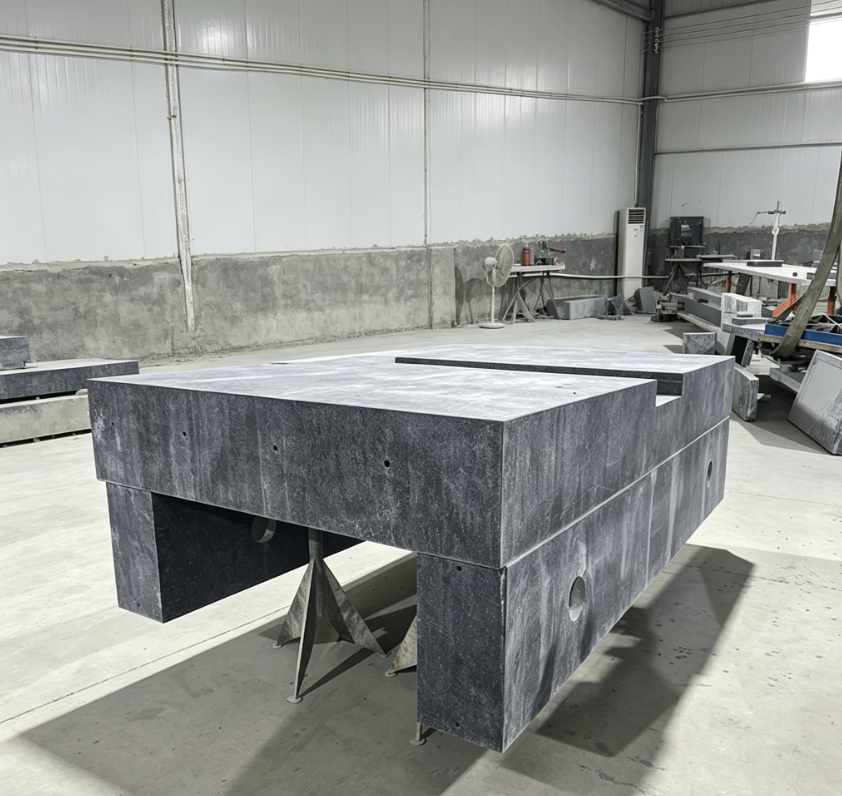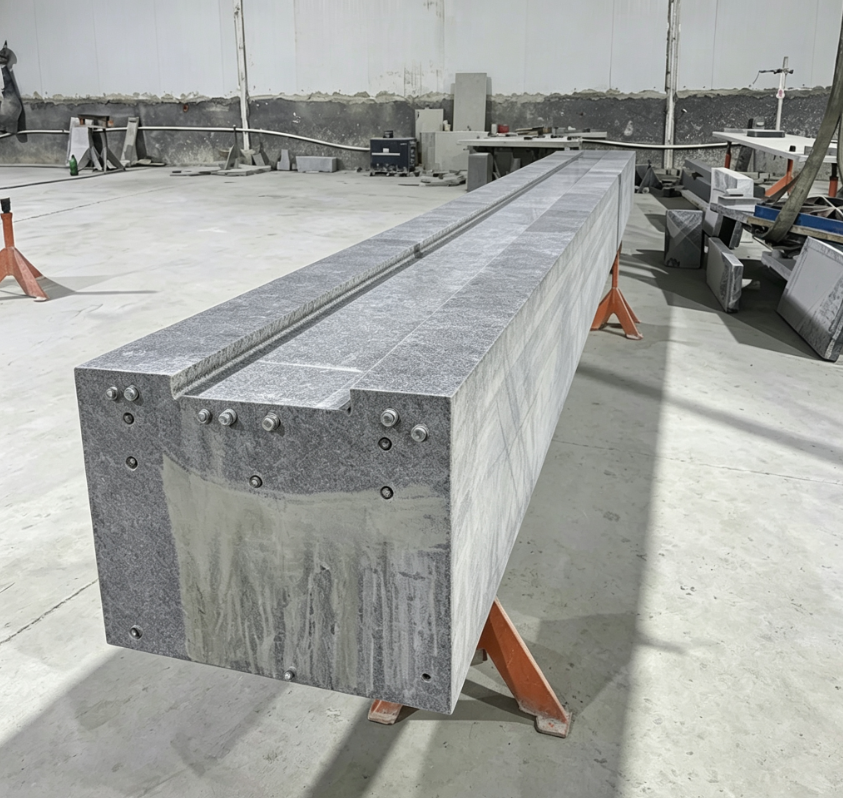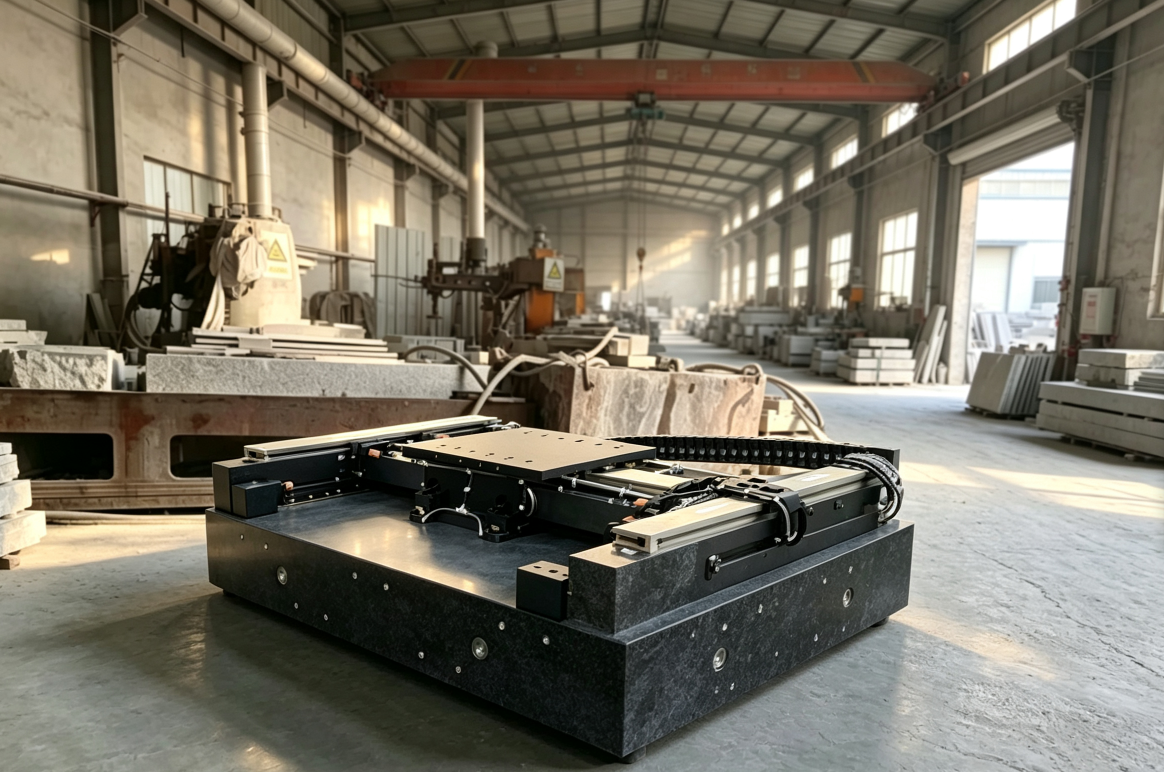
How to Maintain High Precision of Granite Precision Workbenches (Practical Comprehensive Methods)
I. Installation andeling is the Foundation (Determines Long-Term Precision)
Must use adjustable shock-absorbing feet
Four-point or six-point support, three-point positioning with the rest auxiliary; avoid hard contact to generate internal stress and prevent workbench warping and deformation.
The floor must be solid and free of settlement
Do not place on soft ground or weak floorboards;t foundation subsidence will directly destroy flatness.
Allow the machine to settle naturally after installation
Let it stand still for 24~48 hours after installation before fine-tunig precision; let stress fully release; do not put into use immediately after installation.
II. Control Environmental Temperature (The Most Critical)
Constant temperature environment
Ideal tempeature: 20℃±2℃; avoid large temperature differences between morning and evening, or between winter and summer.
Prohibit direct exposure to local heat sources
Do not place near windows to be exposedto sunlight, or near welders, ovens, or air conditioner vents; local temperature differences will cause granite to deform slightly.
Avoid sudden temperature changes
Do not suddenly open rs to let in cold air in winter, or place hot/cold workpieces directly on the table; both will cause instantaneous precision deviation.
III. Daily Usage Protection
Strictly prohibit heavy om impacting or falling
Granite is hard but brittle; heavy impacts will produce internal micro-cracks, leading to slow deformation and loss of precision.
Prohibit prying, or grinding on the table
Do not use it as a fitter’s bench to knock workpieces, scrape, or use violent clamping; this easily causes chipping and stress ation.
Place workpieces gently and use soft protection
Place rubber pads or wooden boards under heavy workpieces to avoid hard contact impacting the table surface.
IV. Cleaning and Maintenance Methodsialized dust-free wiping
Use anhydrous ethanol, specialized dust-free paper / chamois, and wipe in one direction; do not use sandpaper, steel w, or hard-bristled brushes.
Keep the table dry and clean
Long-term attachment of iron filings, dust, and oil stains will slightly corrode the surface and wear the datum ce.
Prohibit strong acids and strong alkalis
Do not use disinfectants or strong alkaline cleaners to prevent mineral structure corrosion and surface pitting.
V. Prevent Stress and formation
Do not drill holes or cut grooves arbitrarily
Random drilling or cutting later will destroy the overall structural stress, causing flatness to quickly become inaccurate.
Apply uniform force over te long term
Do not press on only one corner of the table for a long time; long-term eccentric loading will produce permanent micro-deformation.
Regularly release stress
For large grses, perform a re-inspection and re-leveling once a year.
VI. Regular Precision Maintenance
Periodic calibration
Use levels, optical flats, and right angle gto calibrate flatness and straightness every 3~6 months.
Treat minor scratches promptly
For minor surface scratches or dents, find a professional manufacturer for local precision grindin and repair; do not grind it yourself.