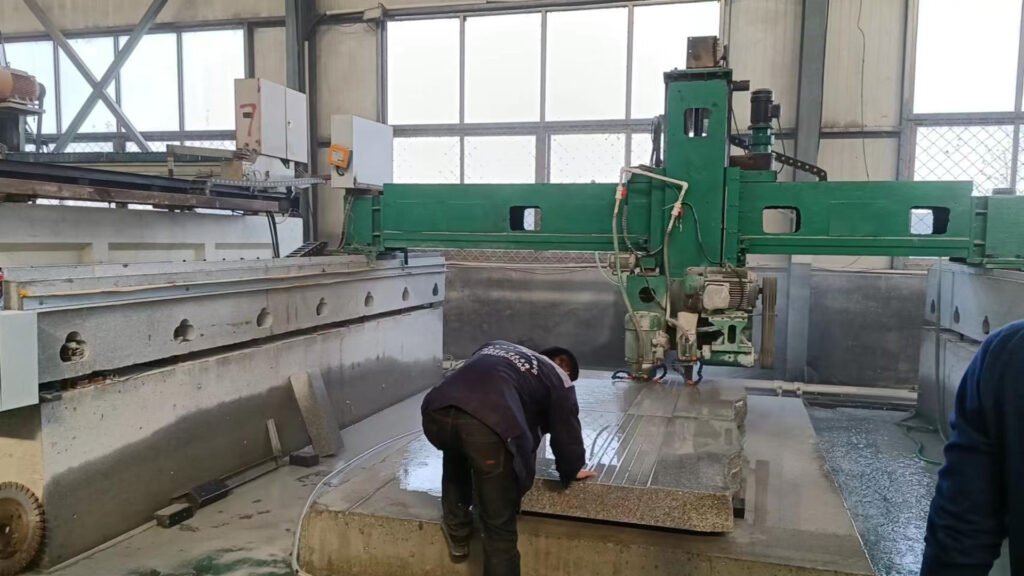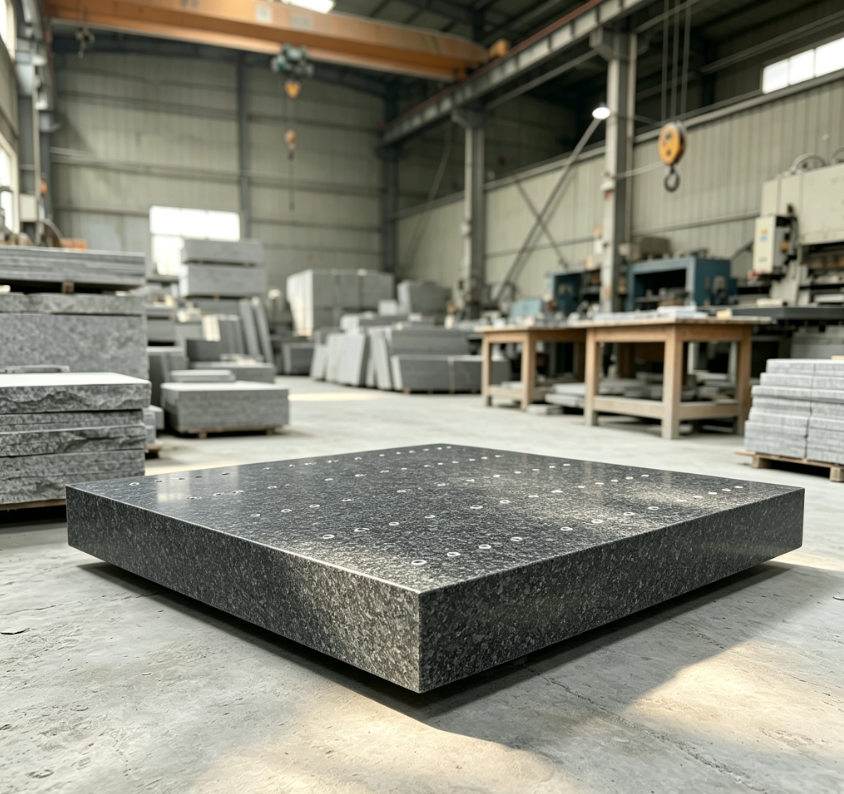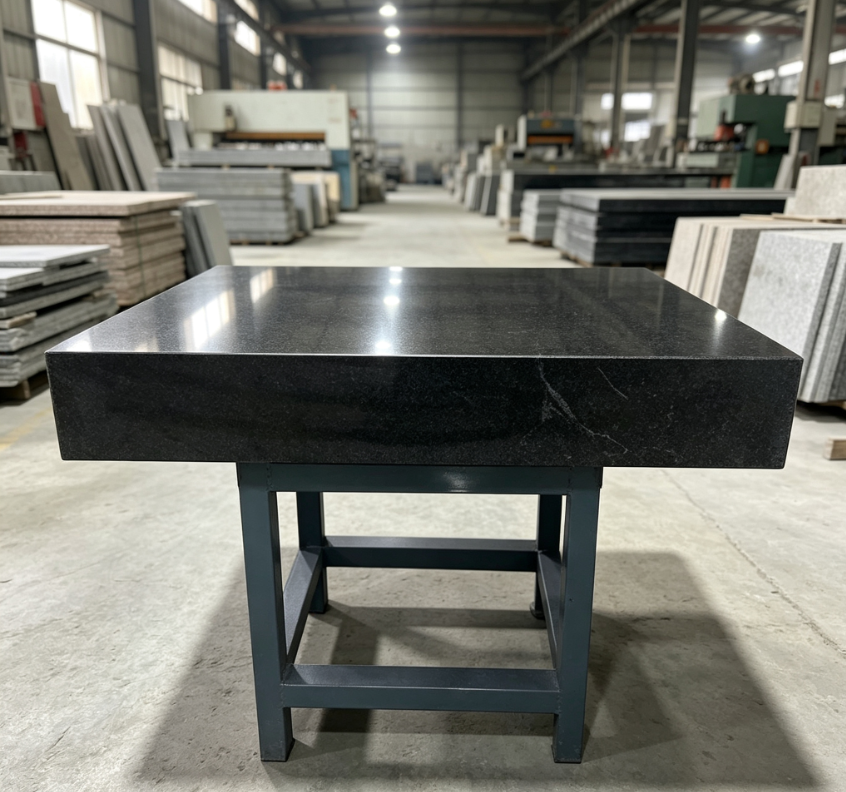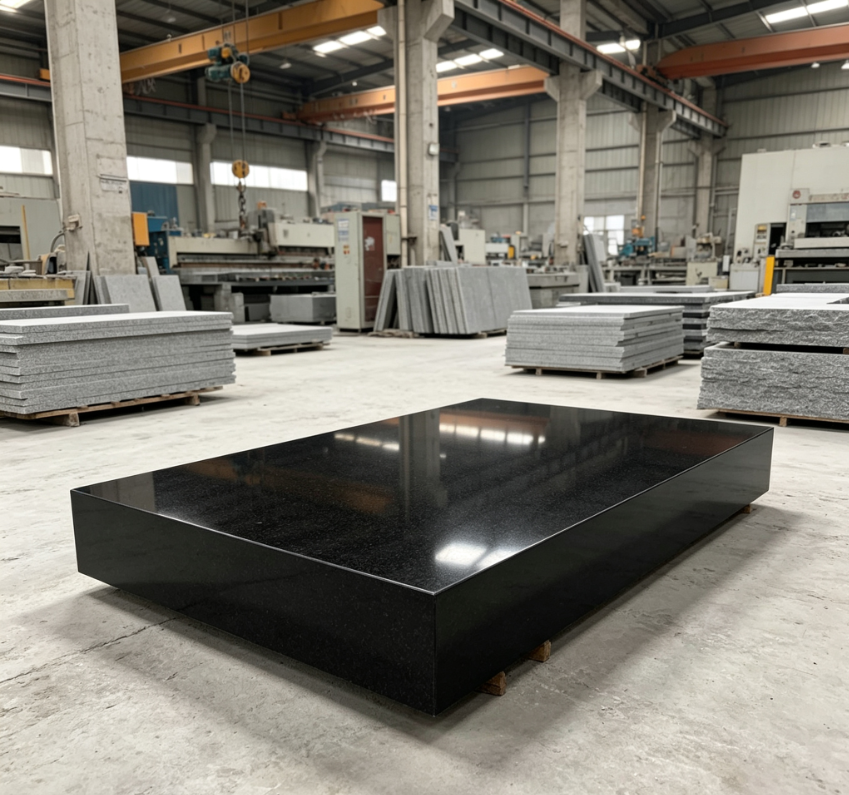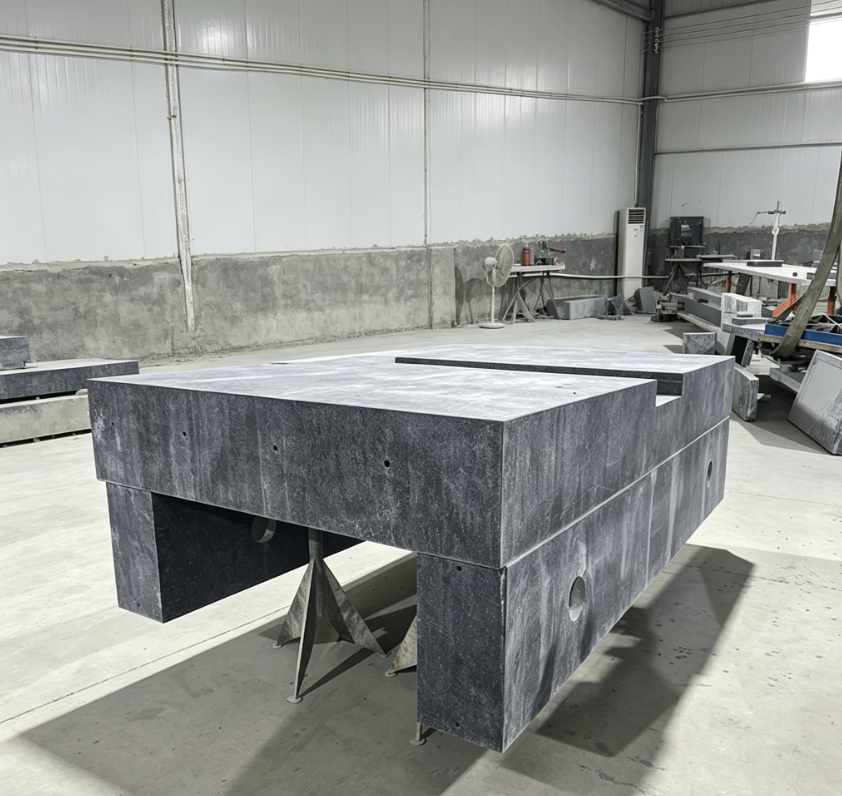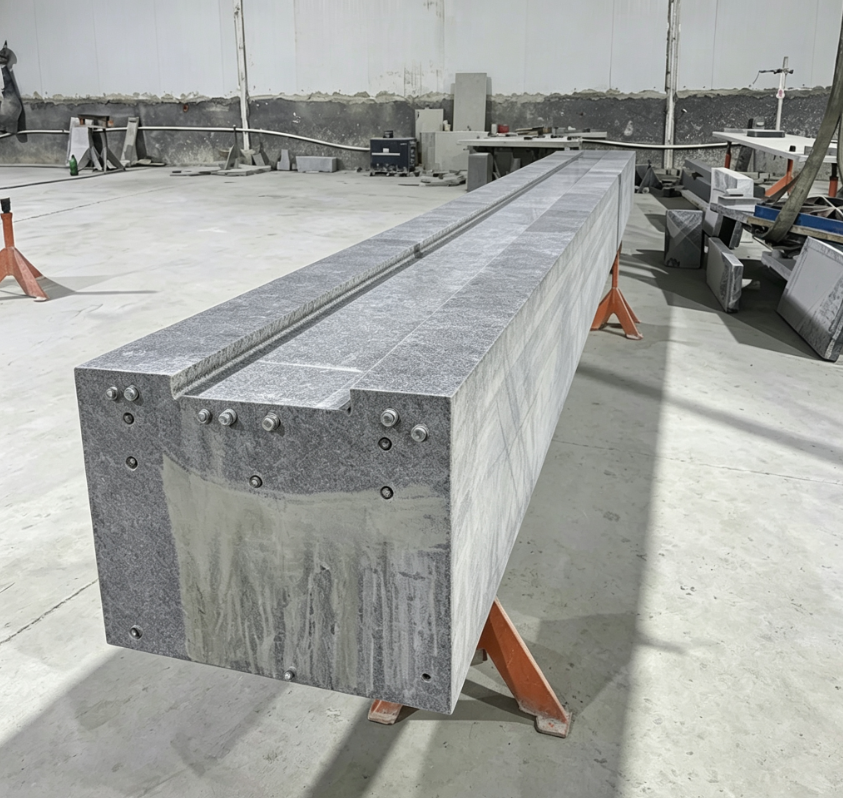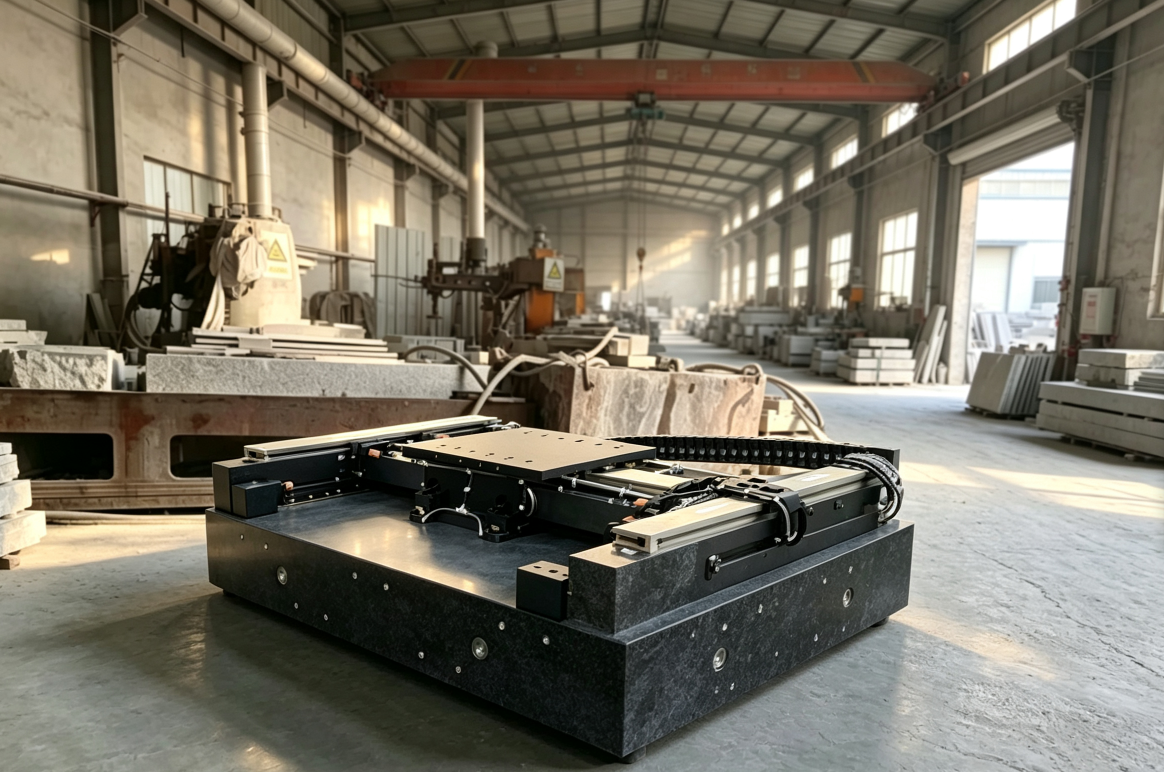
- Material Requirements
Stone material
Use natural granite with dense structure, uniform grains, no, and no impurities, such as Jinan Qing, Taishan Qing, Fengzhen Black, etc.
Raw material performance requirements
Compressive strength≥ 200 MPa
Shore hardness ≥ HS70
Water absorption rate ≤ 0.15%
Thermal expansion coefficient ≤3×10⁻⁶ /℃
Non-magnetic, non-conductive, acid and alkali resistant, corrosion resistant
Raw material processing
The raw material must undergo aging artificial aging to completely eliminate internal stress and prevent deformation in the later stage. - Process Flow Requirements
Standard precision machining process (indispensable):
material cutting → 2. Rough grinding → 3. Aging stability treatment → 4. Semi-fine grinding → 5. Fine grinding → 6. Pol → 7. Scraping / Polishing → 8. Precision inspection → 9. Cleaning and packaging - Geometric Accuracy Machining Requirements
1.ness (core accuracy)
Implement according to GB/T 24519, grade classification:
000 grade (reference grade)
00 gradehigh precision grade)
0 grade (metrology grade)
1 grade (general workshop grade)
Flatness detection method:
Pitch method (level / self-limator)
Error is assessed according to the minimum area method. - Verticality, parallelism (applicable to T-slots / square boxes / rightangle rulers)
Verticality of working surface to side: 00 grade / 000 grade platform ≤ 0.01 mm/m
Parallelism upper and lower working surfaces: Implement according to the corresponding flatness grade - Thickness, dimensional tolerance
Length, width tolerance: ±0.5 mm
Th tolerance: ±1.0 mm
Verticality error of four corners ≤ 0.03 mm/m - Surface Machining Quality Requirements
Surface rough
Precision measuring surface: Ra ≤ 0.2~0.4 μm
Smooth, no scratches, no sand holes, no black spots, no cracksSurface appearance
The color of the working surface is uniform and consistent
The chamfer is uniform, smooth, and there is no chipped corner
No patching, no, no grinding marks
Luster
The precision grinding surface has uniform luster, and local brightening or darkening is not allowed. - T-Slot,ed Hole Machining Requirements
If the platform has slots or holes, it must meet:
Straightness and parallelism of T-slots conform to the corresponding precision grade the platform
The slot surface is smooth and free of burrs, and the slot pitch tolerance ±0.1 mm
The depth and position of the threaded hole are accurate without uneven threads or chipped edges
After drilling, stress must be removed and re-fine grinding to ensure that the overall flatness does not decrease - Environment and Temperature Requirements
Precision grinding, polishing, scraping, and inspection must be carried out in a constant temperature workshop:
Temperature: 20℃±2℃Before machining, the workpiece must be placed at a constant temperature ≥ 8h to eliminate thermal deformation
It is strictly forbidden to carry out final precision machining in environment with large temperature difference, large vibration, and large dust - Stability and Aging Requirements
Stress removal treatment must be carried out after rough machining
ary aging is required before fine machining
Before product delivery, it needs to be stationary and stable to ensure that the precision does not drift over a long period
The product not produce plastic deformation due to time, temperature, and humidity - Inspection and Acceptance Requirements
Each platform must be accompanied by a precision inspection report
Inspect instruments:
Digital level / optical level
Self-collimator
Surface roughness meter
Inspection methods implement national standards: GB/T 2451—2019
Products that do not meet the precision requirements are not allowed to leave the factory - Packaging and Identification Requirements
The working surface pasted with protective film and covered with moisture-proof film
The whole is packed in a wooden box to prevent collision, moisture, and shock
Clear identification:
Model and
Precision grade
Factory number
Production date