Method 1: Pitch Method (High Precision, for Arbitration / Acceptance)
Appl Scenarios: Factory Inspection, Customer Acceptance, High-Precision Tooling Calibration.
Required Tools: Digital Level (or Repeating Level), Plate (Pitch Block), Recording Form.
【Direct Execution Steps】
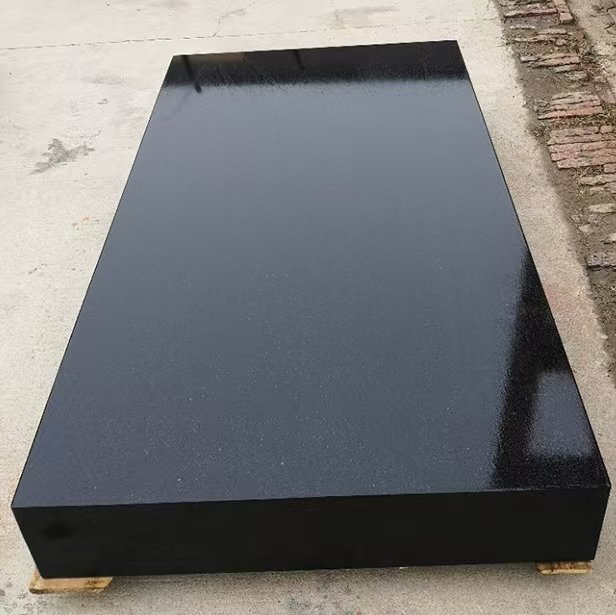
Preparation: Place the granite straight edge stably on the temperature-controlled workbench20℃±2℃), preheat for 1 hour to be isothermal.
Segmentation: Use the bridge plate to divide the measuring surface of the straight edge n equal parts (e.g., divide a 1000mm straight edge into 10 parts, each part is 100mm).
Measure: Start from one end, move the bridge plate to each segment in turn, and record the readings (grid values) of the level.
Recording: Fill the readings into table and calculate the cumulative values.
Assessment: Draw the error curve according to the cumulative values, and the difference between the highest and lowest points of the vertical coordinate of curve is the straightness error.
Method 2: Polishing Transparency Method (Workshop Level, Quick Self-Inspection)
Applicable Scenarios: Precheck before daily use, Wear Check, No need for specific values.
Required Tools: Grade 0 Flat Crystal (or more precise granite flat ruler), Mineral Oil ( engine oil).
【Direct Execution Steps】
Cleaning: Thoroughly wipe the measuring surface of the straight edge and the surface of the flat crystal with anhyd ethanol to ensure no dust.
Oil Application: Apply a very thin layer of red oil (indicator) evenly on the flat crystal.
Polishing: Gently place flat crystal on the measuring surface of the straight edge, gently reciprocate and move back and forth (the distance is about 1/3 of the length of the flat crystal.
Observation: Take off the flat crystal, observe the coloring situation on the surface of the straight edge:
Qualified: Uniform coloring, no interruption, or interference fringes appear (uniform transparency).
Unqualified: No color in some places (protuberance), or local stripes are seriously bent, and obvious dark areas.
Method 3: Dial Method (Visual Method, Suitable for Long Rulers)
Applicable Scenarios: No level on site, need to see specific jump value.
Required Tools: Marble Platform (Reference Surface), Dial Indicator (Lever Dial), Indicator Base.
【Direct Execution】
Setup: Place the granite straight edge on the marble platform, fix the dial indicator on the indicator base, and press the measuring tip vertically on the measuring surface of the straight.
Movement: Let the dial indicator move slowly and uniformly along the full length of the straight edge (or move the straight edge).
Reading: Record the maximum and the minimum reading of the dial indicator during the movement.
Calculation: Maximum value – Minimum value = Straightness Error (Note: This method is affected by the accuracy of the platform, for reference only).
Key Points for Attention (Avoid Pit Guide)
Isothermal Treatment: Granite has slow heat conduction, it must be placed in the workshop for more than 1 hour after picking up from the warehouse, otherwise, thermal deformation will cause all the data to be wrong.
Uniform Force: When placing, be, prohibit single-point support or compression of both ends during handling, and prevent elastic deformation.
Temperature Control: Prohibit direct blowing of the air conditioner during detection, and personnel from breathing directly to the measuring surface (the water vapor exhaled will change the local temperature).