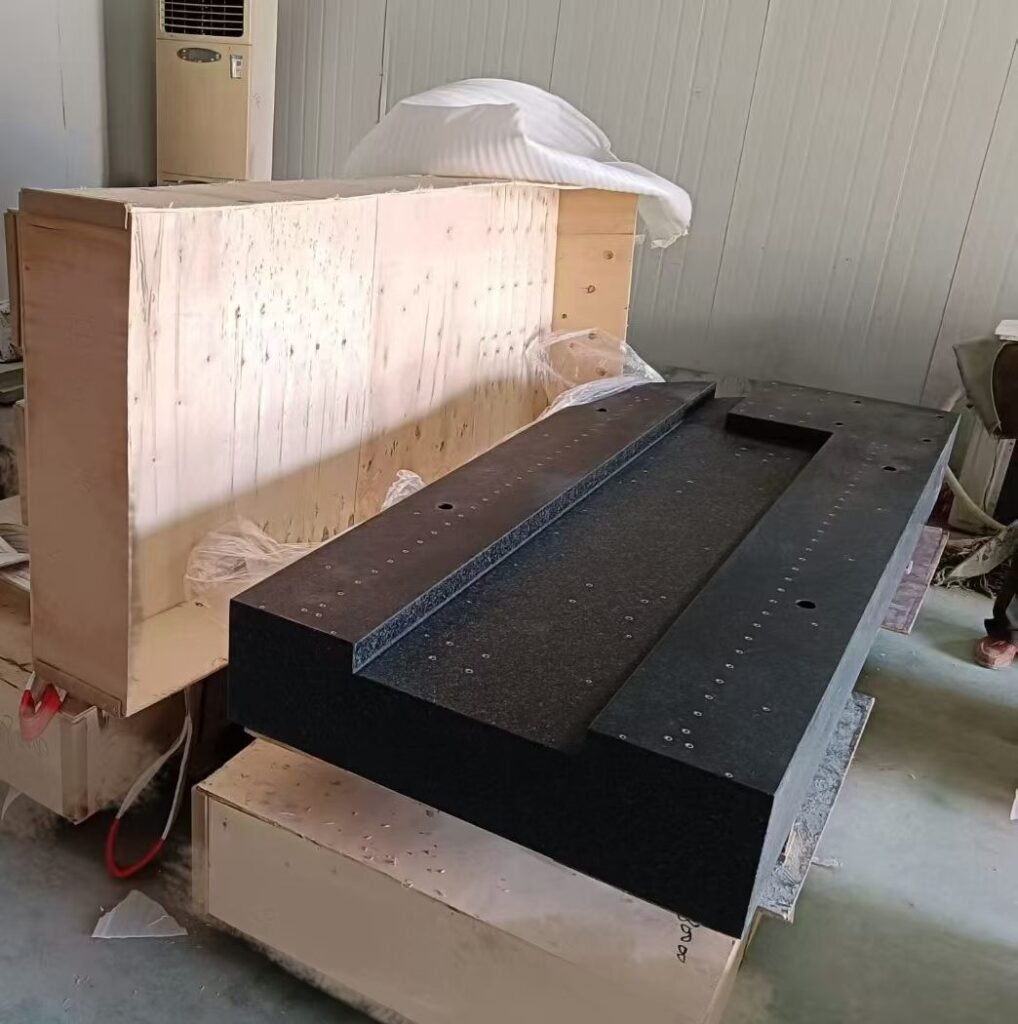
What are granite precision mechanical components?
Granite precision mechanical components are not ordinary construction granite, but high-precision functional comts made from high-quality natural granite (such as Jinan Green and Mount Tai Green) or high-performance artificial granite through a closed-loop process of “raw material selection – rough machining -stage stress relief – graded precision grinding – full-process precision inspection.” Their core value lies in providing long-term stable geometric references for ultra-precision equipment. Whether serving as a load-beo distribute dynamic loads or as a measuring platform to ensure the accuracy of measurement value transmission, their essence is to suppress the impact of external disturbances—such as temperature fluctuations, mechanical vibns, and long-term creep—on equipment precision through the inherent properties of the material.
From the perspective of industry standards, the definition of the “precision grade” centers on form and pon tolerances (flatness, straightness, parallelism) as core quantifiable indicators. Authoritative standards such as China’s GB/T 49 (equivalent to ISO 8512-1), Germany’s DIN 876, and the USA’s ASME B89.3.7 all categori them into a precision system ranging from Grade 000 (laboratory ultra-precision grade) to Grade 2 (workshop tool grade). Among thes Grade 000 (commonly referred to as Grade 000 domestically) requires a flatness tolerance that meets the formula T = 1× D/1000) μm (where D is the diagonal length of the working surface, in mm). This means that for a 1-meter square platform, the flatness error must t exceed 2 μm—a precision equivalent to 1/40th the diameter of a human hair (which is approximately 80 μm).
To ensure this precision, the surfaroughness of the components typically needs to be controlled below Ra0.02 μm. Achieving this metric requires diamond micro-powder grinding with a grit siz of over 2000 or even magnetorheological polishing processes, whereas the surface roughness of ordinary construction granite is merely above Ra10 μm, resulting in a precision difference ofeds of times. Furthermore, precision granite components must meet implicit requirements such as “no internal stress, isotropy, and low water absorption”: for instance, water absorption ust be ≤0.1% to avoid dimensional expansion caused by environmental humidity changes; internal stress must be completely released through natural or artificial aging to ensure no deformation occurs due to stress relaxation during lo.
Why Choose Granite?
Granite used for precision mechanical components must possess the core attributes of “fine crystallization, uniform mineral distrand complete release of internal stress” — this is also the key reason why traditional varieties such as Jinan Qing and Mount Tai Qing have long dominated the industry. The formation of e of granite requires hundreds of millions of years of geological evolution: magma deep underground cools and crystallizes slowly to form a mineral structure dominated by quartz and feldspar, followed term natural aging during which internal stress gradually dissipates, ultimately providing the physical foundation suitable for precision machining.
The following is a comparison of the core parameters and characteristics of mainstream raw matRaw Material Variety
Mineral Composition
Physical Parameters
Core Advantages
Typical Applications
Jinan Qing
Pyroxene (40-50%), basiclagioclase (40-50%), trace amphibole / olivine
Shore Hardness HS70 , thermal expansion coefficien 4.6×10⁻⁶/℃, water absorption rate < 0.2%, compressive strength 2290-3750kg/cm²
Finest crystallization, lowest internal easy control of flatness
Semiconductor lithography machine platforms, high-precision CMMs
Mount Tai Qing
Plagioclase (50-60, pyroxene (30-40%), small amount of biotite
Shore Hardness HS68-72, thermal expansion coefficiet 4.8×10⁻⁶/℃, density 2.9g/cm³, compressive strength 355.2MPa
Better toughness than Jinan Qing, strong impact resistanospace inertial navigation test benches, heavy machine tool beds
Indian Black Sandstone
Quartz (60-70%), feldspar (20%), biotite (5-10%)
Shore Hardness HS75-82, thermal expansion coefficient 0.9×10⁻⁶/, density 2.75g/cm³
Extremely low thermal expansion coefficient, uniform color
High-end optical measurement equipment, nanoimprint lithograp.
Material Characteristic Analysis: Comparison with Ordinary Mechanical Components
The core advantages of granite precision components stem from the dual characteristics of its natural mineral structure and aging treatment over hundreds of millions of years—characteristics that traditional materials such as metals and engineering plastics struggle to match. Compared to ordinary metal (e.g., cast iron, aluminum alloy) or engineering plastic components, there are significant differences in multi-dimensional performance, especially in ultra-precision manufacturing scenarios where these differences directly determine the upper limit of equipment accuracy.
2.1 Hardness and Wear Resistance
Hardness and wear resistance are core indicators ensuring the long-term precision retention of components; this characteristic is primarily determined by the mineral composition and microstructure of granite:
Hardness Performance: Its Mohs hardness is 6-7, equivalent to HRC51 or above—this hardness is far higher than ordinary carbon steel (HRC30-40) and even harder than some alloy tool steels; the Shore hardness typically reaches HS70 or above, with high-quality varieties like Jinan Qing reaching HS108, which is more than three times that of cast iron.
Microscopic Mechanism: Granite mineral particles exhibit an “interlocking mosaic structure”—quartz crystals disperse stress via a hexagonal crystal system and avoid local fracture through crystal plane slip when force is applied; feldspar fills crystal gaps with a framework structure to enhance overall density; and mica lamellae are distributed at grain boundaries to inhibit micro-crack propagation. This structure causes wear in granite to be primarily abrasive wear, rather than the adhesive wear or fatigue wear typical of metal materials.
Wear Resistance Data: Under identical high-frequency friction conditions, the 10-year wear of granite is ≤0.3μm, whereas the annual wear of cast iron reaches 0.8μm—meaning that the precision degradation of a granite component after 10 years of continuous use is equivalent to only 3 months of degradation for a cast iron component. Actual tests by the UK National Physical Laboratory show that using granite gauges reduces measurement error transmission by 40%.
Thermal Stability and Dimensional Invariance
Thermal stability is one of the most critical propertes in ultra-precision manufacturing — thermal expansion and contraction caused by temperature fluctuations are the primary source of equipment precision drift. The thermal stability advantages of granite make it the preferred material for ulton equipment:
Coefficient of Thermal Expansion (CTE): The CTE of high-quality granite is typically ≤3×10⁻⁶/℃, which isonly 1/3 to 1/4 that of cast iron (approximately 11×10⁻⁶/℃), and far lower than that of aluminum ally (23×10⁻⁶/℃).
For example, a 1-meter-long granite component will expand by only 0.03mm with a temperature fluctuation of 10℃, whereason component of the same length will expand by 0.11mm — this difference is sufficient to cause complete equipment failure in sub-micron precision scenarios.
Precision Retentionility: After sufficient aging treatment, the internal stress of granite is fully released, resulting in a precision drift of ≤0.2μm over 5 years — this etric is 1/5 that of cast iron components. A practical application case from a national-level metrology institute shows that after using granite components, the equipment calibration cycle was extended from six mto two years, and annual maintenance costs were reduced by 60%.
Anisotropy Control: Some granites possess gneissic structures, where the difference inn directions parallel and perpendicular to the gneissic foliation can reach 23.8% (e.g., Wulian Red granite). To control this difference, ry typically employs methods such as directional raw material screening (selecting ore sections with indistinct gneissic foliation) and directional cutting during processing (making the working surface perpcular to the gneissic foliation) to limit the anisotropy error of the final product to within 0.5×10⁻⁶/℃, ensuring thprecision is not affected by structural orientation.
2.3 Vibration Damping Characteristics (Seismic Resistance)
Ultra-precision machining and measurement are extremely sensitive to vibration — even micron-level vions can lead to deteriorated surface roughness or measurement data deviation. The vibration damping characteristics of granite are the core reason for its irreplaceability in high-precision scenarios:
DampingCoefficient: The loss factor of granite (a core indicator of vibration attenuation capability) is five times that of cast iron, with an absorption rate of up to 85% for hiy vibrations (>500Hz), compared to 70% for cast iron.
This characteristic can rapidly attenuate high-frequency vibrations generated during equipment operation (such as spindle rotaton, cutting, or optical element displacement), avoiding the impact of resonance on precision.
Practical Application Effect: A granite machine bed custom-made for a German Schunk Group laser processing equipment measured to have a running amplitude of ≤0.02mm/s. The machining accuracy improved from ±0.05mm/m with the original metal beto ±0.03mm/m, eliminating the need for additional vibration damping devices and directly reducing the equipment’s structural complexity and maintenance costs.
Frequency Response Difference: It is worth noting that granite and cast it frequency-complementary damping characteristics — granite performs better in the high-frequency range (>500Hz), while cast iron performs better in the low-frequency range (<Hz). This is the core reason why equipment sensitive to high-frequency vibrations, such as CMMs and lithography machines, use granite bases, while large traditional machine tool foundations still prefe.