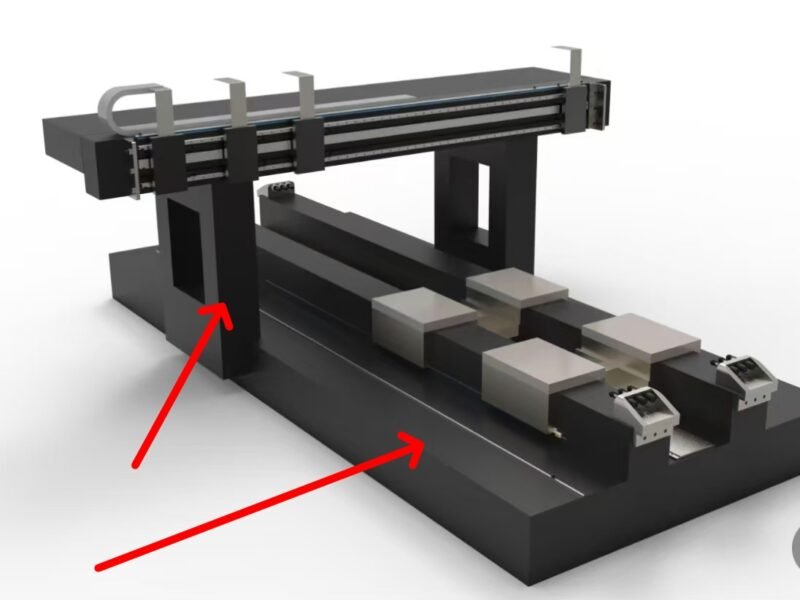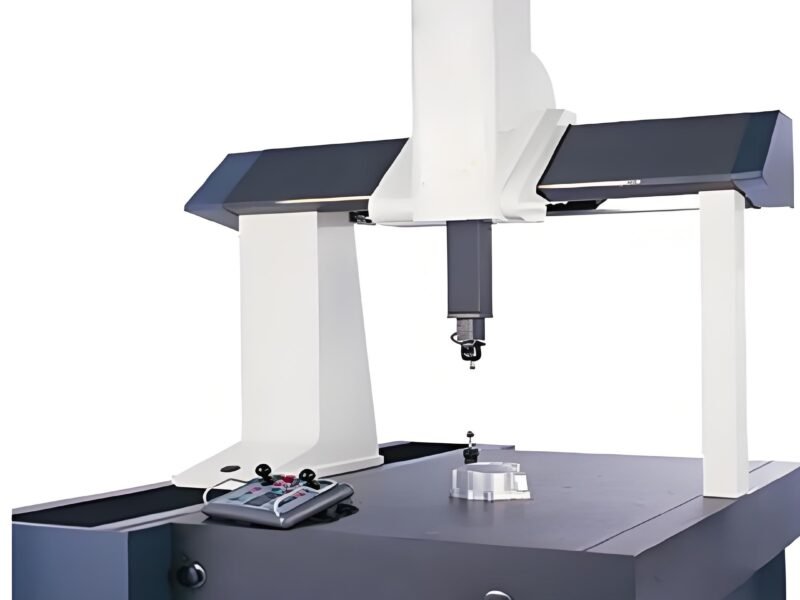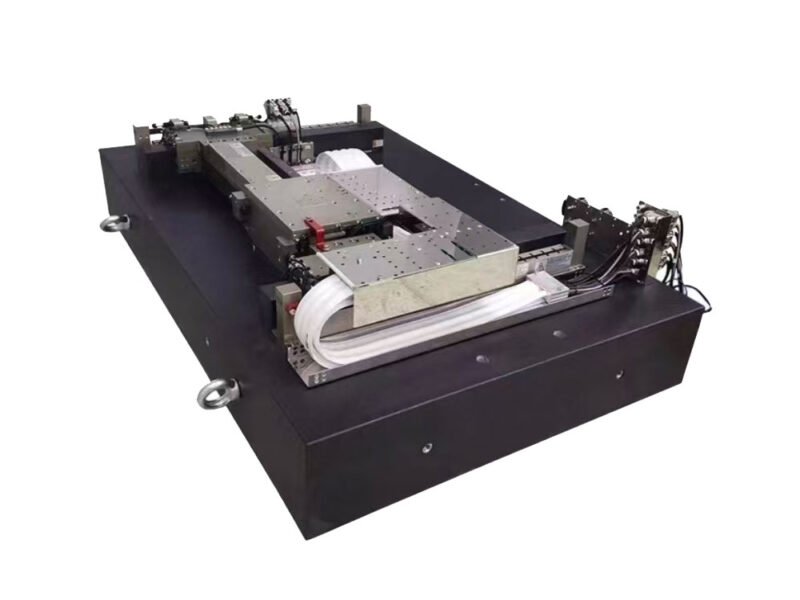
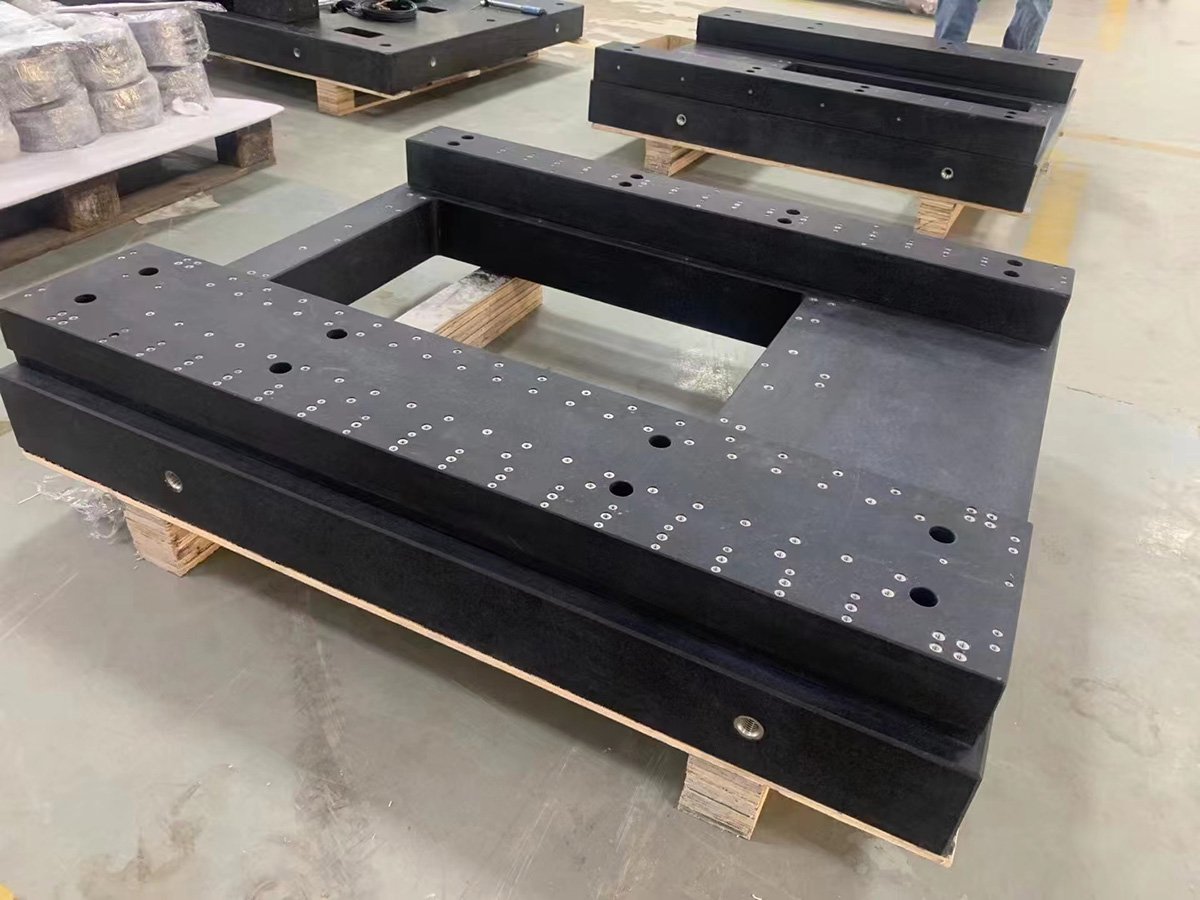
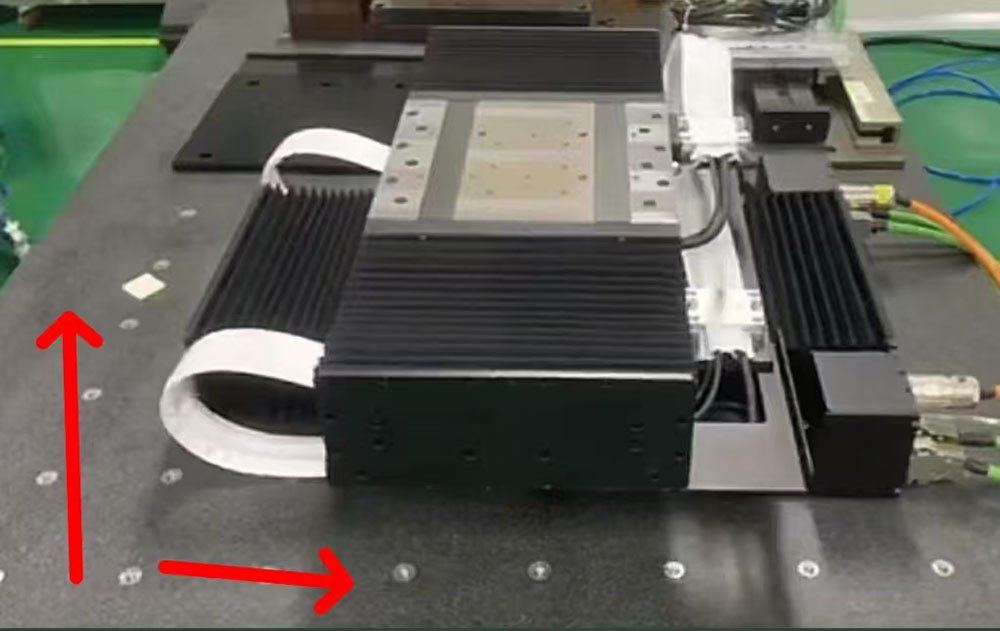
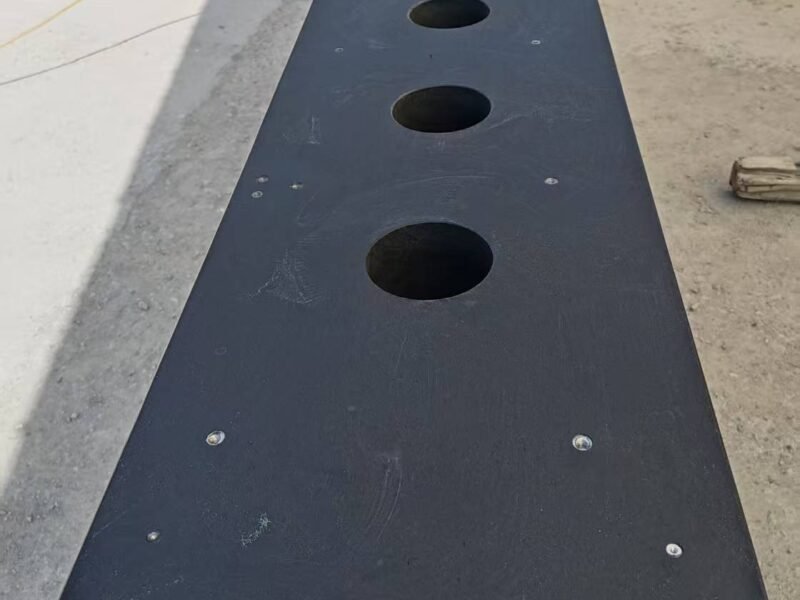
Base de máquina de granito
Welding Wonders Forjando juntos la excelencia
DETALLE DE PRODUCTOS
🎯 Core Advantages
The advantages of granite mainly stem from its natural and stable physical properties:
· Longterm precision and stability
· Characteristics: After billions of years of natural aging, the internal stress of the rock has been eliminated, and it hardly deforms. The of thermal expansion is extremely small, and it is insensitive to temperature changes.
· Advantages brought: It can maintain a working precision of microns or even higher for a time (for example, the flatness can reach 2 microns), making it an ideal reference measuring surface and equipment base.
· Excellent physical and chemical properties
Characteristics: High hardness, wear resistance; non-conductive, non-magnetic; resistant to acid and alkali corrosion.
· Advantages brought: Long service life suitable for electromagnetic sensitive environments; no need for oiling to prevent rust, simple maintenance.
· Excellent damping and shock-absorbing properties
· Characteristics: The internal structure can effectively absorb and attenuate vibrations.
· Advantages brought: Significantly reduce the vibration of the equipment itself and external interference, and improve the stability of precisionining and measurement.
🛠️ Main Application Fields
Based on the above advantages, granite components play a central role in many high-precision and cutting-edge fields:
· Precision measuring instruments
· Typical equipment: Workbench, guide rail, and beam of the three-coordinate measuring machine; various granite plates, straightedges, and gauges, etc., as reference measuring tools.
· Role: As a geometric reference for measurement, its stability directly determines the measurement accuracy of the instrument.
·-end manufacturing and testing equipment
· Typical equipment: Base and workbench of high-precision CNC machining centers, laser equipment, and optical equipment; frame of optical inspection equipment.
· Role: Provide a super stable and vibration-resistant “foundation” for the equipment, ensuring that the machining and testing processes are not.
· Semiconductor and electronic industries
· Typical equipment: Wafer air-floating platform, precision positioning platform, PCB drilling machine body.
Role: In a cleanroom environment, its dust-free, low thermal expansion, and highly stable characteristics are key to ensuring nanometer-level process precision.
· Other precision
· Typical equipment: Precision motion truss systems that require ultra-high repeat positioning accuracy (such as below 6 microns).
· Role: Used high-rigidity and high-damping mechanical structural components to improve the dynamic performance of the system.
FAQ
1. What is the maximum size of granite workbench that can be processed??
1. Our factory can achieve 4000mm × 2000mm × 700mm in a single piece (without splicing, with high-precision platforms of grade 00 and 000), with a conventional platform thickness of 150-400mm; heavy-duty bases can achieve 600-800mm;.
2. Multi piece splicing platform (can be made larger, mainly level 0, suitable for large equipment bases) Our factory can achieve 8000mm × 4000mm × 600mm (splicing short board: the accuracy at the splicing joint is slightly poor, and there is a slight risk of misalignment between the boards under long-term temperature and humidity cycles. High precision measurement should avoid splicing as much as possible).
3. Selection reference suggestions.
✅ Level 000/Level 00 Metrology Inspection Platform: Priority given to integrated whole piece, recommended ≤ 3000 × 2000mm.
✅ Level 0 large-scale assembly and equipment base: splicing solutions can be selected to achieve a size of 6 meters or even larger.
✅ Thickness selection: The larger the length and width, the thicker the height (thickness) must be to prevent deflection and deformation of the tabletop, for example, 3000 × 2000, starting from a conventional thickness of 500mm
2. How many micrometers can the flatness reach? Can the accuracy be achieved at level 00, level 0, or level 000? What are the levels of 000/00/0?
3. Should we use Jinan green or other granite?
1. Physical parameters of Jinan Qingxin: density of 3.07~3.3 g/cm ³; Water absorption rate<0.13%; Linear expansion coefficient 4.16 × 10 ⁻⁶/℃; Mohs hardness level 6-7;
Advantages: ultrafine grain size, uniform and dense structure, low internal stress, good shock absorption and damping, minimal temperature and humidity deformation, stable up to levels 000, 00, and 0; Not dyed, permanently colorfast; Resistant to cutting fluid, non-magnetic, suitable for three coordinate, optical, and semiconductor reference platforms.
Applicable scenarios: metrology room benchmark, 000 level, 00 level high-precision detection platform, high-end equipment base, etc.
2. Indian Black Granite [high-end alternative, can be used at level 000/00]
The performance is close to Jinan Qing, with high density and low coefficient of thermal expansion; Imported raw materials, large-sized raw materials are easier to obtain than Jinan Qing.
Applicable: Class 000, 00 precision base, linear motor platform; The price is slightly lower than the genuine Jinan green.
3. Zhangqiu Black [Cost effective main force, up to level 00, regular level 0]
The density is about 2.8 g/cm ³, and the performance is slightly lower than that of Jinan Qing. It is generally stable at level 0 or level 00, and level 000 is not recommended.
Attention: Some materials need to be dyed, and their water absorption rate is slightly higher than that of Jinan green.
Recommended scenarios: Ordinary workshop 0-level inspection platform, medium precision equipment base.
4. Northeast material [only level 0, ordinary tooling platform]
The grain size is coarse, the density is low, and the stability is poor. It can only achieve level 0 or 1 and cannot achieve level 00/000.
Applicable: Workshop marking, fixture positioning, not suitable for precision measurement.
4. Is there a constant temperature and humidity workshop?
Workshop environmental parameters:
reference temperature: 20 ℃ (international reference temperature for length measurement)
Class 00 control: 20 ℃± 1 ℃,
Class 000 ultra-high precision control: 20 ℃± 0.5 ℃, hourly temperature fluctuation<0.3 ℃;
Relative humidity: 40%~60% RH (conventional stable 45~55% RH), humidity fluctuation within ± 5% RH;
Supporting facilities: shock-absorbing independent foundation, dust-proof purification, no direct blowing, reducing precision interference caused by vibration and airflow.