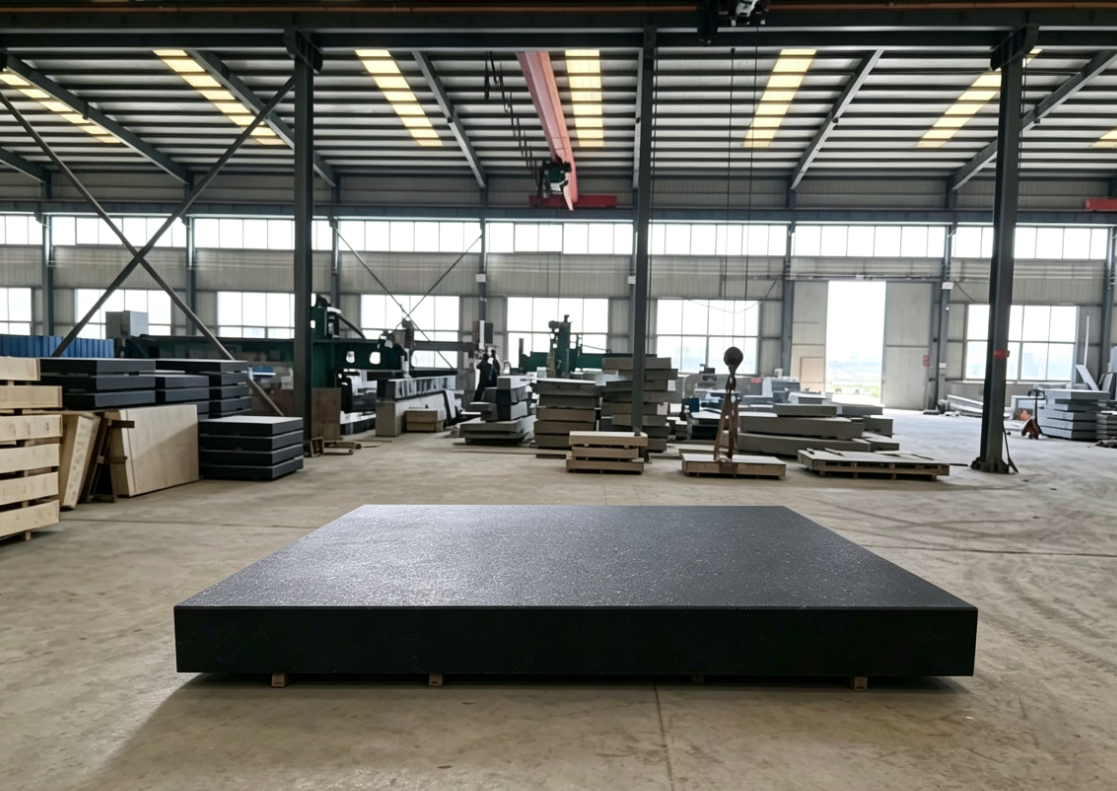
I. Material Description Commonly referred to in the industry as “marble,” it is actually natural black diabase (Indian Black/Jinan Blue Granite), 000grade material specifically for optical equipment, with characteristics adapted to optical nano-level stability requirements: 1. Low thermal expansion coefficient: 0.6×10⁻/℃, only 1/3 of steel, almost no deformation with temperature changes; 2. High damping vibration reduction: Natural crystal structure rapidly absorbs vibrations, eliminating optical path; 3. No internal stress: Natural aging over millions of years, ensuring the flatness and guide rail datum remain undeformed during long-term use; 4. Rust-, non-magnetic, and high hardness, suitable for semiconductor/optical inspection in cleanrooms.
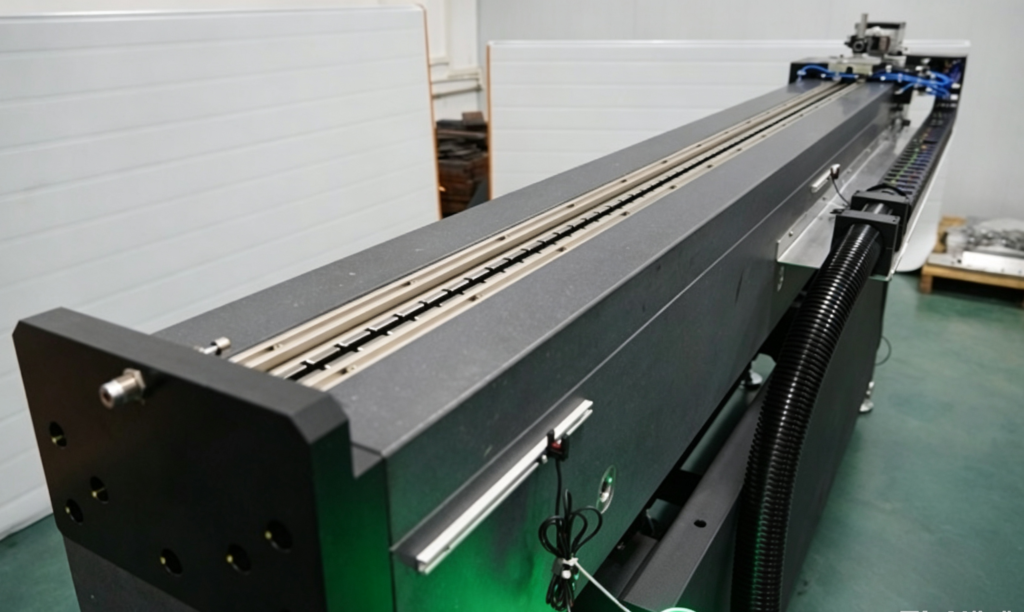
II. Two Process Solutions for “Integrated Guide Rails” 1: Granite Body Integrated Grooved Guide Rails (Integrated Type) Precision guide rail grooves are milled directly into the granite base, and air bearings/roller guide rails embedded. The guide rail datum and the base share the same datum plane, eliminating secondary assembly errors. This is selected for the highest precision optical equipment (lithography, wafer inspection). – Advantages: Extremely small Abbe error, maximum overall rigidity, synchronous deformation with temperature changes; – Applications: Nano-positioning, laser interference, microscopic optical inspection Solution 2: Granite Base Precision Steel Guide Rail Embedded Installation (Mainstream Mass-Production Model) The base reserves a high-precision installation datum, and the guide rails are locked in place via stainless steel threaded inserts and pins. The flatness fits at the micron level, offering higher cost-effectiveness. It is universally used for2D, 3D coordinate, and visual inspection. – Advantages: Short processing cycle, guide rails can be replaced individually, supports large-stroke customization; Optional Guide Rails: Ball linear guide rails, air-floating frictionless guide rails, hydrostatic guide rails.
III. Key Precision Indicators (000-Grade Optical Base) 1. Geometric Precision of the Base Body – Worktable flatness: ≤2μm/1000mm; – Straightness of rail installation surface: ≤0.5μm/m; – Perpendicularity/Parallelism: ≤1μm/m; – Threaded pin hole positioning tolerance ±0.03mm, stainless steel threaded inserts to prevent stripping. 2. Operating Precision of Integrated Guide Rails 1. Ball Mechanical Guide Rails ( for Imaging/Inspection) Repeat positioning accuracy ±0.5~1μm, linear motion straightness ≤1μm/full length; 2. Air-Floatingstatic Guide Rails (High-End Optical/Semiconductor) No mechanical friction, no crawling, bidirectional repeat positioning up to ±30nm, straightness 0.1m/100mm, suitable for laser and wafer inspection.
IV. Core Advantages (Compared to Ordinary Base with Separate Guide Rails) 1. Reduction in System Error Ordinary separate structures (base independent table plate) involve double-layer assembly, superimposing multi-layer flatness errors; integrated guide rails share a single datum, eliminating optical path deviation caused by assembly gaps. 2. Unified Thermal Stability The guide rails and base are made of the same material and expand thermally synchronously. Temperature will not cause misalignment between the guide rails and the base, ensuring no drift in long-term optical imaging. 3. Integrated Vibration Reduction Vibrations will not cause resonance the base and the guide rails, ensuring no ripples in high-magnification microscopy and laser ranging imaging. 4. Compact Structure and Stronger Rigidity Eliminates intermediate plates, concentrates the overall machine weight, resists overturning, and ensures stable operation of heavy-load lenses and inspection modules. 5. Long-Term Maintenance-Free Granite not rust or deform, and the guide rail datum remains stable year-round, making it suitable for 24-hour mass-production inspection in cleanrooms.
V. Main Application Industries
- Semiconductor: Wafer appearance inspection, chip packaging alignment, lithography auxiliary positioning platform;
- Optical Inspection: Fully automatic 2D imaging machine, 3D vision scanning, laser interferometer;
- Precision Measurement: Coordinate measuring machine, optical comparator, contour meter base;
- Laser Equipment: Laser cutting, femtosecond laser processing, optical calibration platform;
- Scientific Research Laboratory: Microscopic imaging, spectral testing, precision displacement experimental table.
VI. Customization and Accessory Specifications
- Dimensions: Full-size customization from 300×300 to 3000×6000mm, thickness 100~300mm for enhanced rigidity;
- Guide Rail Configuration: Single-axis, dual-axis XY, and triple-axis XYZ integrated guide rails, with optional dustproof bellows;
- Accessories: Can be paired with granite vibration-damping supports and air-floating vibration-damping foot pads, suitable for laboratory/workshop vibration environments;
- Precision Grading: Grade 000 is uniformly recommended for optical equipment, while Grade 0 and Grade 1 can be selected for ordinary inspection equipment to reduce costs.
VII. Model Selection Recommendations
- Nanoscale optical paths, semiconductors, laser scientific research → Granite integrated slotted air-floating guide rail base;
- Mass vision inspection, 2D, component dimension measurement → Embedded ball guide rail granite base;
- Workshop environments with high dust and temperature fluctuations → Prioritize high-density Indian Black granite with sealing and pore-filling treatment.