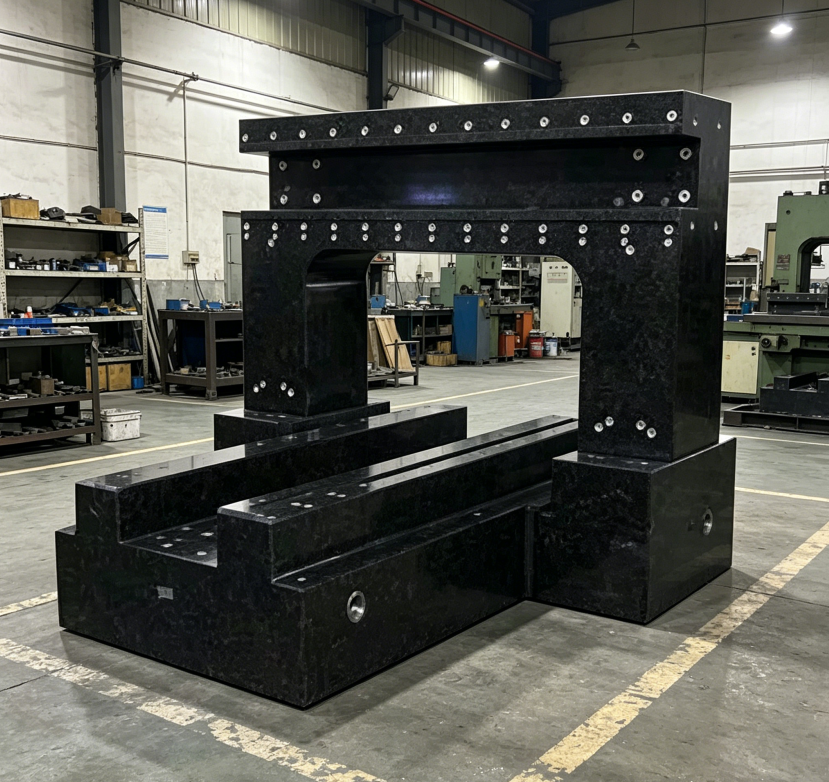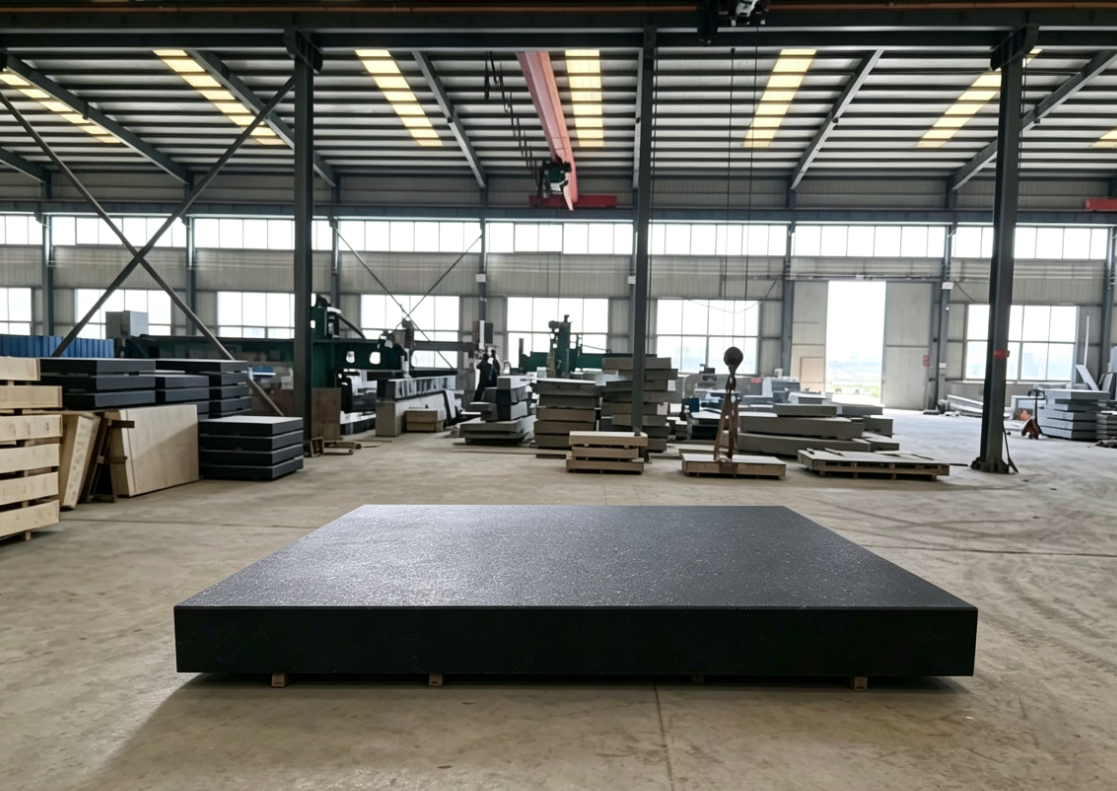
Precautions for Constant-Temperature Heat Treatment of Granite Components
Based on processing experience with Jinan reen, Zhangqiu Black, and Indian stone, this guide covers the entire process from loading, heating, holding, cooling, post-processing, and prohibitions, highlighting the most common pitfall production.
I. Pre-loading Precautions
Heat treatment must be performed after rough machining is completed.
All shaping, milling, drilling, slotting, and installation of embedded sta steel parts must be finished, leaving only grinding allowances; precision machining and grinding must not be followed by heat treatment, as this will destroy the processed accuracy.
Clean the component surface thorou
Remove dust, cutting slurry, water stains, and oil; keep the stone dry to prevent residual moisture from causing color differences or hidden cracks after heating.
Placement Method
Large base coments must be placed flat in a single layer; stacking or heavy pressure is strictly prohibited.
Columns, beams, and irregular shapes must be supported to prevent bending during heatin.
Leave a 5–10cm gap between components to ensure uniform hot air circulation.
Use solid wood or rubber blocks to suspend components from the bottom; do not let them directly contact the ovenetal plate.
Stone in the same batch should be as uniform as possible.
Do not mix Jinan Green, Indian stone, and ordinary granite in the same batch, as their coefficients of thermnsion differ, leading to inconsistent deformation.
II. Precautions for the Heating Stage (The Most Critical Phase for Cracking)
Strictly control the heatingate: 5–8°C/h; exceeding 10°C/h is strictly prohibited.
Rapid heating creates a large temperature difference between the inside and outside of the granite, causing uneven crystal expansion, which ily leads to hidden cracks, invisible cracks, and edge chipping or loss of precision during later grinding.
Do not suddenly expose to high heat or direct hot air blasts.
The oven must en uniform hot air circulation; localized high temperatures are not allowed.
Heat more slowly when ambient temperature is low.
In winter, when workshop temperatures are low, reduce the heatin rate to 3–5°C/h.
III. Precautions for the Constant-Temperature Holding Stage
Temperature must be strictly controlled: 55–60°C; excee is strictly prohibited.
Excessively high temperatures will damage the granite crystal structure, causing micro-cracks, discoloration, and a dull surface.
Temperature fluctuationust be ≤±3°C.
Avoid sudden highs and lows, as repeated stress changes will fail to relieve internal stress.
Holding time is determined by thickness/size.
Small comp 24h, medium components: 48h, large precision components: 72h; insufficient time will result in incomplete stress release.
Components with embedded parts can be treated normallinless steel embedded parts and threaded sleeves can be loaded into the oven together without issue.
IV. Precautions for the Cooling Stage (High-Risk Area for Deformapid cooling, opening the door suddenly, blowing air, or spraying water is strictly prohibited.
Cooling must be slow, with a rate controlled at 3–5
Do not open the door to remove components until the temperature drops below 30°C.
Removing components at high temperatures causes the stone to contract rapidly upon contact with cold air, leading to st rebound and warping.
Keep the oven sealed throughout the cooling process; do not open the door arbitrarily.
V. Post-Discharge Precautions
After discharge, let compo sit at room temperature in the workshop for over 24 hours to fully stabilize before performing semi-precision milling or grinding.
Avoid vibration, impact, or heavy pressure during the restinriod.
Do not transport or lift components immediately after discharge while they are still hot.
VI. Absolute Prohibitions (Red Lines)
Do not perform heat treatment after grinding or precision machio not exceed 70°C.
Do not heat or cool rapidly.
Do not stack large components when loading the oven.
Do not load wet materials or materials with slurry directly ito the oven.