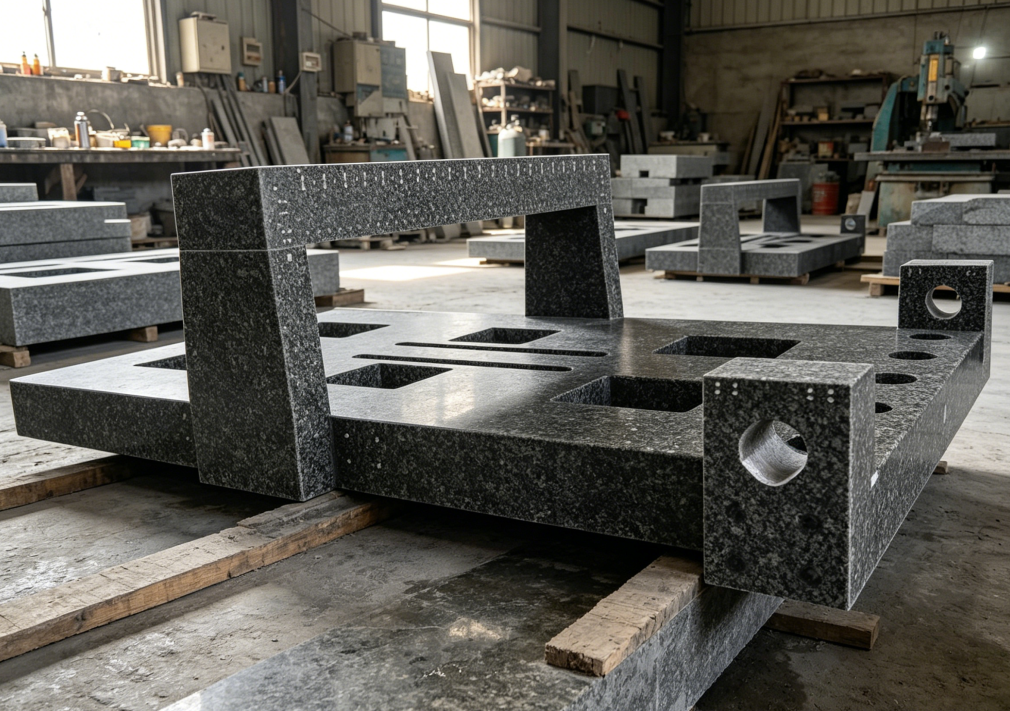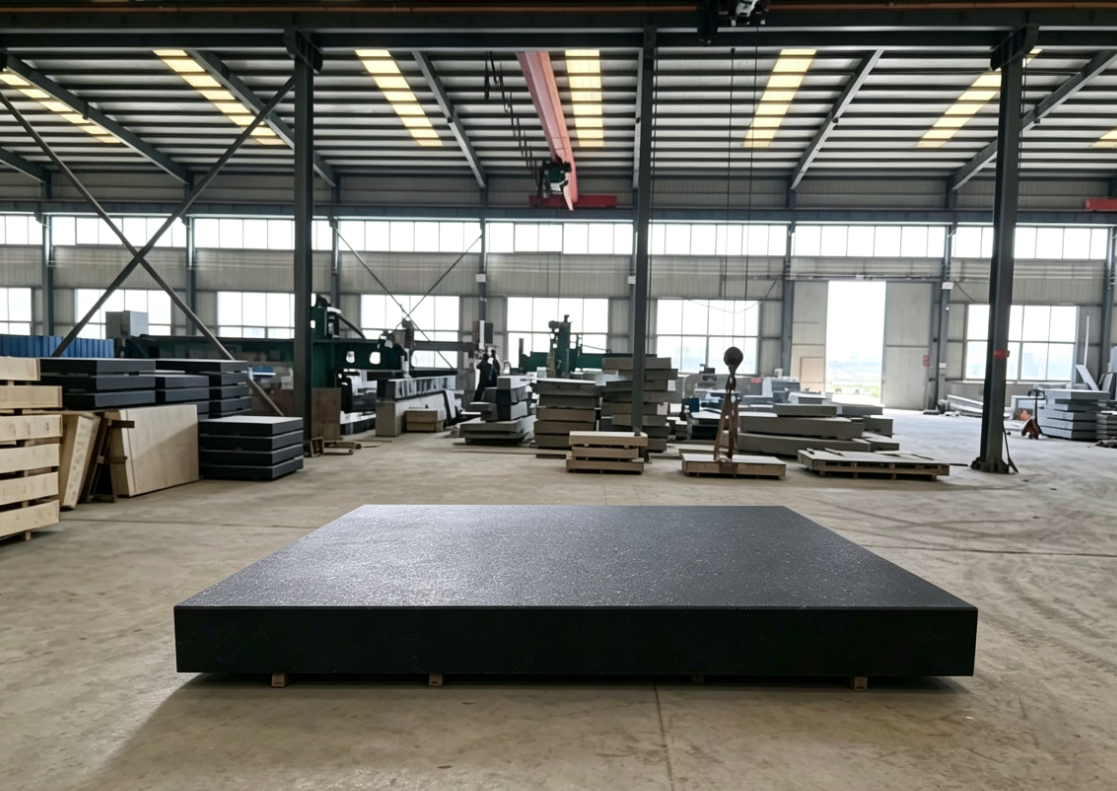
Granite inspection platforms are indeed one of the most core and commonly used reference instruments in the fields of industrial measurement and precision inspection; they can be described as”cornerstone of precision measurement.”
🔍 What is it actually used for?
The granite inspection platform, also known as a granite plate or marble platform, serves the core function of providing a high-precision, high-stability planar reference. Almost all precision inspections rely on it to establish the “zero point” and “reference plane.”
Common application scenarios include:
Workpiece flatness / parallelism / perpendicularity inspection: For example, using dial indicators, micrometers, and height gauges to inspect part form and position tolerances.
Scribing and fixture positioning: Cooperating with right angle rulers and square blocks on the platform to scribe workpieces and position fixtures.
Installation and commissioning of precision equipment: Serving as the mounting base for equipment such as CMMs, vision measuring machines, and optical microscopes.
Metrology room reference transfer: Acting as workshop-level and laboratory-level length and planar references.
✨ Why does industrial inspection rely on granite platforms?
Compared to cast iron platforms, its advantages are almost tailor-made for precision inspection:
Ultra-high precision that lasts long-term
After precision grinding, the flatness of a granite platform can reach the micron level (000 grade precision can even reach sub-micron levels). Unlike cast iron, it does not lose accuracy quickly due to stress release, rust, or wear, and its service life can reach several decades.
Strong resistance to deformation, unaffected by temperature
Granite has an extremely low coefficient of linear expansion, so dimensional changes caused by environmental temperature fluctuations are much smaller than those of steel. It reduces the impact of thermal deformation on inspection results, making it an ideal choice for constant-temperature metrology rooms.
High hardness wear resistance, not afraid of workpiece scratches
With a Mohs hardness of 6-7, the working surface is not easily scratched when parts and measuring tools slide on it, and it can maintain the flatness of the reference surface even after long-term use.
Built-in vibration damping effect, reducing measurement errors
The dense crystalline structure effectively absorbs vibration, avoiding interference from workshop equipment vibration and personnel movement, making the readings of dial indicators and micrometers more stable.
Rust-proof and corrosion-resistant, extremely low maintenance cost
It is not afraid of humidity or slight cutting fluid/oil stains. Unlike cast iron platforms, it does not rust or peel, and daily maintenance only requires wiping with a neutral cleaner.
📊 Precision Grades of Industrial Platforms (National Standard)
Domestically used granite platforms are divided into four precision grades, corresponding to different inspection scenarios:
Cuadro
| Grado de precisión | Applicable Scenario | Flatness Tolerance (Example: 1000×1000mm Platform) |
|---|---|---|
| 000 Grade | Metrology institutes, laboratory references, ultra-high precision detection | ≤2μm |
| 00 Grade | CMMs, vision measuring machines, precision measuring tool detection | ≤4μm |
| 0 Grade | Workshop routine detection, fixture positioning | ≤8μm |
| 1 Grade | Rough machining detection, scribing platform | ≤16μm |
💡 Additional Tips: Key points for selection and use
Material priority: Choose Jinan Green (Jinan Qing). It has a dense structure and good stability, making it the preferred stone for industrial inspection platforms.
Size and thickness matching: The larger the platform, the thicker it must be; otherwise, it is prone to deformation due to its own weight or load.
Installation method is important: For large platforms, it is recommended to use three-point positioning support to avoid twisting and deformation caused by uneven force.