The King of Stable Precision in Precision Manufacturing: Marble Platforms and Linear Motors
I. Introduction
The positioning accuracy requirements for semiconductor metrology, micro-nano laser processing, optical inspection, and high-end automation equipment continue to descend to the sub-micron and nanometer levels. To achieve long-term stable ultra-high precision, a single high-performance driving component is far from enough. Linear motors provide gapless high-speed driving capabilities, while marble (granite) platforms construct a stable and non-deforming mechanical reference. The strong combination of the two forms the core solution for current ultra-precision equipment, becoming the widely recognized “golden precision duo” in the field of precision manufacturing.
Many equipment manufacturers focus only on motor performance, while ignoring the system errors caused by the base. Metal beds are prone to thermal deformation, resonance, and long-term creep; ordinary castings cannot meet the requirements of dynamic high-precision scenarios. However, the combination of marble platforms linear motors solves the three major pain points of vibration, thermal drift, and transmission error from the fundamental material level.
II. Two Core Components, Each Performing Its Function
- Marble Platform: The Stable Foundation of the Entire System
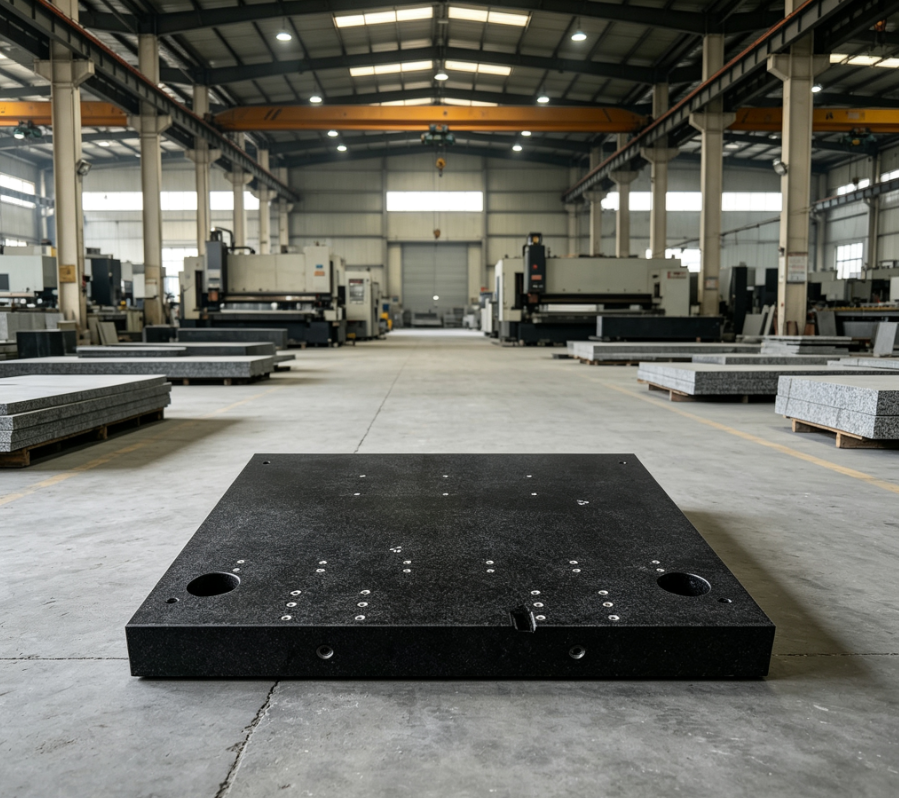
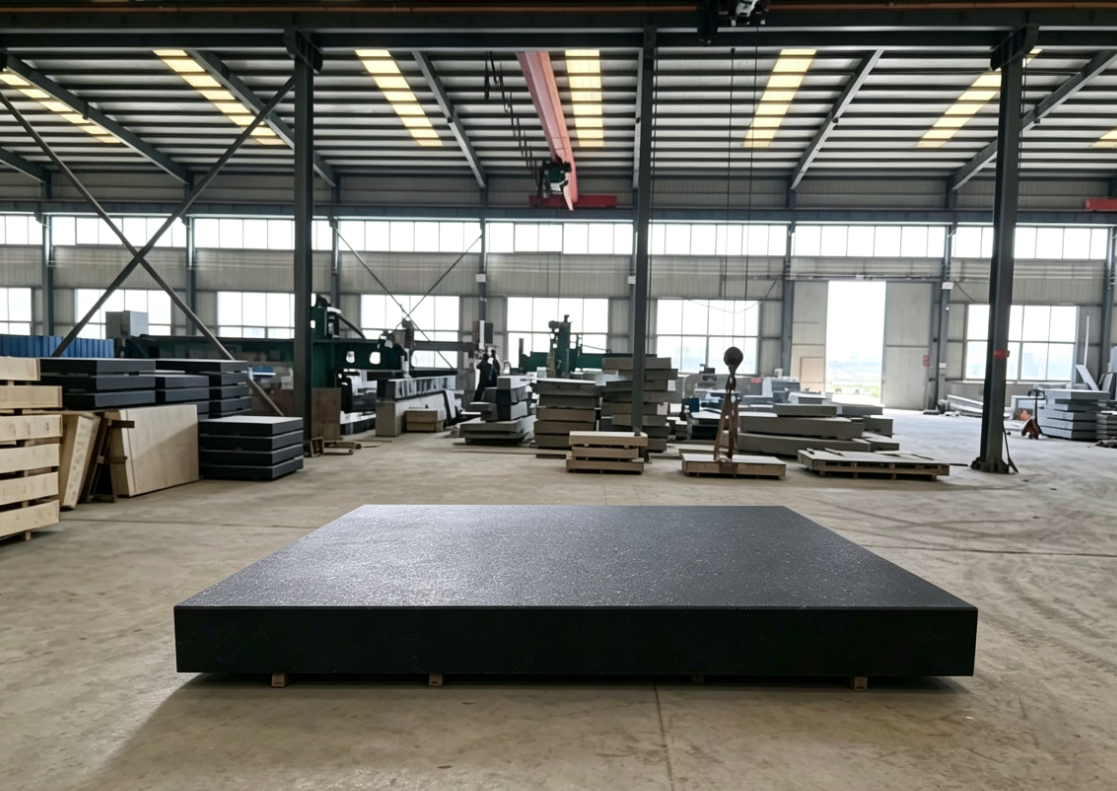
The raw material for marble platforms used in the industrial precision field is black granite (such as Jinan Green, Indian Black, etc.), which is distinct from decorative marble.
✅ Core Advantages:
Extremely low coefficient of thermal expansion: Far lower than steel, the deformation caused by temperature changes is minimal, effectively controlling thermal drift errors;
Excellent vibration damping: The natural crystal structure quickly absorbs vibrations, suppressing oscillations generated by motor start-stop and high-speed reciprocating movements;
Fully stabilized internal stress: After long-term natural aging, it is not prone to slow deformation, and the accuracy of the reference plane is durably maintained;
The surface can be ultra-precisely ground, grooved, drilled, and pre-embedded with cooling pipelines, flexibly integrating guide rails, linear motor stators, and sensors;
Corrosion-resistant and non-magnetic, suitable for use in optical, semiconductor, and electromagnetic environments.
The marble platform does not generate power; its mission is to provide a nearly unchanging rigid reference. Without a stable base, even the most high-end linear motors struggle to realize their nanometer-level positioning potential. - Linear Motor: The High-Precision Gapless Power Core
Traditional screw modules have backlash, friction, and elastic deformation; the higher the speed, the worse the dynamic accuracy.
Linear motors eliminate all intermediate transmission structures, achieving “direct motor-to-load driving”:
✅ Core Advantages:
Zero transmission backlash, eliminating positioning deviations caused by screw backlash;
High acceleration and fast response, suitable for high-speed and high-frequency reciprocating motion;
Smooth motion, which, combined with grating closed-loop control, easily achieves sub-micron or even nanometer-level repeatability;
Long service life, no crawling at low speeds, suitable for long-term continuous operation.
Shortcoming: Linear motors continuously generate heat during operation, and thrust fluctuations easily induce vibrations. If paired with a base that has poor rigidity and weak vibration damping, the vibrations and thermal deformations will be continuously amplified.
III. 1 1>2: Synergistic Advantages of Marble Platform × Linear Motor
Standalone linear motors and standalone marble platforms each have their limitations; their integrated combination creates a complementary effect:
Vibration Damping Synergy
The high-speed start and stop of linear motors generate disturbances, while granite rapidly attenuates vibrations, preventing vibration amplification and ensuring stable grating readings;
Thermal Drift Suppression
The low thermal expansion characteristic of marble reduces overall deformation caused by heat diffusion from the motor; high-end solutions can embed water-cooling channels inside the stone to achieve active temperature control;
Integrated Structural Design
The linear motor stator, air bearing guide / linear guide are directly installed on the ground marble reference surface, reducing cumulative errors from multi-layer assembly; common forms: marble base single-axis platform, marble gantry, marble beam linear motor module;
Long-term Precision Consistency
Under 24-hour continuous operation, compared to cast iron platform solutions, the precision drift is smaller, significantly reducing the frequency of periodic equipment calibration.
IV. Mainstream Structural Forms
Single-axis Linear Motor Platform
Marble base equipped with a linear motor and linear guide / air bearing guide, widely used in wafer inspection and laser engraving;
Marble Gantry Linear Motor System
Marble fixed beam linear motor driven slide, mostly used in large-area optical inspection and the panel industry;
Marble Beam Linear Motor (Dual-drive Synchronous)
Moving beam of large-scale equipment, synchronously driven by dual linear motors, relying on the rigidity of granite to ensure synchronization precision, commonly used in CMMs and automated inspection equipment.
V. Applicable Industry Scenarios
Semiconductor: Wafer appearance inspection, prober, lithography supporting motion platforms
Optoelectronics: Mini/Micro LED inspection, optical lens centering, laser micromachining
Precision Metrology: CMMs, high-precision calibration platforms
Scientific Research Equipment: Electron beam systems, micromanipulation, quantum optics experimental platforms
VI. Key Selection Points (Practical business content, ready for direct customer communication)
Material Selection: Jinan Green is suitable for conventional domestic precision equipment; Indian Black has higher density and is suitable for ultra-high stability export equipment;
Precision Matching: The flatness and straightness accuracy of the platform must match the positioning accuracy of the linear motor;
Thermal Management Planning: For long-term high-speed operation scenarios, prioritize marble embedded cooling structures;
Guide Rail Pairing: For micron-level applications, use linear guide rails; for nano-level dynamic scenarios, prioritize air-bearing hydrostatic guide rails;
Installation Layout: The installation position of the motor stator, cable slots, and cooling hole locations should be integrated into the design in advance to avoid secondary processing later.