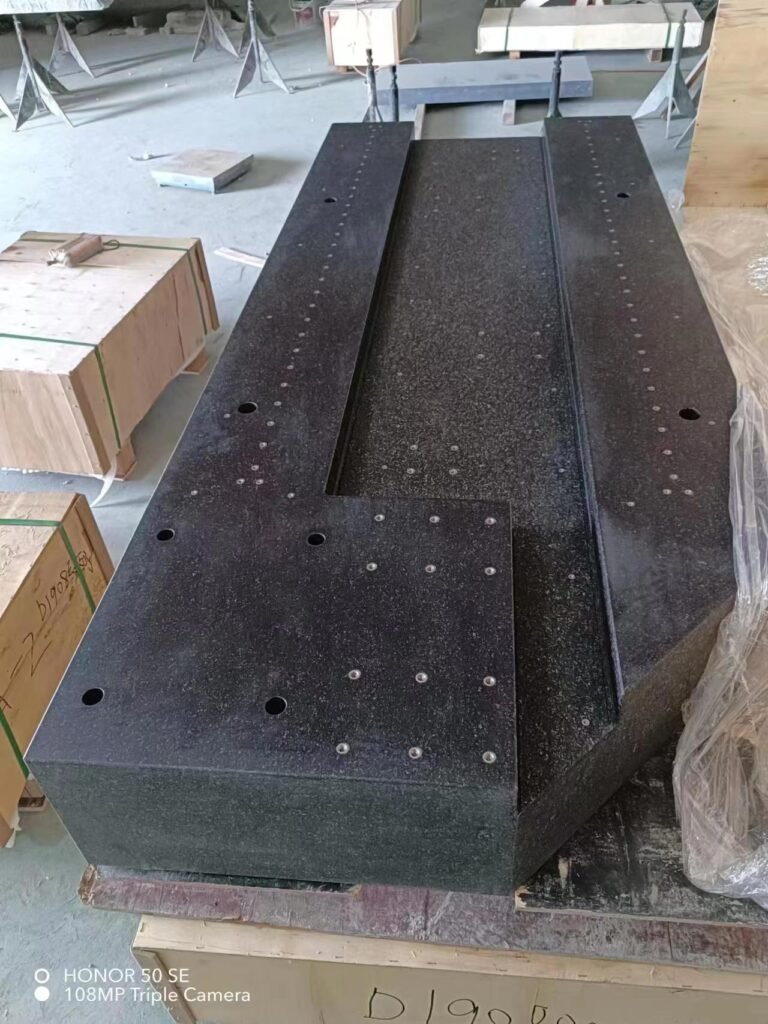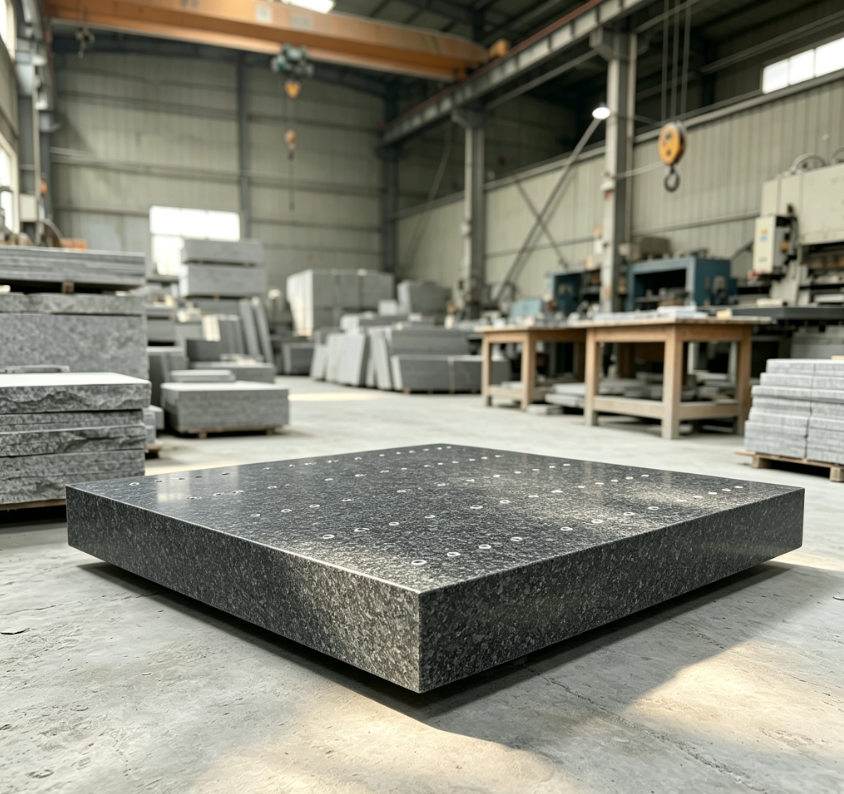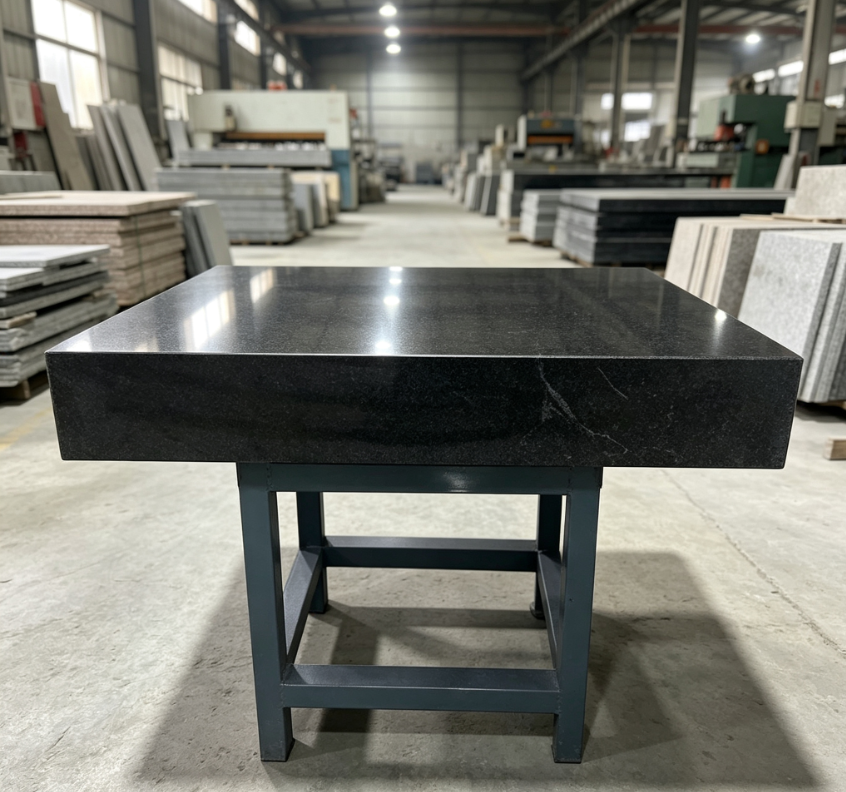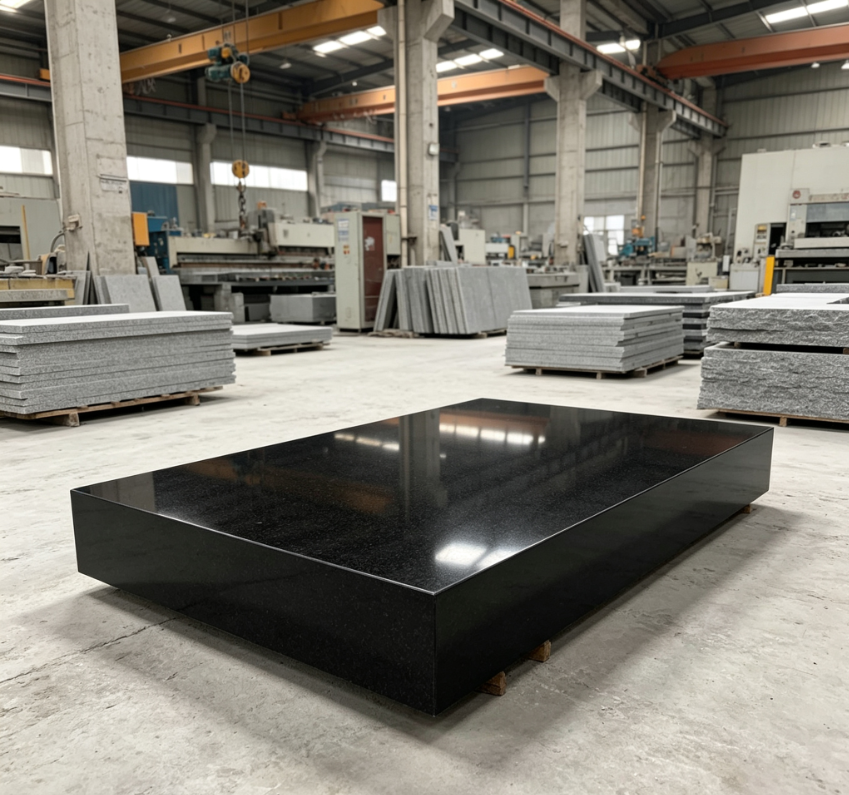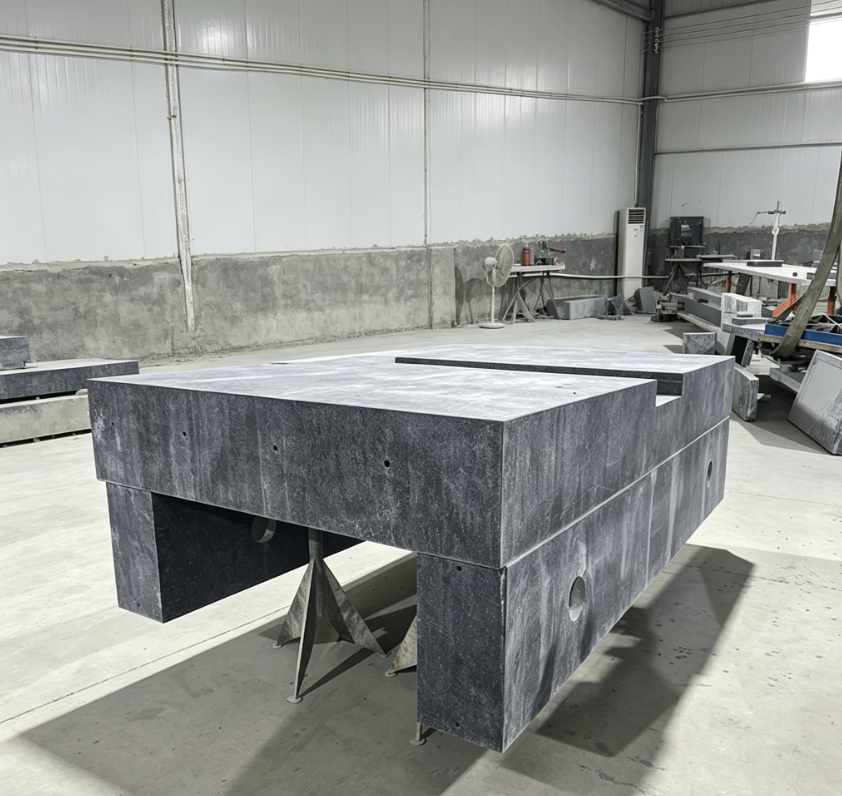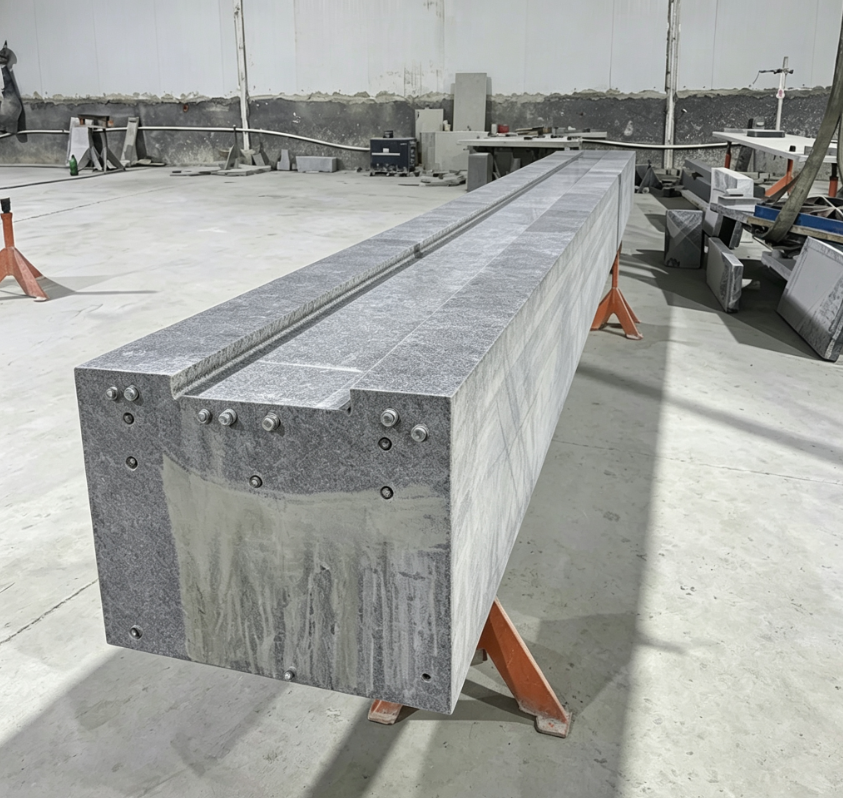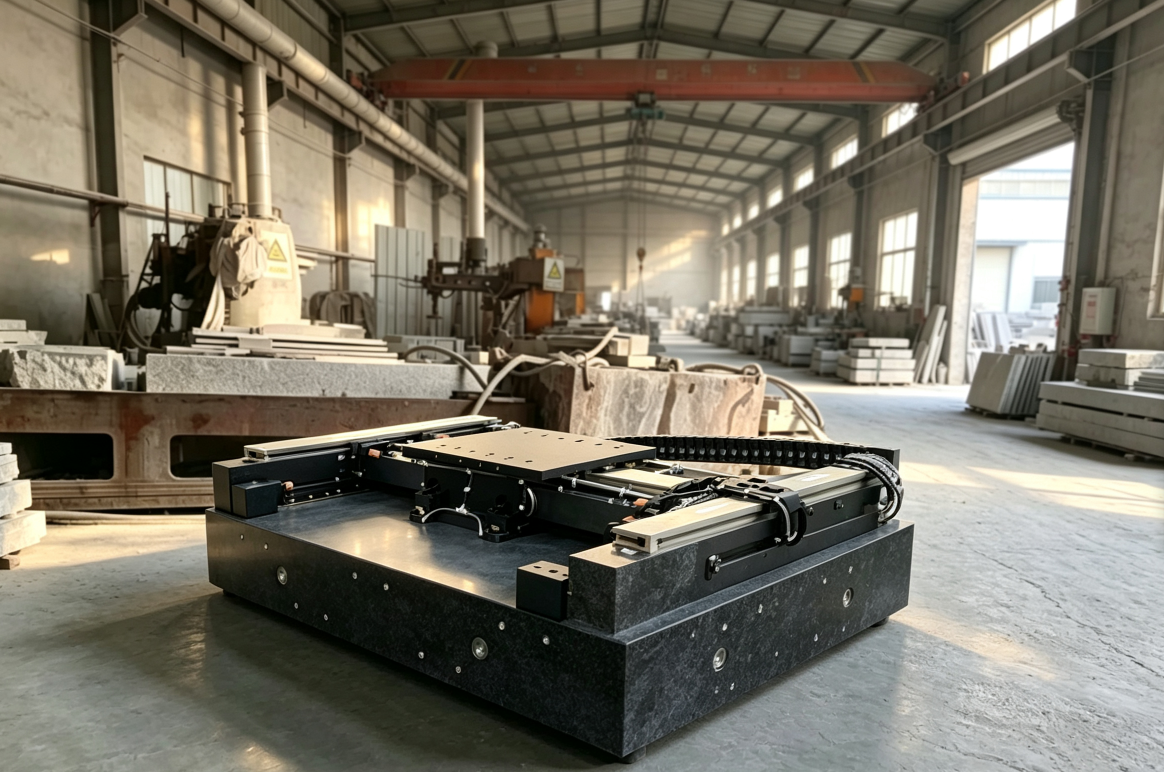
Semiconductor manufacturing is a game of nanoscale precision, and granite is the only cost-effective structural material that simultaneously meets the requirements of ultra-stability, ultra-flatness, vibration resistance, low thermal expansion, and long-term dimensional stability.
I. Precision Requirements for Semiconductors: Nanometer-level; a difference of 1ns scrapping
Semiconductor lithography, etching, inspection, bonding, probe stations…
The required precision is:
±0.1μm to tens of nanometers
While ordinarl structures:
Cast iron creeps, rusts, and expands with heat
Aluminum has poor rigidity and expands with heat
Steel is too heavy, magnetic, and prone o resonance
Artificial marble has a loose structure and poor stability
Only high-grade black granite can hold this line.
II. 6 “Irreplaceable” Advantages f Granite
- Extremely low and uniform coefficient of thermal expansion (most critical)
Granite: ≈4.5×10⁻⁶ /℃
Alumnum: ≈23×10⁻⁶ /℃
Cast iron: ≈10~12×10⁻⁶ /℃
A temperature fluctuation of 1℃ causes aluminum to de5 times more than granite.
Even a 0.5℃ temperature fluctuation inside semiconductor equipment
causes aluminum/iron structures to drift by several microns, directly scrappine chip.
Granite barely “wanders” with temperature. - Extremely high damping, naturally vibration-resistant (chips fear vibration most)
Inside semiconductor equipment:
High-speed motors
Air-bearig platforms
Vacuum pumps
External factory vibrations
Granite’s internal damping is 5~10 times that of cast iron,
causing vibrations to quickly attenuate without resonmplification.
Vibration >10nm affects lithography alignment and imaging.
Granite is a natural “anti-vibration base”. - Long-term stability: no deformation decades
Granite is natural rock, naturally aged over hundreds of millions of years,
with no internal stress, no creep, and no relaxation.
Cast iron and aluminum alloys undergo slight deforma after a few years,
while granite:
Precision drift < 0.5μm over 10 years
For semiconductor equipment, it is a “permanent reference”. - Hgh rigidity, sufficient self-weight, and resistance to deformation
Semiconductor equipment often has moving parts weighing several tons,
requiring a base that does not bend, twist, or
Granite has high density and rigidity,
so even large platforms with large spans have minimal deflection. - Non-magnetic, non-conductive, and rust-proof
Litd inspection equipment have high-precision optical systems,
laser interferometers, and capacitance sensors,
as well as strong electric and magnetic fields.
Cast iron and steel are magnan interfere with precision sensors.
Granite: completely non-magnetic, insulating, rust-proof, and resistant to acids and alkalis. - Can be machined to extremeigh flatness and maintain it
Super-grade granite can be ground to:
Flatness 0.2μm/m² or higher
Surface roughnes 0.02μm
Once this precision is achieved,
it requires almost no recalibration for decades.
III. Where in Semiconductor Equipment Must Granite Be Used?
Almost all precision workstations depend
Lithography machine base & worktable base
Nanometer-level alignment; a slight error scrapping the entire wafer
Probe station and test station bases
Needle tipsact the chip; vibration directly damages the wafer
Dicing machine, thinning machine, and bonding machine bases
High-speed motion precision positioning
AOI optical inspection equipment platsual imaging must be absolutely stable
Precision supports inside etching and thin film deposition equipment
Chamber environments are harsh; requires corrosion resistance stability
It can be said:
Without ganite bases, advanced process semiconductor equipment simply cannot be manufactured.
IV. Why not use more advanced materials?
Such as ceramic, Invar, or carbon fiber?
Ceramic: Brittle, expensive, prone to cracking in large sizes
Invar: Extremely expensive, heavy, difficult to machine
Carbon fiber: Complex thermal drift characteristics, poor damping
Artificial marble: Far less stable than natural granite
Considering cost, performance, and size comprehensively, granite is the only optimal solution.
V. One-sentence summary
Semiconductor equipment requires
nanometer-level stability, nanometer-level flatness, and nanometer-level vibration resistance
Granite is precisely the naturally perfect material that is
low thermal expansion, high damping, high rigidity, stress-free, non-magnetic, and corrosion-resistant.