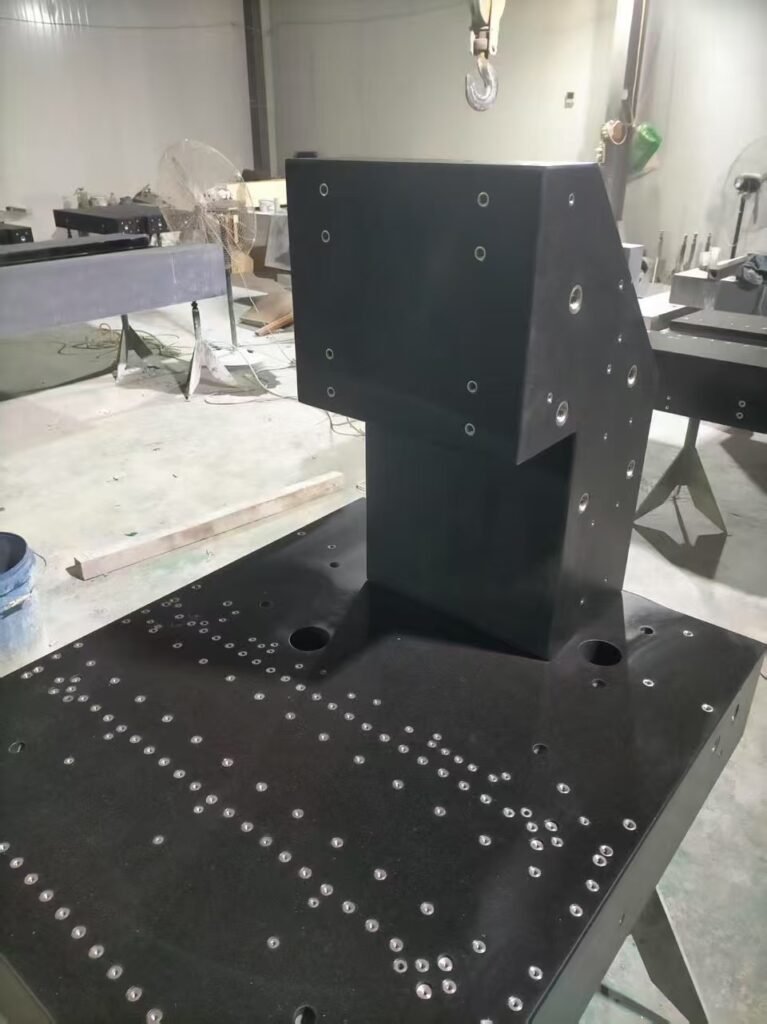
Granite gantry bases have become a critical foundation component for high-precision, high-speed CNC machine tools to achieve ultra-precision machining, with theilue stemming from the extremely low internal stress, high damping characteristics, and low coefficient of thermal expansion endowed by natural geological aging. Compared with traditional cast iron and artificial marble (minesting) bases, granite demonstrates significant advantages in dynamic stiffness retention, thermal deformation control, vibration attenuation, and long-term positioning accuracy stability, making it particularly suitable for high-precision machining scrios such as aerospace, optical molds, and semiconductors. This report systematically analyzes the influence mechanism of granite gantry bases on the stability of CNC machine tools from the perspectives of materia properties, structural mechanics, stability indicators, and engineering applications, and clarifies its applicable boundaries and technical advantages through multi-material comparisons.
The stability of CNC machine tools is a core factor determining machining accuracy, surface quality, and production efficiency. In the context of modern manufacturing advanwards micron and even nanometer-level precision, even minute deformations or vibrations of 0.1μm can lead to the scrapping of critical components such as aircraft enginemiconductor wafers. As the “foundation” of the entire machine, the physical properties of the materials and the structural design of the machine tool’s major components (olumn, crossbeam) directly determine the machine’s stability performance under complex operating conditions such as dynamic cutting, temperature fluctuations, and long-term operation.
In traditional design, cast iron has long nated as the material for machine tool bases due to its mature manufacturing processes and controllable costs. However, with the surge in demand for precision machining, the inherent defects of cast as residual internal stresses that are difficult to eliminate through artificial aging, a high coefficient of linear expansion, and limited damping characteristics—have gradually become bottlenecks for precision improvement. example, the slow release of residual internal stresses in traditional cast iron beds after long-term operation can cause minute deformation, while a temperature fluctuation of just 1°C can result in dimensil changes of several micrometers, failing to meet the stringent requirements of ultra-precision machining.
The application of granite (especially dense varieties such as Jinan Black and Indian Black) as a new material for machine tool bases c traced back to Coordinate Measuring Machines (CMMs) in the mid-20th century—these devices require extremely high long-term stability of reference surfaces, a demand perfectltched by the characteristics of natural granite. Since the 1980s, high-end sectors such as aerospace and optical machining began introducing granite into the design of CNC machinl beds; from 2023 to 2026, driven by the surge in demand for precision parts in the semiconductor and new energy vehicle industries, the penetration rate of grgantry bases entered a period of rapid growth. According to statistics from the China Machine Tool Association, the demand for granite bases in the precision machinery sector re82,000 units in 2023, accounting for 37.6% of the overall market, a 6.3 percentage point increase from 2020.
Unlconstruction granite, machine tool-grade granite must meet strict material screening standards: it requires the selection of fine-grained, homogeneous, and crack-free blocks. For some high-grades (such as Jinan Black), the mineral grain size is ≤0.1mm and density fluctuation is ≤0.05g/cm³, ensuring uniformity of physical properties. Based on industry field data and engineering cases from 2023 to 2026, this report will deeply explore the multi-dimensional stability impact of granite ganbases on CNC machine tools, and systematically compare them with cast iron and artificial marble, providing scientific support for the optimization of machine tool design and high-precision manufacturin.
- Key Indicators of CNC Machine Tool Stability
Before delving into the influence of materials, it is necessary to clarify the core indicators for ev CNC machine tool stability and their engineering significance—these indicators are not isolated but interconnected, collectively determining the actual machining capability of the machine tool.
2.1 Dynamic Stiffnic stiffness refers to the ability of the machine tool structure to resist elastic deformation under dynamic alternating loads (such as cutting force fluctuations, spindle high-speed rotation imbalance, and tool change is). Its core evaluation parameters are natural frequency and amplitude decay rate. Unlike static stiffness, which only reflects deformation under static loads, dynamic stiffness directly corresponds to vibration response during actual machining: when tfrequency of dynamic loads approaches the natural frequency of the machine tool structure, resonance is triggered, causing a sharp amplification of amplitude. In such cases, even if the static stiffness tremely high, the generation of machining errors cannot be avoided.
The physical essence of dynamic stiffness is the structure’s “resistance to vibration deformation,” and its numerical value is equal the ratio of the excitation force amplitude to the vibration displacement amplitude—the higher the ratio, the smaller the deformation of the structure under the same dynamic load. For high-speed cutting, theon frequency of cutting forces typically ranges from hundreds to thousands of Hertz. If the dynamic stiffness of the machine tool structure is insufficient, it will directly lead to relative displacement between tool and the workpiece, causing chatter marks on the machined surface, and may even lead to tool breakage .