Granite Precision Gauges: How Accuracy Grade Directly Determines Service Life
A brief summary of the core logic: The higher the accuracy grade (000 > 00 > 0 > 1 > 2), the stricter the requirements for material, processing, operating environment, and maintenance. The theoretical physical lifespan is longer, but the effective accuracy lifespan is shorter; low-grade gauges have similar physical lifespans, but their accuracy degrades faster. Below is a detailed explanation using plain language and industry test data:
I. First, Understand 2 Key Lifespan Concepts
Physical Lifespan: The number of years the stone body remains uncracked, unchipped, and undamaged, allowing it to be used as a component (the material lifespan of all granite grades is almost the same, 20–50 years).
Accuracy Lifespan: The effective service life during which the factory flatness/perpendicularity tolerance remains unchanged (the higher the accuracy grade, the more sensitive this lifespan is).
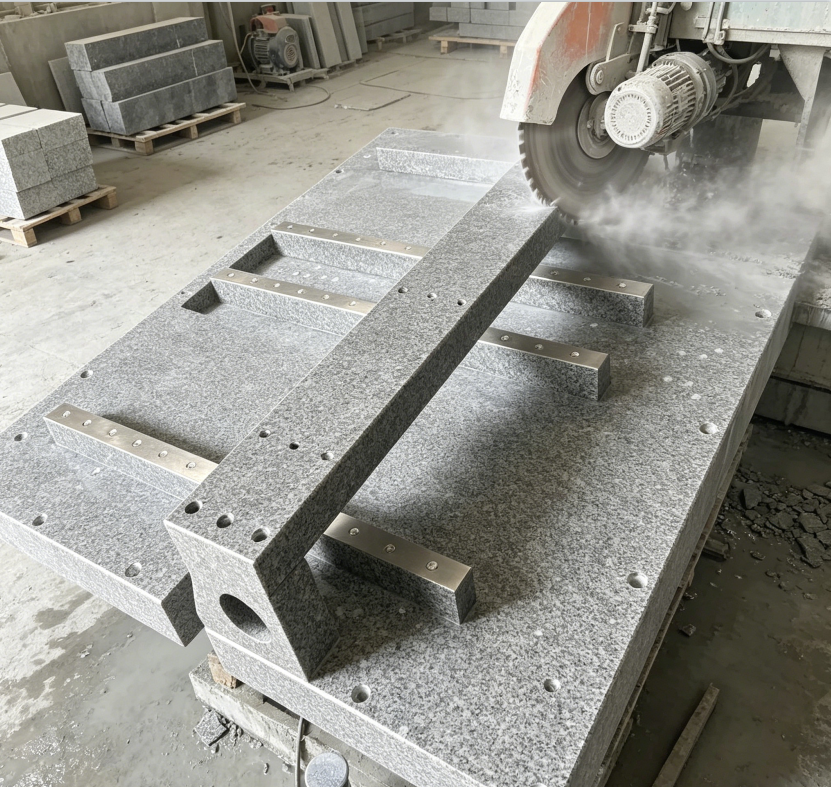
II. Differences in Accuracy Grade → Service Life (Based on the granite square in your picture)
- Grade 000, Grade 00 (Ultra-precision grade, common for your square)
Extremely strict accuracy tolerance: The flatness tolerance is only 1–3μm; even the slightest deformation or scratch will exceed the limit.
Accuracy Lifespan: 20–40 years when used properly in a constant-temperature metrology room; in a regular workshop environment, accuracy will degrade and downgrade in 5–8 years.
Characteristics: Extremely long physical lifespan, but the accuracy is “delicate”. Slight bumps, temperature fluctuations, and dust friction will directly cause the loss of the original 00/000 grade accuracy, leaving it to be downgraded and used as Grade 0/1. - Grade 0 (Precision grade)
Tolerance is doubled, and fault tolerance is improved.
Accuracy Lifespan: 15–30 years in a dry precision workshop, 10–15 years in a regular workshop.
Characteristics: Balances accuracy and durability, making it the most balanced grade for workshops. - Grade 1, Grade 2 (General inspection grade)
Loose tolerances, insensitive to minor deformations and scratches.
Accuracy Lifespan: 8–15 years in a regular machining workshop; can be used stably even with rough handling.
Characteristics: The most durable accuracy lifespan; even with slight surface wear and minor bumps, it still meets the grade requirements.
III. 4 Underlying Reasons Why Accuracy Grade Affects Lifespan - Different Processing Stresses: High-precision parts are more “sensitive” internally
Grade 000/00 parts undergo ultra-fine grinding and aging to relieve stress, completely releasing internal stresses in the stone, making the body more stable; however, the surface microstructure is extremely fine. Once subjected to external impact, it is highly prone to invisible internal cracks and micro-deformations, directly scrapping the high precision.
Low-grade parts have greater processing roughness, making their surfaces more resistant to scratches and impacts. - Vastly Different Environmental Tolerance
Grade 000/00: Must be kept at a constant temperature of 20±2°C, dust-free, and vibration-free. A temperature difference >5°C will cause micron-level deformation, and long-term fluctuations will directly accelerate accuracy failure.
Grade 1/2: Basically unaffected by temperature differences, vibrations, and dust in a regular workshop.
In short: The higher the accuracy, the more demanding the environment. If the environment is substandard, the lifespan is directly cut in half. - Completely Different Wear Sensitivity
Granite has a high Mohs hardness, but it still experiences micron-level wear:
Grade 00: Wears by 0.1–0.3μm per year, exceeding the tolerance in a few years;
Grade 2: Tolerance is tens of microns; the same amount of wear will not affect the grade for decades. - Different Downgrade Reusability
After the accuracy of high-precision gauges degrades, they can be used in a downgraded manner: Grade 00 → Grade 0 → Grade 1 → Grade 2, making the overall usage cycle actually longer; low-grade gauges are scrapped directly after degradation.
IV. Practical conclusions for your ** granite square (precision component with holes) **
For CMM, vision measuring machines, and laboratory standards, choose Grade00/000: Physical lifespan of 30 years, but requires a constant temperature environment, otherwise accuracy will degrade in about 5 years;
For workshop inspection and tooling positioning, choose Grade 0: Best cost-performance ratio and longest accuracy lifespan;
For general scribing and assembly verification, choose Grade 1: Durable and, with the simplest maintenance.
V. A simple one-sentence summary
The higher the grade, the more durable the stone itself, but the shorter the time it maintains high; the lower the grade, the longer it maintains its grade accuracy, but it cannot meet high-end inspection requirements.