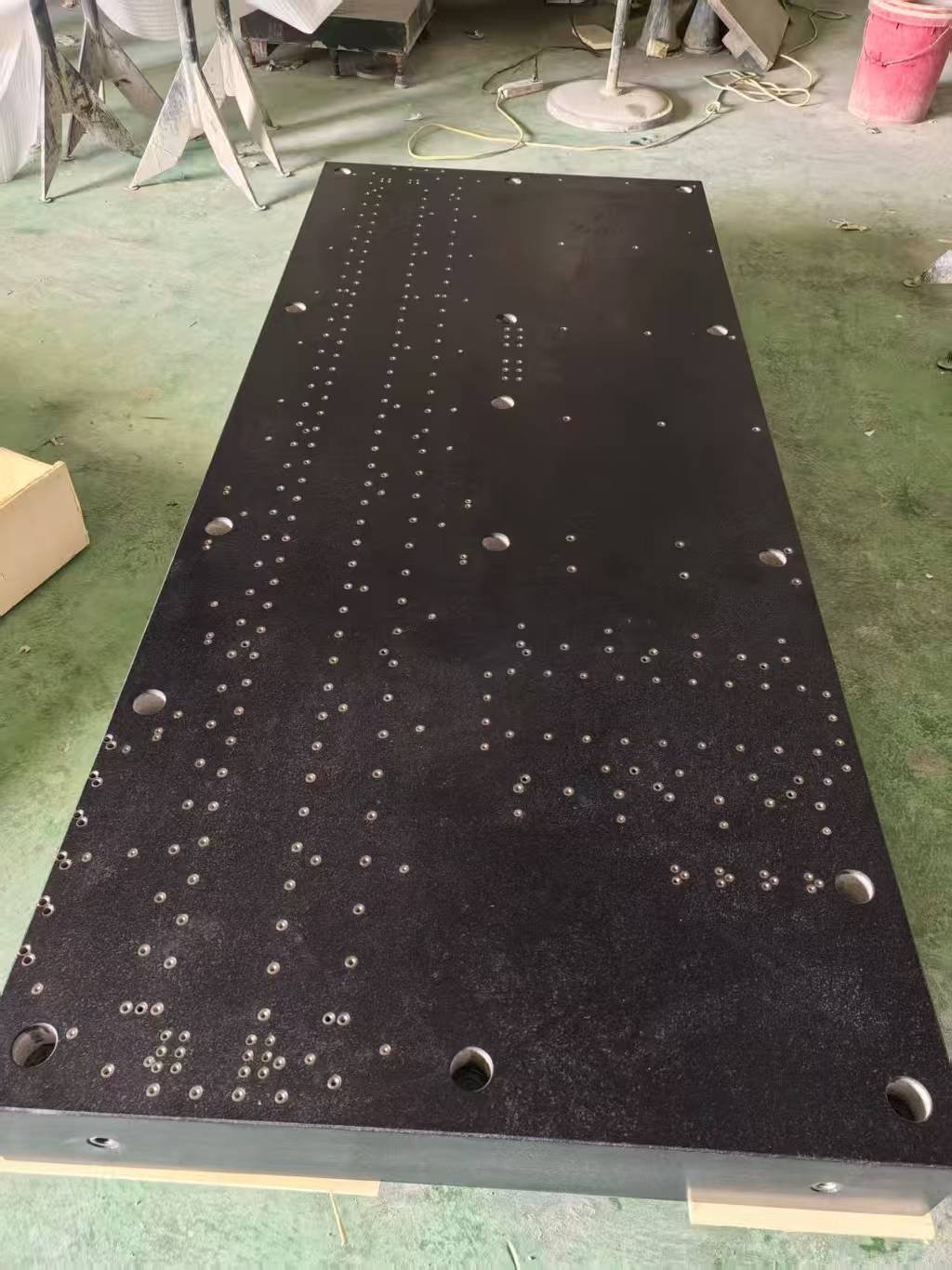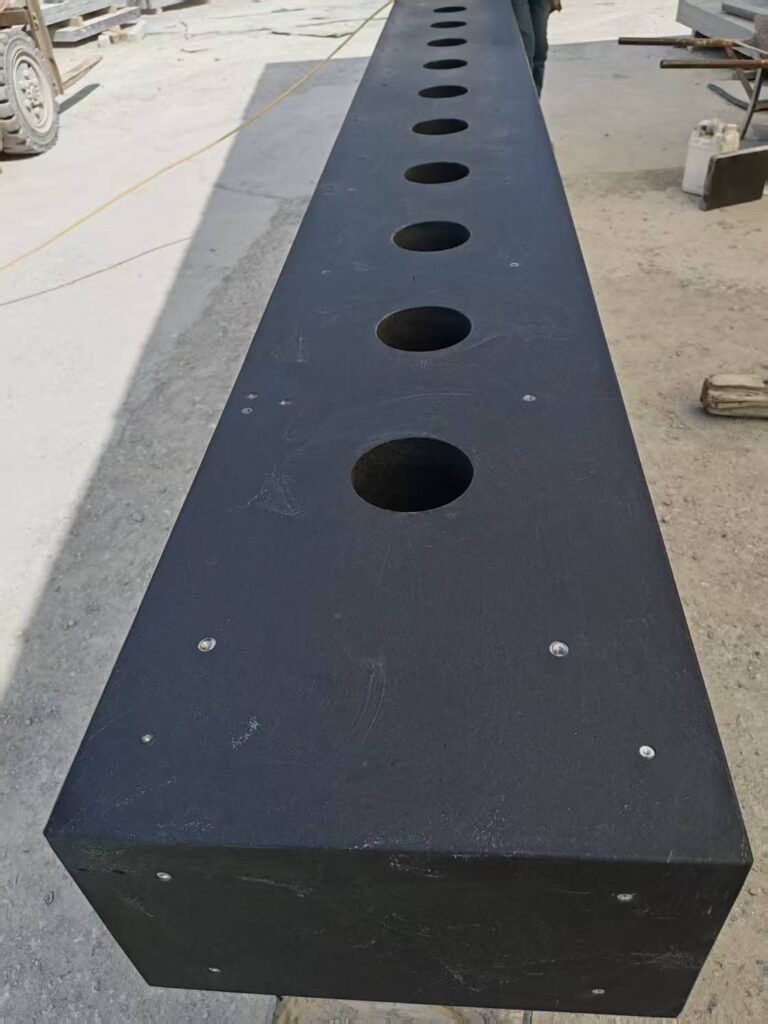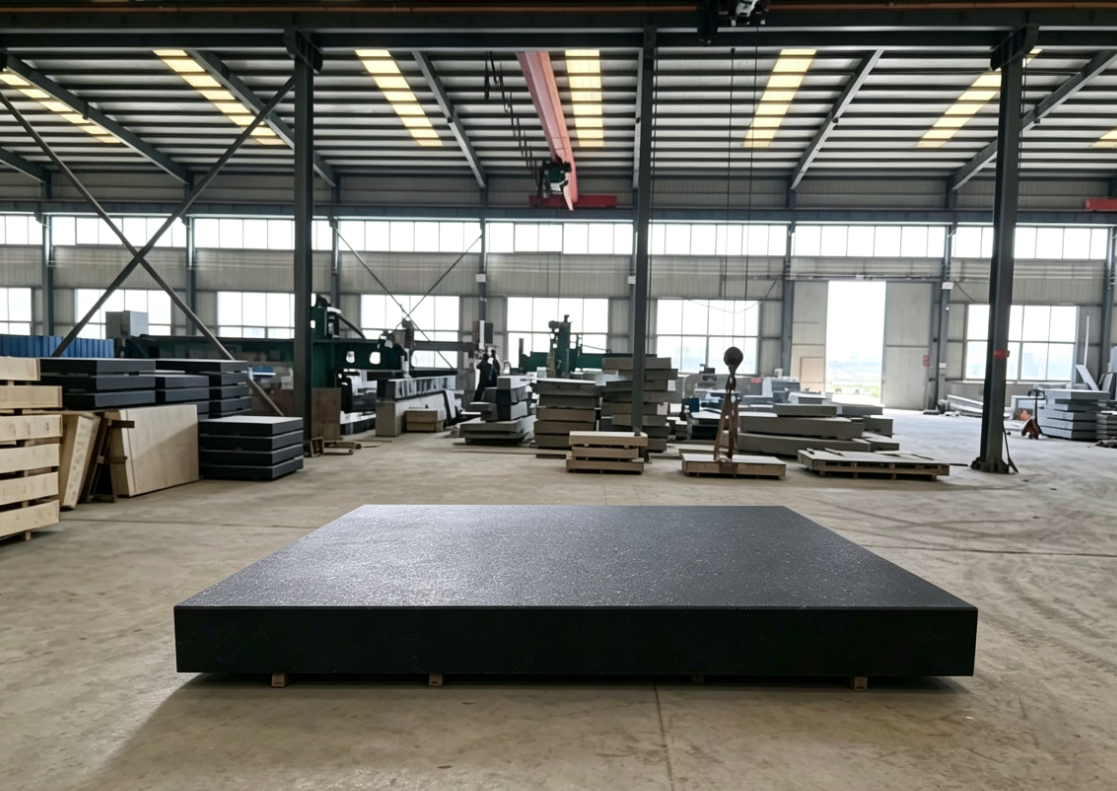
In the field of ultra-precision manufacturing and metrology, equipment bases are not merely simple support structures, but the physi carriers of precision benchmarks—their performance directly determines the imaging resolution of optical systems, the accuracy of parameters in semiconductor inspection, and even the full lifecycle yield of core equipment such as lithogramachines and coordinate measuring machines. For equipment requiring precision at the sub-micron or even nanometer level, even a deformation of 0.1 μm or vibation of 0.01 mm/s in the base can lead to catastrophic consequences, such as measurement data deviation, lithography overlay errors, or the scrapping of entire batches of waferSpecifically, materials for precision equipment bases must meet five core requirements:
Dimensional stability: During long-term use (years to decades) and temperature fluctuations, deformation must be controled within 1/10 of the equipment’s precision threshold—for example, a 12-inch semiconductor wafer inspection platform requires base deformation ≤0.05 μm/m; oise, it will cause wafer positioning deviation and affect the repeatability of inspection results;
Vibration control: Capable of rapidly attenuating micro-vibrations generated by the equipment elf (such as motors and guides) and the environment (such as personnel movement and air conditioning airflow), suppressing amplitude to the nanometer level to avoid vibration interference with optical system imaging or probesitioning;
High hardness and wear resistance: Able to withstand cyclic loads from workpiece placement and guide sliding over the long term, with surface wear ≤0.1 μm/no precision drift caused by metal fatigue, ensuring that the accuracy of the reference surface does not degrade with usage time;
Chemical inertness: In special environments such as semiconductor lithography wand chemical laboratories, it must withstand corrosion from acid and alkali vapors and organic solvents, while being non-magnetic and non-conductive to avoid interference with detection signals suchectron beams and magnetic fields;
Cost-effectiveness: The ability to maintain precision over the full lifecycle and maintenance costs must be superior to alternative materials; even if the initial procurement ost is high, it can be recovered through extended calibration cycles and reduced scrap rates.
Traditional metal materials (such as cast iron and steel) possess high rigidity but have high coefficients of thermal eion and long periods for internal stress release, failing to meet the requirements of modern ultra-precision equipment; engineering plastics and aluminum alloys, due to insufficient rigidity and susceptibility to deformatinly suitable for low-precision scenarios. It is against this backdrop that natural granite has become the industry’s first choice—geological processes spanning hundreds of millions of years have endowth a uniform fine-grained structure and extremely low internal stress, fundamentally resolving the core defects of traditional materials.
Analysis of Physical Properties: Why is Granite So Stable?
The superior performance of granite is not man-made but stems from its igneous orind long-term geological evolution: magma deep underground cools and crystallizes slowly, forming a dense mass primarily composed of quartz and feldspar; subsequently, after hundreds of millionsyears of strata pressure and temperature changes, internal stresses are completely released, ultimately forming a uniform and stable crystal structure. These naturally endowed properties are difficult for any artificial synthetic material to precisely eplicate.
2.1 Coefficient of Thermal Expansion and Dimensional Stability
2.2 Density and Damping: The Core Source of Vibration Damping Performance
2.3 ess and Wear Resistance: The Key to Long-term Precision Maintenance
2.4 Rigidity and Resistance to Deformation: Precision Guarantee under Heavy Loads
2.5 Flatness and Mchinability: The Geometric Foundation of Precision
- Analysis of Chemical Stability: Adaptability to Special Environments
In addition to physical properties, chemical stability is another key requirement for bamaterials of precision equipment — in special scenarios such as semiconductor lithography workshops (with acid and alkali vapors, organic solvents), chemical laboratories (contact with corrosive reand magnetic detection laboratories (sensitive to magnetism), the chemical properties of the material directly determine the service life and precision stability of the equipment. The chemical inertness and special physicaroperties of granite make it an ideal choice for these scenarios.
3.1 Corrosion Resistance and Chemical Inertness
3.2 Anti-static and Insulatio
3.3 Tolerance to Special Environments
- Material Comparison Analysis: Granite vs. Other Common Base Materials
4.1.1 Granite v Cast Iron (Traditional Material)
Cast iron was once the mainstream material for precision equipment bases, but its performance can no longer meet the requirements of modern ultra-precision equipment. The advantages ofre reflected in:
Thermal stability: The coefficient of thermal expansion is only 1/3 to 1/4 that of cast iron, and the deformation under temperature fluctuatins is only 1/5 to 1/10 that of cast iron, effectively suppressing temperature drift;
Vibration damping: The internal damping coefficient is 15 times greater thast iron, and the vibration attenuation capability exceeds cast iron by 40%. The equipment operating amplitude can be reduced to ≤0.02mm/s without additional vibration damping devices;
Precisin retention: Natural aging over hundreds of millions of years eliminates internal stress, so it will not undergo slow plastic deformation due to the release of casting stress like cast iron. The precisiondrift over 5 years is ≤0.2μm, which is less than 1/5 that of cast iron;
Chemical stability: Non-magnetic and rust-free,eed for anti-rust coating, and will not interfere with magnetic measurement equipment, making it suitable for special scenarios such as semiconductor and magnetic laboratories.
4.1.2 Granite vs.teel Plate:
Steel has better rigidity than granite, but in the ultra-precision field, its core performance still has obvious shortcomings:
Coefficient of thermal expansion: The coefficient of thermal expans of steel is 2 to 3 times that of granite, and the deformation under temperature fluctuations is significantly greater — for example, a 1-meter long steel base will elongae by about 12μm under a 1℃ temperature difference, while granite only elongates 2 to 3μm, failing to meet sub-micron level precision reqs;
Vibration damping: The internal damping coefficient of steel is only 1/15 that of granite, and the vibration attenuation capability is extremely poor. Vibration during equipment operation will transmitted to the reference surface, interfering with the precision of optical systems or detection probes;
Wear resistance: The Mohs hardness of steel is only 4 o 5, about 2/3 that of granite. Long-term use easily leads to wear and metal fatigue, with a wear amount of ≥2μm over 10 years, making its precisietention far inferior to granite.
4.1.3 Granite vs. Ceramic (Engineering Material)
Alumina ceramic is a new engineering material with high hardness and high wear resistbut it still cannot replace granite:
Coefficient of thermal expansion: The coefficient of thermal expansion of ceramic is slightly higher than granite, and its thermal conductivity is 10 to 2imes that of granite (about 20 to 30W/mK) — this means that ceramic bases will respond faster to environmental temperature changes, and local temperature fluctuations (such uipment heat dissipation) will lead to larger instantaneous deformations, which is unfavorable for long-term precision stability;
Brittleness and processing cost: The Mohs hardness of ceraic reaches 8 to 9, but it is extremely brittle, with impact resistance only 1/5 that of granite. Processing is prone to chipping and cracking, and the ye is usually below 60%. At the same time, the processing cost of ceramic is 2 to 3 times that of granite, and the processing difficulty of large-size platfor is higher;
Damping performance: The damping coefficient of ceramic is only 1/5 that of granite, and the vibration attenuation capability is insufficient. It cannot effectively absorb environmental micrbrations and can only be used in scenarios with low vibration requirements.
4.1.4 Granite vs. Carbon Fiber Composites (High-end Materials)
Carbon fiber composites are high-end materials that e emerged in recent years, possessing advantages such as low density and a low coefficient of thermal expansion; however, they still have obvious limitations in the ultra-precision field:
Anisotropic cot of thermal expansion: The coefficient of thermal expansion of carbon fiber composites exhibits significant anisotropy — the coefficient along the fiber direction can be as lowas 0.08 ppm/°C, while the coefficient perpendicular to the fiber direction may reach as high as 4.7×10⁻⁶/°C. This difference causes warping deation of the base under temperature fluctuations, failing to meet the requirements for high-precision reference surfaces;
Cost and creep risk: The cost of carbon fiber composites is 5 times that of granite, and there is a certain risk of creep under long-term loading — for example, under a load of 500 kg/m², the annua of a carbon fiber base is approximately 0.1 μm, while that of granite is ≤0.01 μm, failing to meet long-term precision requirements spanning deca performance: The loss factor of carbon fiber composites is 0.03 to 0.05, which is superior to metal but still lower than that o granite (0.05 to 0.2), making it unable to effectively absorb high-frequency micro-vibrations.
4.1.5 Granite vs. Artificial Granite (MinerCasting)
Artificial granite (also known as mineral casting) is a composite material made by mixing and curing marble powder, quartz sand, and other aggregates with epoxy resin. Its performance lies ween that of natural granite and cast iron:
Coefficient of thermal expansion and internal stress: The coefficient of thermal expansion of artificial granite is typically 1 to 15×10⁻⁶/°C, much higher than that of natural granite. At the same time, there is a certain amount of residual curing stress within it, leading to slow stress release duriong-term use (such as over 3 years), causing precision drift and stability far inferior to natural granite;
Wear resistance: The Mohs hardness of artificial granite i only 3 to 5, with a wear amount of ≥1 μm over 10 years, which is more than 3 times that of natural granite, failing to meet long-term precision rerements;
Advantages and applicable scenarios: The advantage of artificial granite lies in its simple molding process, allowing for the fabrication of complex-shaped components, and its cost is lower than that of natral granite. Therefore, it is only suitable for ordinary industrial equipment with lower precision requirements (such as millimeter-level), and cannot be used in ultra-precision scenarios like senductors and optical inspection.