قاعدة آلة تصنيع من الجرانيت عالية الدقة مزودة بإدخالات ملولبة
I. Basic Product Definition
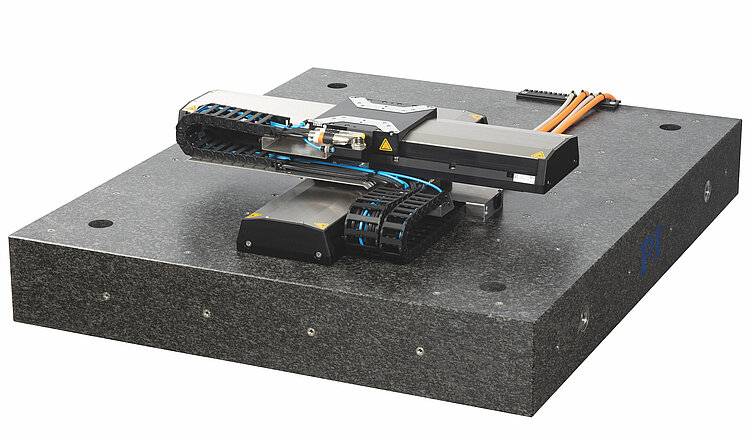
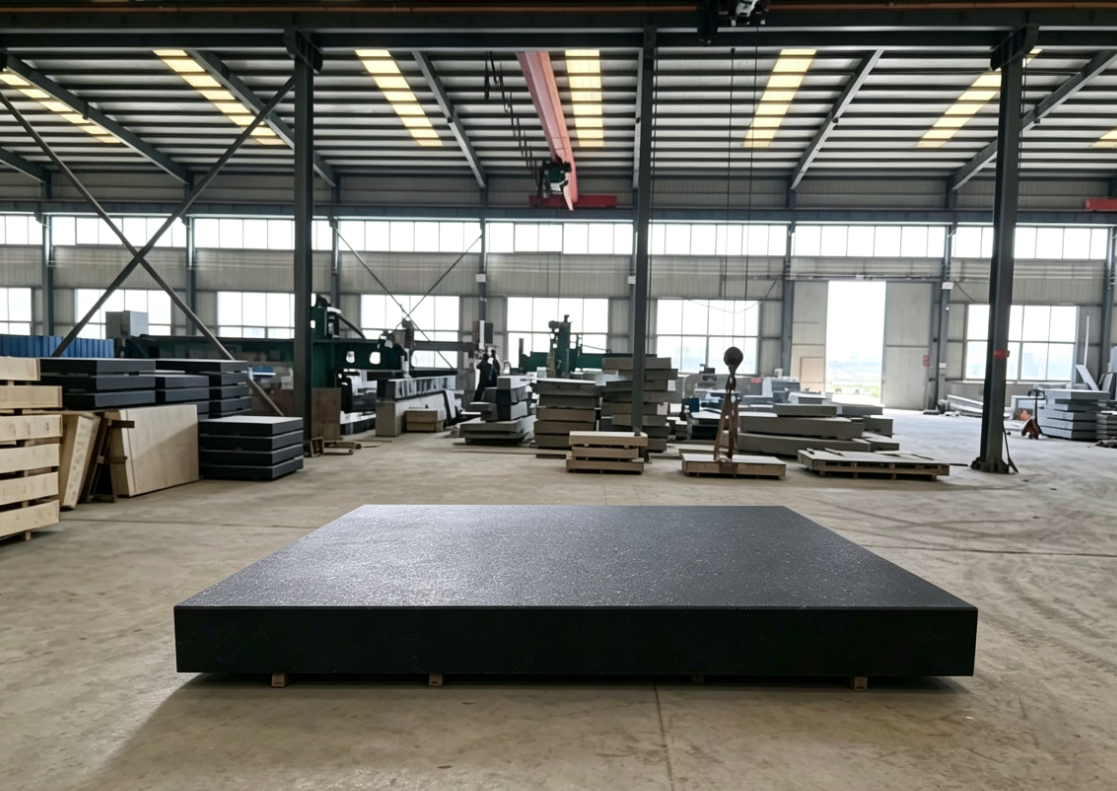
Made of dense black natural granite (primarily Jinan Green) through integral grinding and shaping, the base features pre-embedded stainless steel threaded inserts (threaded sleeves) on the working surface, sides, and bottom. Replacing cast iron machine tool beds, it serves as a reference base for precision machining, inspection, and motion equipment, combining high flatness, low thermal deformation, strong vibration damping, and non-magnetic, rust-proof characteristics.
II. Core Process and Structure of Threaded Inserts
- Insert Material and Specifications
Material: 304/316 stainless steel thickened threaded sleeves, rust-proof and pull-out resistant, preventing direct tapping of the stone which causes cracking or stripped threads;
Common threads: M6, M8, M10, M12, M16 for heavy-duty machine tools, customizable to imperial 1/4, 3/8, 1/2;
Layout: Full-surface grid layout, dense local area inserts, side-mounted inserts, and bottom-fixed inserts. - Complete Processing Workflow
Granite blanks are cut and rough-ground to eliminate internal stresses;
Diamond water-cooled drilling is used to reserve countersunk holes for insert installation;
High-strength epoxy structural adhesive fills the holes, stainless steel threaded inserts are pressed in, and then cured and left to rest;
High-precision grinding and scraping are performed in a constant-temperature workshop to ensure surface flatness, with the insert end faces recessed 0.3~1mm below the surface to avoid affecting the fit of moving parts;
Full-size inspection: Flatness, straightness, hole position tolerance, and insert pull-out strength;
Glaze sealing and anti-seepage treatment to prevent cutting fluid and oil penetration/corrosion. - Process Advantages
Repeated assembly and disassembly of screws will not damage the granite substrate, allowing equipment modules to be repeatedly tightened over the long term;
Hole positioning accuracy of ±0.1mm ensures a unified installation reference for multi-axis slide tables and spindle modules;
The countersunk design ensures a gap-free fit for linear guides, grating scales, and motor bases.
III. Core Advantages of Granite vs. Cast Iron Machine Tool Bases
Excellent Thermal Stability
The coefficient of thermal expansion is far lower than that of cast iron. Under continuous long-term machining temperature rises, the base deformation is minimal, ensuring stable machining dimensions. Suitable for high-precision engraving, micro-hole, and optical machining tools.
Superior Vibration Damping
The dense natural crystal structure absorbs cutting vibrations and suppresses resonance, improving surface finish and extending the service life of tools, grating scales, and spindles.
Non-magnetic and Rust-proof
It does not attract iron chips and is free from rust-induced deformation, with extremely slow precision decay over long-term use; cast iron is prone to rust and creep deformation over time.
صلابة عالية ومقاومة للتآكل
With a Shore hardness above 70, the guide rail installation reference surface is wear-resistant and difficult to scratch.
Long-term Precision Retention
No aging or tempering is required. Natural stress release is completed before leaving the factory, and the change in reference flatness over years of use is negligible.
IV. Precision Grades (Commonly used in machine tools)
Grade 000 (Ultra-precision machine tools)
Flatness ≤1.5μm/m, used for optical grinders, micro-hole drilling machines, and semiconductor packaging machines;
Grade 00 (Mainstream precision machine tools)
Flatness ≤3μm/m, standard for precision engravers, miniature CNCs, coordinate grinders, and vision inspection machines;
Grade 0 (Conventional automation equipment bases)
Flatness ≤6μm/m, for ordinary non-standard automation and grinding equipment.
Matching Precision: Straightness of the guide rail installation surface, side perpendicularity, and position tolerance of threaded holes are simultaneously met.
V. Typical Application Machine Tools / Equipment
Precision CNC Machining Category
Micro-engraving machines, micro-hole drilling machines, dedicated CNC for ceramics / glass / graphite, coordinate grinders, micro-part grinding machines;
Optical Semiconductor Equipment Bases
Wafer dicing equipment, lens grinding machines, PCB micro-hole drilling machines, FPC processing equipment;
Inspection and Measurement Category Machine Tools
Fully automatic vision measuring machines, 3D dimension measuring machines, roughness / profile measuring equipment complete machine bases;
Linear Motion Multi-axis Equipment
Gantry linear modules, dual-axis slide table assembly bases, precision dispensing and screw-locking automated machine tools;
Non-standard Precision Tooling Machine Tools
Watch part processing, camera module processing, micro-bearing assembly machine tools.
VI. Customized Supporting Structures
Multi-surface embedded inserts: guide rails installed on the tabletop, covers / motor brackets installed on the sides, embedded inserts on the bottom connected to vibration isolation brackets;
Thickened Load-bearing Version: machine tool base thickness of 150~300mm, enhancing rigidity and insert pull-out strength;
Grooved Composite Structure: can simultaneously process guide rail installation steps, clearance grooves, and chip removal grooves;
Vibration Isolation Support: paired with granite-dedicated cast iron vibration isolation brackets and inflatable anti-vibration pads to isolate ground vibrations;
Protective Treatment: overall anti-seepage glazing, resistant to corrosion from cutting fluids, alcohol, and cleaning solvents.
VII. Key Usage Precautions
Tighten screws to the standard torque to avoid excessive torque causing insert debonding or loosening;
Clean cutting fluids promptly after processing, as long-term soaking will penetrate the stone surface;
Prioritize using the pre-reserved threaded inserts on the base for lifting, and prohibit single-point heavy pressure impact;
Installation environment is recommended to be a constant temperature workshop to further leverage the low thermal expansion advantage.