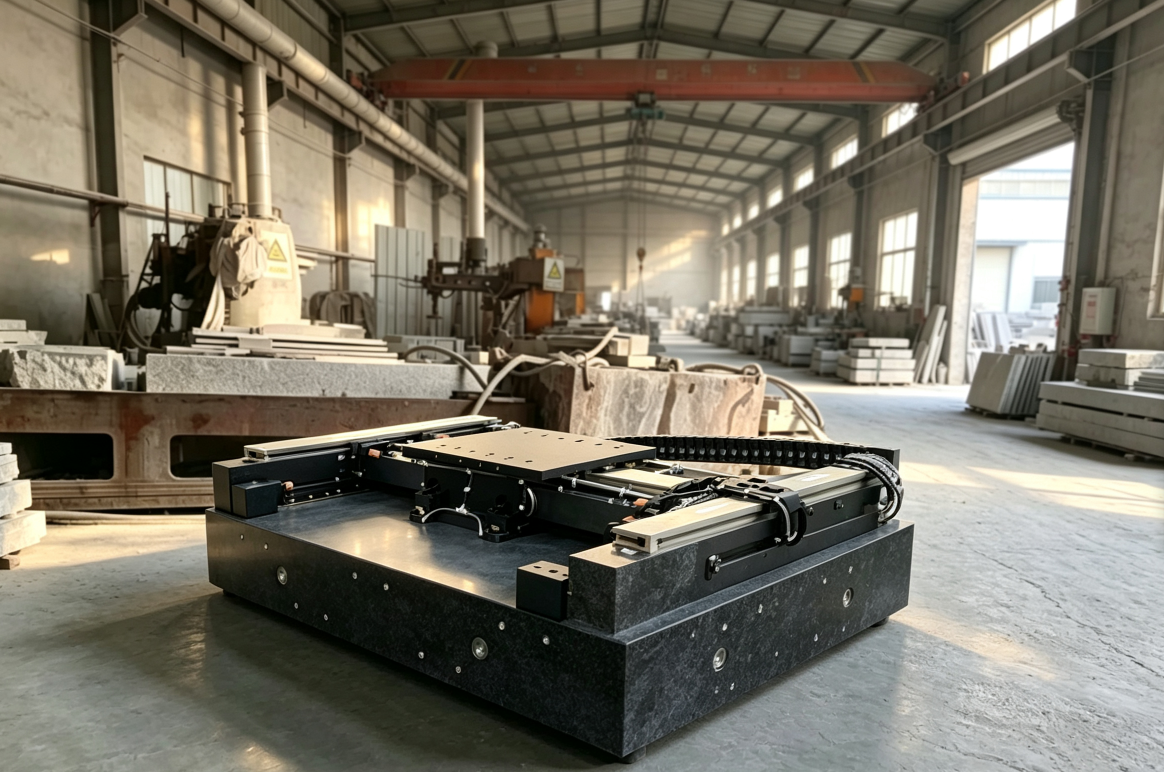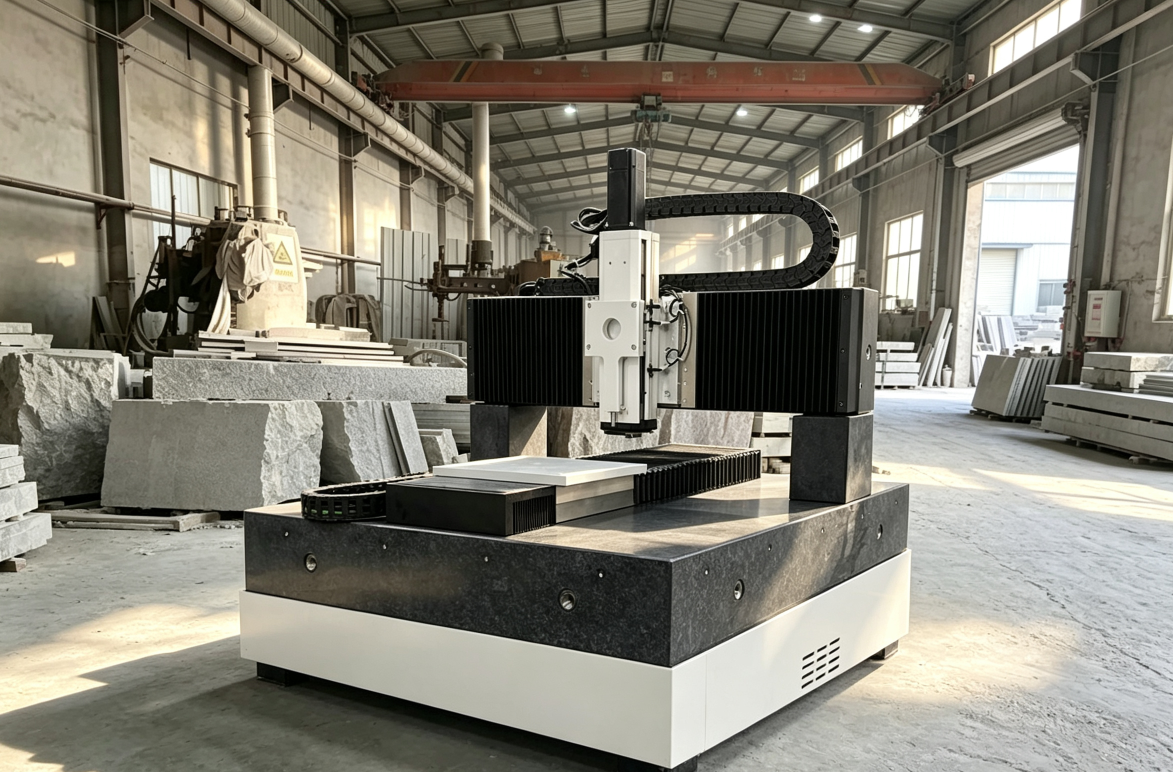
Complete Grinding Process for Precision Granite (Marble) Inspection Platforms
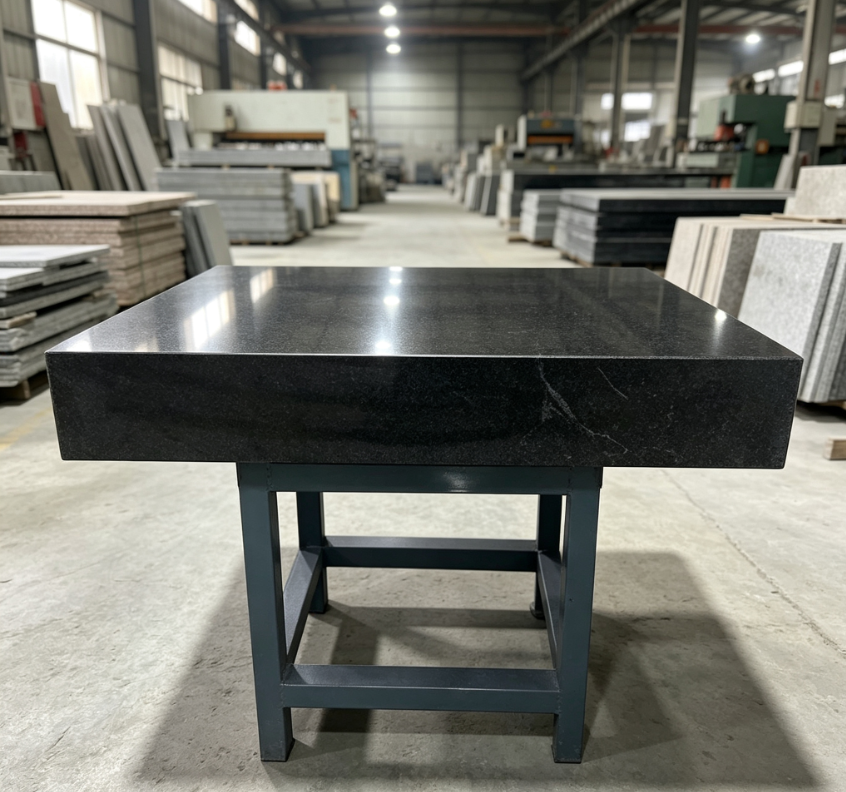
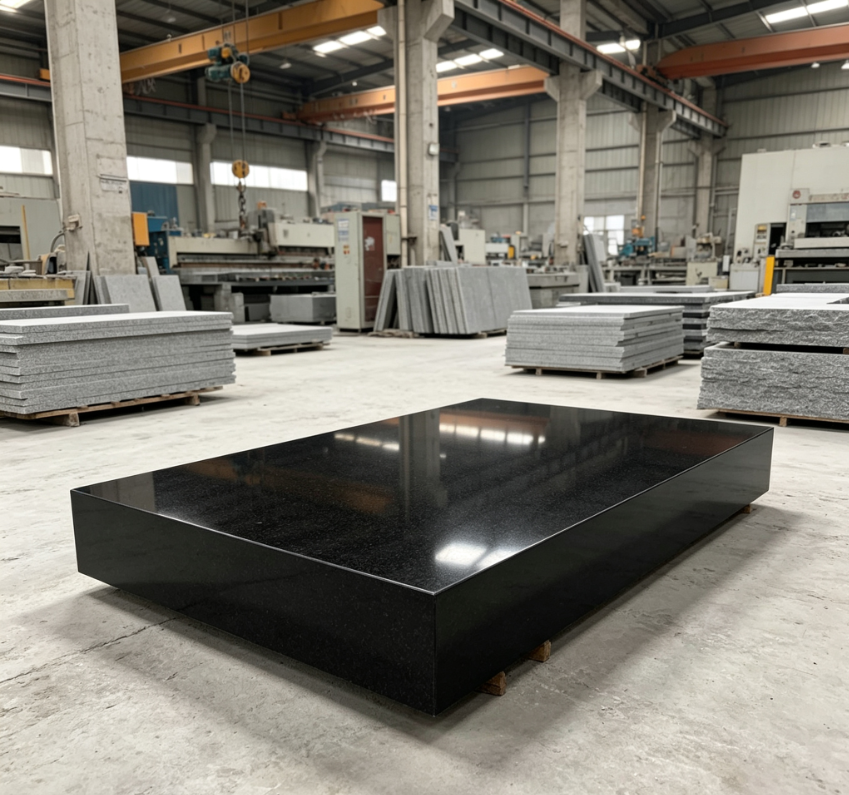
The measurement platforms used in the industry actually utilize Jinan Qinghei Granite (commonly known as marble platforms). The 0-grade / 00-grade high-precision six-sided grinding process consists of five core stages: preliminary stress relief pre-treatment, multi-stage mechanical grinding, manual matching grinding, constant temperature stabilization, and full-size precision inspection. All fine machining must be completed in a constant temperature workshop of 20±2°C. For thin 50mm slabs, an additional stress relief process is added to prevent deformation and warping.
I. Pre-processing Stages (Essential before grinding, determining precision and stability)
Rough Block Cutting and Shaping
Diamond saws cut the granite rough blocks into 500×500×55mm blanks (leaving a 5mm grinding allowance on each side), cut to length and width, with rough chamfering on all four sides to remove chipped edges, cracks, and pore defects.
Natural / Artificial Stress Relief Aging
Simple process: Blanks are placed in a constant temperature environment for 48 hours;
High-precision 00-grade six-sided platforms: Artificial aging at 120°C for 48 hours, or natural aging outdoors for 3 months, to completely release internal stresses and prevent precision rebound and warping after grinding.
Reference Rough Milling and Leveling
Gantry milling heads quickly mill the six sides to remove saw marks, leaving a uniform grinding allowance of 0.3–0.8mm on all six sides to ensure they are roughly perpendicular to each other.
II. Multi-stage Mechanical Grinding (Assembly line: rough → semi-fine → fine grinding, processed side by side)
Each side must complete the following abrasive gradient in full. Skipping grinding disc grits is strictly prohibited. Each stage must be rinsed with clean water and dried to prevent coarse particles from scratching the fine-machined surface. Water cooling is used throughout the grinding process to control the temperature, ensuring the stone surface temperature does not exceed 40°C.
- Rough Grinding (80#, 120# diamond metal grinding discs)
Function: Smooth out all unevenness and deep saw marks after milling, and unify the slab thickness;
Process: Cross-pattern cutting, uniform grinding under high pressure;
Stage Standards: Flatness ≤0.1mm/m, roughness Ra1.6~3.2μm; thickness error of the six sides after rough grinding is controlled within ±0.03mm. - Semi-fine Grinding (240#, 320# resin grinding discs)
Function: Eliminate deep scratches from rough grinding and initially correct surface unevenness;
Process: Grinding pressure reduced by 30%, rotation speed increased;
Stage Standards: Flatness ≤0.05mm/m, roughness Ra0.4~0.8μm. - Fine Grinding (400#, 600#, 1000# progressive refinement)
Function: Significantly reduce surface errors, with no visible scratches on the surface;
Process: Spiral uniform grinding, with corners separately supplemented;
Stage Standards: Flatness ≤0.01mm/m, roughness ≤Ra0.2μm, approaching the national standard 0-grade reference. - Pre-fine Grinding (1500#, 2000# ultra-fine grinding discs)
Mechanical grinding conclusion, removing fine textures from fine grinding. Parallelism and perpendicularity of the six sides initially meet standards, but at this stage, it only reaches the ordinary single-side 0-grade standard; 00-grade six-sided platforms must add a manual matching grinding process.
III. Manual Precision Lapping (Grade 0 / Grade 00 core process, determining final accuracy)
Mechanical grinding can only guarantee a basic flat surface; micron-level accuracy relies entirely on manual cast iron lapping plates silicon carbide / alumina micro-powder lapping, with each of the six faces flipped and lapped one by one, repeatedly exchanging reference planes to ensure perpendicularity and parallelism. Scientific Instrument Network:
Grade 0 Standard Lapping
Using W10 and W7 micro-powder cast iron lapping plates, the grid method is used for multi-point repeated lapping. Every 30 minutes, the flatness is checked with an electronic level bridge plate. Local high points are manually lightly ground and corrected until the flatness error meets the GB/T20424 national standard Grade 0 tolerance.
Grade 00 Six-Face Full Lapping (Extra high-precision process)
Switching to W3.5 ultra-fine lapping micro-powder, the top and bottom working surfaces and the four side surfaces are lapped in 3 cycles, with no less than 4 hours of lapping per face. The lapping process involves alternating flips to eliminate stress, ensuring that the perpendicularity and parallelism between any two of the six faces both meet the Grade 00 micron standard. This is also the core reason why the price of a six-face fully ground platform doubles.
IV. Mirror Polishing and Protection
After precision lapping is completed, it is lightly polished with cerium oxide polishing liquid soft polyurethane polishing pads. A dense, smooth, and wear-resistant layer is formed on the surface, reducing the roughness to below Ra0.025μm. After polishing, it is rinsed with clean water, dried, and sprayed with a special stone anti-rust sealant to prevent moisture from penetrating and causing color difference or deformation.
V. Constant Temperature Stable Resting (Preventing accuracy rebound, critical final step)
After grinding and polishing are completed, the platform is placed flat in a constant temperature workshop for resting:
Grade 0 flat plate: Rest for 48 hours;
Grade 00 six-face precision thin plate (50mm thin model): Rest for 5–7 days;
During this period, the flatness is re-checked twice daily. Once the dimensions are completely stable without deformation, it enters the final inspection process at Furuihua.
VI. Finished Product Full-Size Accuracy Inspection
Flatness: Diagonal grid method inspection, data recorded by laser interferometer;
Parallelism of the six faces, perpendicularity of adjacent faces;
Length, width, and thickness dimension tolerances, surface roughness;
An ex-factory accuracy inspection report is issued, and qualified products are entered into the warehouse.