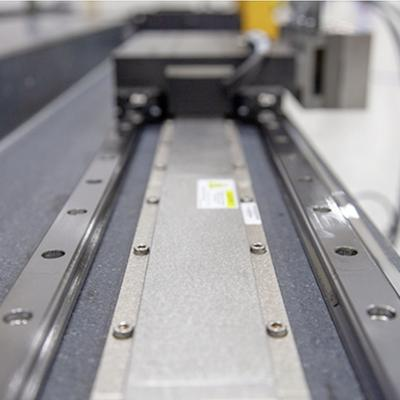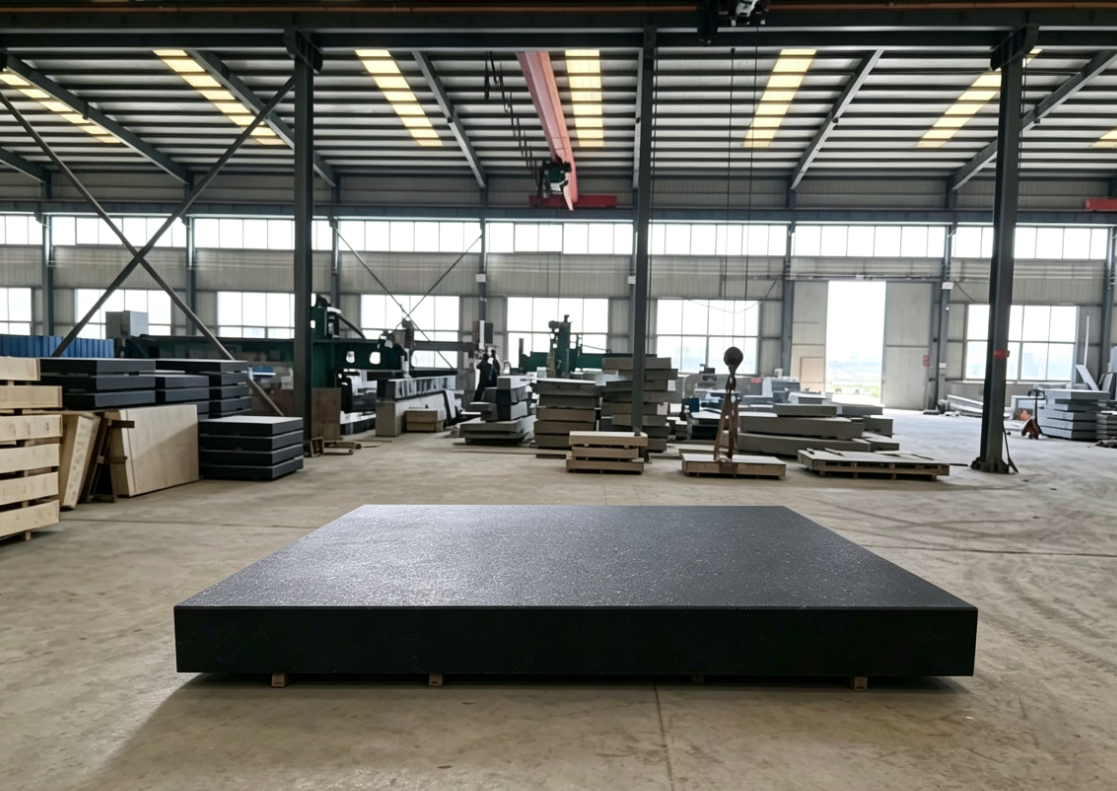
With its four core advantages of extremely low thermal expansion coefficient, high rigidity, strong vibration damping, corrosion resistance, granite has become the preferred structural material for laser equipment (especially high-precision and micro-machining types). It is widely used in bases, gantries, optical, and precision tooling, supporting nanometer-level stability and micrometer-level machining accuracy.
I. Core Material Advantages (Essential for Laser Equipment)
Ultra-low Coefficient Thermal Expansion (CTE): Approximately (2.5\sim4.5\times10^{-6}/^\circ\text{C}), only 1/2 to1/3 that of steel/cast iron; minimal deformation under temperature fluctuations, maintaining flatness at ±0.3μm/°C, ensuring long-term stability of laser optical path and focus.
Ultra-high Rigidity and Vibration Damping: Dense natural microcrystalline structure with high elastic modulus and excellent damping properties; vibration damping efficiency is 0% higher than steel, effectively isolating vibrations from motors, pumps, and the ground, eliminating spot drift and positioning errors.
Long-term Dimensional Stability: High hardness (J Black HS70~80), high compressive strength (245N/mm² ), and water absorption rate <0.13%; rust-proof, creep-, and resistant to cutting fluids/moisture, maintaining original flatness for ten years with extremely low maintenance costs.
Precision Machining Adaptability: Capable of being machined to micrometerlevel flatness (≤1μm/m), high-precision mounting holes/threads/vacuum grooves, meeting the stringent installation requirements of linear motors, grating scales, and optical mirror.
II. Typical Applications in Laser Equipment
- High-Precision Laser Cutting/Marking Machine Bases and Gantries
Fiber/CO₂ Laser Cutting Machines (e.., IPG LaserCube): The entire machine base gantry beam use Jinan Black/Taishan Black granite, ensuring positioning accuracy of ±1μm and straightness ≤.5μm/m under high-speed motion.
Large-format Laser Marking Machines: Granite platforms support workpieces and suppress vibrations, ensuring uniform lines and sharp edges during-speed marking at 2000mm/s.
- Semiconductor/Microelectronics Laser Micromachining Platforms
Lithography Machines (EUV/ArF),fer Dicing, ITO Etching: Granite optical bases/platforms support lasers, beam expanders, and focusing lenses, achieving nanometer-level (≤50nm) positioning to ensure chip yield.
Picosecond/Femtosecond Laser Systems: Ultra-low CTE and high vibration isolation meet the micrometer-level machining requirements for micro-holes in medical and semiconductor slotting.
- Laser Engraving/Deep Engraving Machine Workbenches
Stone (Granite/Marble) Laser Engraving: Granite workbenches are and stable, compatible with CO₂ (100W ) / fiber lasers, achieving 0.025mm precision deep engraving and high-contrast marking. Granite laser machine workbench.
Hardware/Mold Laser Marking: Granite platforms are anti-magnetic and wear-resistant, suitable for high-precision positioning of large batches of workpieces and long- stable production.
- Laser Inspection/Measurement Equipment Reference Platforms
Laser Interferometers, Profilometers, 3D Scanners: Granite reference platforms provide a stable reference with flatness0.5μm/m, ensuring accurate and repeatable inspection data.
III. Mainstream Material Selection (Commonly used in the laser industry)
Jinan Green (Shandong): CTE ≈ 3.5 × 10⁻⁶/°C, high hardness, uniform black spots, preferred for high-end laser equipment bases / gantries.
Taishan Green (Shandong): Performance close to Jinan Green, high cost-performance ratio, used for medium and large laser cutting machines / engraving machines.
Indian Black / South African Black: Uniform color, good polishability, suitable for laser marking machine worktables / decorative optical platforms.
IV. Comparison with Traditional Materials (Steel / Cast Iron / Aluminum Alloy)
Performance Granite Steel / Cast Iron Aluminum Alloy
Coefficient of Thermal Expansion Extremely low (1/3 of steel) High
Vibration Damping Optimal (high damping) Average Poor
Rigidity / Stability Extremely high (no deformation) Prone to creep / rust one to deformation
Accuracy Retention Stable for a decade (μm level) Decays in 1-2 years Short-term decay
Overall Cost Medium- (low long-term maintenance) Low (short-term) Medium
V. Application Trends
High Precision: Picosecond / femtosecond lasers and semiconductor EUV lithography drive the upgrade of granite to nanometer-level stability.
Large-scale: 6m × 3m ultra-large format laser equipment adopts monolithic granite bases to reduce splicing errors.
Functional Integration: Granite platforms integrated with vacuum suction, anti-static, and cooling channels, adapted for automated production lines.