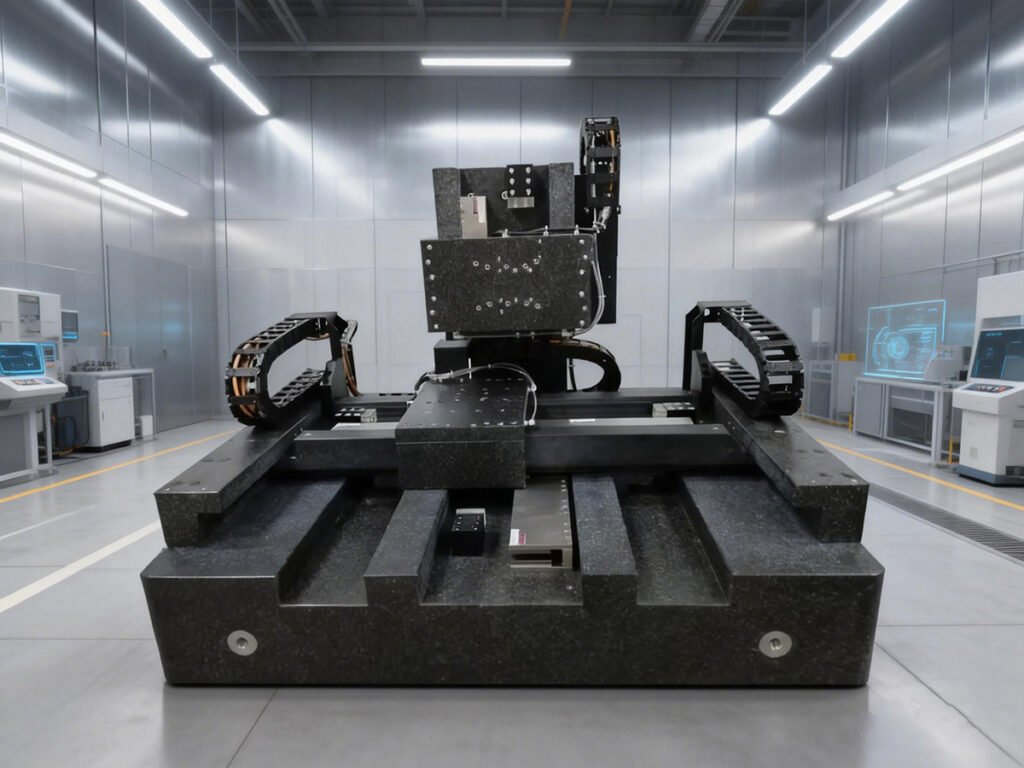
Use a granite base for laser processing, leveraging its ultra-stability, ultra-flatness, low therml expansion, and high damping characteristics to provide a zero-drift reference for the laser head/workpiece. At the same time, strictly control the four major risks of heat, vibrn, dust, and force to prevent granite damage and loss of processing accuracy. The following provides actionable operations and parameter schemes following the complete process.
I. Applicable Scenarios (The Best CombinatioGranite Base Laser)
Precision Marking / Engraving: Panel inspection equipment scales, positioning references, QR codes, serial numbers (dept0.01–0.2mm)
Microstructure Processing: Air-bearing grooves, positioning grooves, tiny blind holes (φ<0.5mm)
Precision Scribing / Calibration: Optical reference lines, installatince surfaces
Repair / Modification: Surface micro-processing, deburring, local modification
II. Equipment and Material Preparation
- Laser Equipment Selection (Based on Processing Objective)
Tablcessing Type | Recommended Laser | Power / Wavelength | Applicable Scenario
Surface Marking / Shallow Engraving | CO₂ 10.6μm) | 80–150W | Text, logos, shallow reference lines
Deep Engraving / Micro-grooves | Pico / Femtoecond (355/532nm) | 30–100W | Precision grooves, blind holes, no thermal damage
Large-area Etching |iber (1064nm) | 50–100W | Coarse texture, identification - Granite Base Pre-treatment (Critical)
Flatness: ≥Gr00 (Flatness ≤0.005mm/m), Surface Roughness Ra≤0.05μm
Cleaning: Use lint-free cloth isopropyl alcohol to thoroy remove oil, fingerprints, and dust
Fixturing: Use flexible clamps / vacuum suction; strictly prohibit direct tapping, welding, or point pressure
Leveling: Adjust with elecnic level to ≤0.02mm/m to avoid tilt causing focusing deviation - Environmental Control (Determines Precision and Lifespan)
Temperature: Win ±0.5℃, no direct air conditioning or sunlight
Vibration: Stay away from vibration sources; add air-bearing vibration pads under the base (natural frequency <2Hz)
Cleanlinss: Class 1000 or higher, equipped with strong exhaust dust filtration (prevent silicon dust from contaminating the optical path)
III. Processing Workflow (Standard SOP)
- and Positioning
Base leveling → Workpiece cleaning → Flexible clamping (clamp rubber pad) → Alignment with dial indicator
Large-size base: Use multi-point support load dision to avoid micro-deformation caused by local stress - Optical Path and Focusing Calibration (Core of Precision)
Laser head perpendicular to granite surface (Perpendiularity ≤0.01mm)
Auto-focus Z-axis compensation: Defocus ±0.1mm (Pico); CO₂ uses 1–2mm positive defocus
Spot diameten processing ≤20μm, marking ≤50μm - Process Parameters (Directly Usable)
(1) CO₂ Laser (Marking Shallow Engraving)
Power: 80–100% (80–150W)
Speed: 100–300mm/
Frequency: 500–1000Hz
Scan times: 2–5 times (deepen as needed)
Auxiliary gas: Compresse air (0.3–0.5MPa), to blow away dust and cool
(2) Pico Laser (Precision Micro-processing)
Wavelength: 355nm (UV)Pulse width: <10ps
Frequency: 100–500kHz
Speed: 500–2000mm/sDefocus: ±0.1mm
Advantages: Heat-affected zone <5μm, no chipping, no cracks
(3) General Test Cutting Principles
First use scrap mat of the same material to create a parameter matrix (power / speed / frequency)
Observation: Check for edge chipping, depth uniformity, surface roughness
Fine-tuing: Power↑, Speed↓ → Depth↑; Frequency↑ → Surface
- Processing Monitoring
Full-process monitoring: Dust emission, laser power stability, temperature changes
Abnormal handling: Edge chipping Immediately reduce power, increase speed, increase air assist
Prohibited: Touching the base, adjusting clamping, opening/closing the safety door during processing - Posting
Cleaning: Wipe clean dust with isopropyl alcohol and lint-free cloth
Inspection: Measure depth, flatness, and positional accuracy using a contour meter /r
Protection: Apply neutral stone sealer to the processed surface (anti-stain, moisture-proof)
IV. Granite Base Protection (Top Priority)
Prohibited Actions
Diring, cutting, or tapping on the base (high temperature / stress causes cracking)
Single-point heavy pressure, stepping, knocking, or dragging
Cleaning with strong acids or basodes surface, expands micro-pores)
Long-term laser irradiation at a fixed point (local overheating → thermal cracking)
Thermal Management
Single processing ime ≤ 30min, with intermittent cooling
Strong air assist local air cooling to avoid local temperature rise > 2°C
Prohibited: Laser head distance < 5mm (to prevent tmal shock)
Dust and Maintenance
Must fully open exhaust dust filtration during processing to prevent silicon dust from entering the optical path and air-bearing system
Clean the base surface check levelness and flatness weekly
Quarterly: Re-measure reference accuracy using a laser interferometer
V. Common Issues and Countermeasures
Table
Issue Cause Solution
Edge chipping Excessive power, low speed, focuation Reduce power, increase speed, optimize defocus, add gas assist
Uneven depth Tilted base, focus drift, temperature fluctuation Re-level, calibxis, control temperature
Rough surface Low frequency, large spot size, dust accumulation Increase frequency, reduce spot size, enhance gas assist
Base micro-deformation Local oveng, clamping stress Shorten processing time, flexible clamping, uniform load distribution
Precision drift Vibration, temperature, foundation settlement Vibration isolation, constant temperature, regular lel recheck
VI. Safety Standards
Personal Protective Equipment: Laser safety glasses (matching wavelength), dust mask (for silicon dust), gloves
Environment: Ventilation, fire prevention, unauthorized personne prohibited
Equipment: Emergency stop button functional, protective door closed, no light leakage
VII. Conclusion
The granite base is the “Golden Benchmark” for laser precisiochining: its stability, flatness, and rigidity counteract the risks of heat, vibration, and dust in laser processing. The operational core is: strict control of temperature and vibrati flexible clamping, precise focusing, test cutting for parameters, and full protection of the base throughout the process.