Analysis of the Six Core Advantages of Using Granite for High-Precision Machine Bases
I. Extremely Low Thermal Expansion Coefficient, Zero Precision Drift in Constant Temperature Conditions (Core Advantage)
The linear expansion coefficient of high-density Jinan blue granite is only 4.5~6×10⁻⁶/℃, about half that of cast iron (11~13×10⁻⁶/℃), and its thermal diffusion speed is much slower than metals, responding sluggishly to temperature changes.
When the workshop temperature varies by 1~2℃, cast iron bases experience micron-level expansion and contraction, as well as local thermal distortion and warping, causing measurement/machining datum shifts; granite expands and contracts uniformly, with thermal deformation controllable within the sub-micron range;
It is compatible with the 20±1℃ standard constant temperature metrology room, significantly reducing the temperature compensation dependency of CMMs, optical inspection instruments, and ultra-precision grinders;
The material is isotropic, with synchronized thermal expansion across X/Y/Z axes, preventing asymmetric torsional deformation, ensuring stable dimensional datums without drift during long-term continuous operation.
II. Natural Stress Relief Over Hundreds of Millions of Years, Lifetime Creep-Free and Long-Term Precision Stability
Cast iron casting retains significant internal stresses; even with artificial annealing, it will still slowly creep and warp within 3~5 years, with flatness degrading annually, requiring re-grinding and calibration every year;
Granite has undergone hundreds of millions of years of natural geological aging, completely releasing internal stresses; after precision grinding at the factory, its geometric accuracy remains virtually unchanged for ten years, with no slow deformation issues.
It is suitable for equipment requiring long-term stable datums, such as semiconductor lithography and aerospace precision inspection, significantly reducing annual calibration and maintenance costs.
III. Ultra-High Damping and Vibration Isolation, Isolating Micro-Vibration Interference to Eliminate Measurement Jumps
Granite’s dense polycrystalline structure inherently possesses high damping characteristics, with a damping coefficient 3~5 times that of cast iron, capable of rapidly absorbing and dissipating micro-vibration energy from ground resonance, air compressors, machine tool spindles, and personnel movement:
Self-running vibrations and external workshop vibrations will not continuously resonate and amplify;
Laser equipment, image measurement, and nano-scale inspection are extremely sensitive to vibration; granite bases can suppress vibration marks and data jumps without additional complex vibration isolation modules;
Dynamic stability during cutting and scanning processes is stronger, improving workpiece surface finish and inspection repeatability.
IV. Non-Magnetic and Non-Conductive, No Electromagnetic Interference, Suitable for Optical/Semiconductor Precision Scenarios
Granite is a natural non-metallic mineral, completely non-magnetic, insulating, and anti-static:
It does not attract iron filings or metal debris, preventing debris protrusions from damaging the datum plane;
It does not interfere with the magnetic field signals of servo motors, displacement sensors, optical lenses, and wafer inspection modules;
It is resistant to corrosion from cutting fluids, photoresist, and pure water, does not oxidize or discolor during long-term use in dust-free laboratories, making it the only suitable base material for semiconductor and LCD panel inspection equipment.
Cast iron bases are easily magnetized and rust, failing to meet the requirements of high-precision optical and microelectronic equipment.
V. High hardness, wear and corrosion resistance, extremely long maintenance cycle
Granite has a Shore hardness of HS70 or above, while ordinary cast iron is only HS18~25:
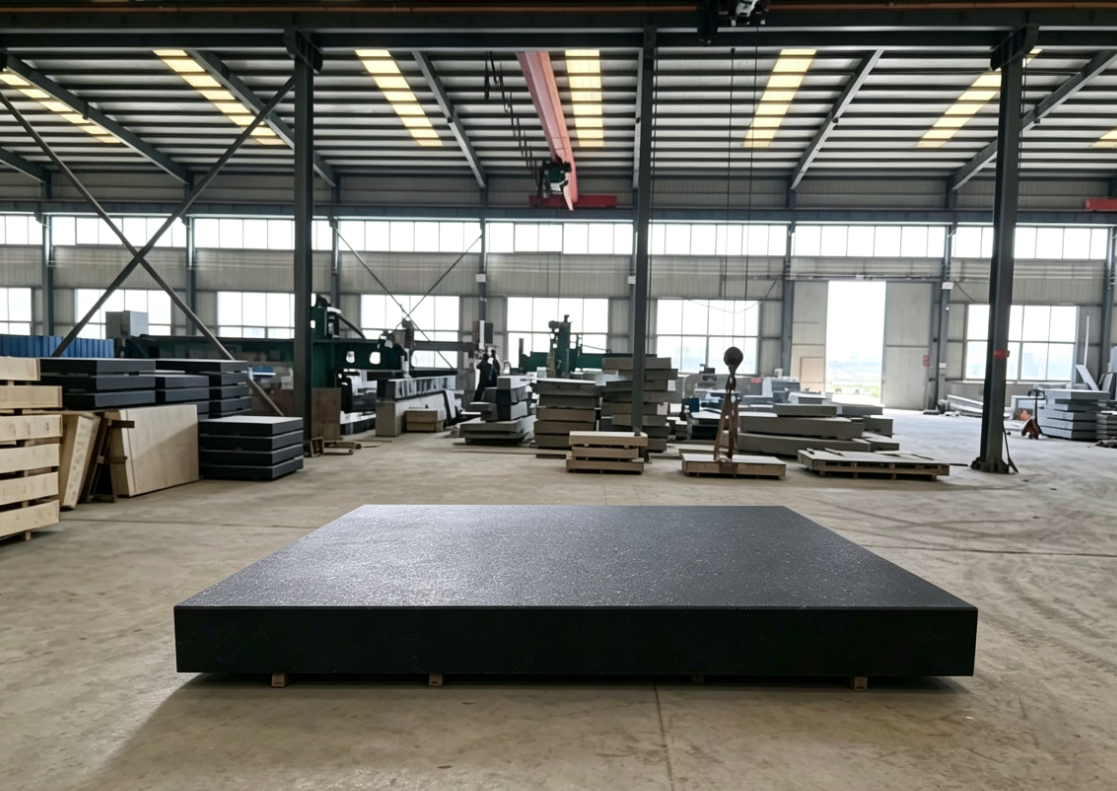
Measuring instruments and hard workpieces can be repeatedly pushed and pulled without easily scratching the reference surface, and the degradation rate of flatness accuracy is far lower than that of metal;
It does not rust or oxidize, and cutting fluids, oil stains, and water vapor will not cause rust spots or protrusions;
No regular application of anti-rust coatings is required, and the reference accuracy can be maintained with simple wiping, resulting in lower maintenance costs over the entire life cycle.
VI. High rigidity and compression resistance, meeting the heavy-load requirements of precision equipment, with a structure that is not easily deformed
High-density granite has extremely high compressive strength, and the uniformly distributed load-bearing capacity of conventional precision equipment bases can reach 3~5 tons, fully covering the workpiece load requirements of CMMs, vision systems, and small ultra-precision machine tools:
The self-weight uniformly disperses the load, with no local collapse or elastic deformation under pressure;
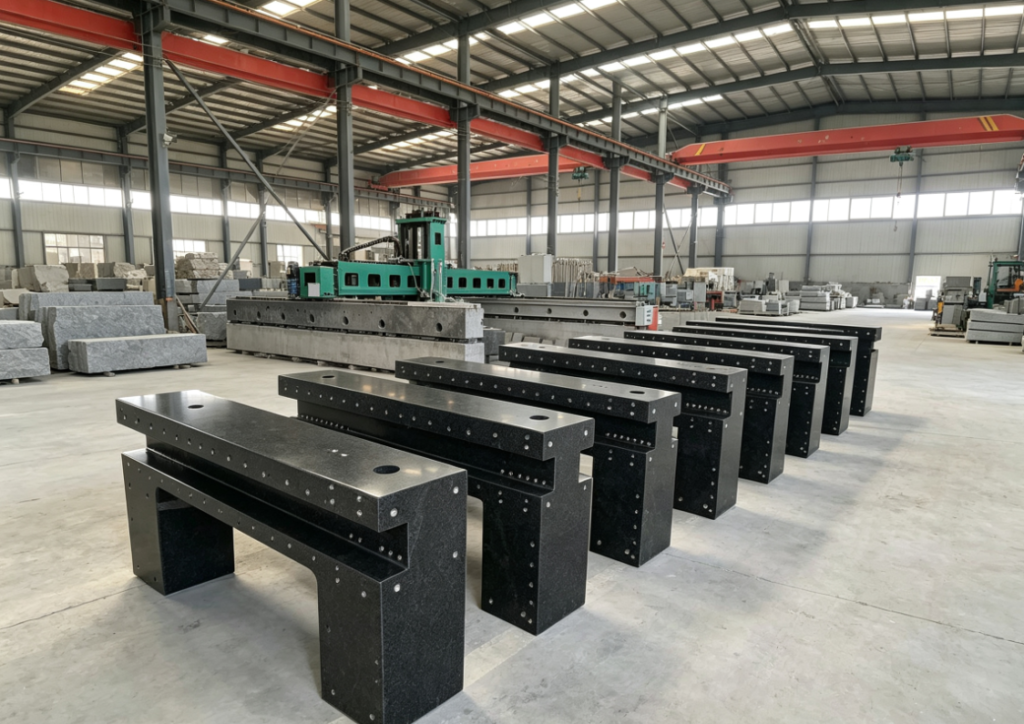
The one-piece molded base has no joints, and its overall rigidity is superior to welded cast iron structures;
Threaded holes, cooling channels, and guide rail mounting references can be pre-embedded in one piece, integrating the assembly reference and eliminating composite errors caused by assembly gaps.
Supplement: Distinction of application boundaries between cast iron and granite
Advantages of cast iron bases: Extreme heavy loads (heavy-duty tooling over 10 tons, welded assemblies), rough machining and marking stations, with stronger toughness against violent impacts;
Irreplaceable scenarios for granite bases: Micron/nanometer-level measurement, optical inspection, semiconductor equipment, constant temperature laboratories, and high-precision machinery with strict requirements for temperature, vibration, and long-term accuracy.