Why Silicon Carbide Ceramic Components are the Core Key to Next-Generation Precision Machinery
Facing next-generation high-end precision equipment such as EUV/advanced lithography, 3nm and below semiconductor equipment, ultra-precision optics, vacuum metrology, and high-speed nano-motion platforms, traditional granite, aluminum alloys, steel, and alumina ceramics have reached performance bottlenecks. Silicon carbide (SiC) advanced ceramics, with their ultimate comprehensive performance across four dimensions—mechanical, thermal, chemical, and vacuum cleanliness—have become irreplaceable structural/functional components for nano-scale precision systems, serving as the core material cornerstone for the iteration of next-generation precision machinery.
I. Core Material Performance: Completely Overwhelming Traditional Precision Substrates
- Ultra-high specific stiffness, solving the problem of high-speed motion deformation (The first guarantee of precision)
The elastic modulus of silicon carbide is 400–450 GPa, 5–6 times that of granite and aluminum alloys, with a density of only 3.1g/cm³ (far lower than steel and cast iron), offering world-class specific stiffness:
Granite and metal bases are prone to bending, pitching, and micro-deformation during high-speed start-stop and acceleration, directly causing nano-scale positioning errors;
The lightweight, high-rigidity structure of SiC ensures that even large-scale worktables, gantry beams, and optical mirror mounts experience almost no elastic deformation during high-speed reciprocating motion, completely suppressing geometric errors that closed-loop compensation cannot correct;
It meets the high-speed, large-stroke, and nano-repeatability positioning requirements of next-generation equipment (e.g., lithography machine worktables scanning at meter-per-second speeds with a positioning tolerance < 1nm). - Near-zero thermal deformation ultra-fast temperature equalization, eradicating temperature drift (A necessity for advanced processes)
Low coefficient of thermal expansion: approximately 4×10⁻⁶/℃, only 1/3 of steel, resulting in minimal dimensional drift under temperature fluctuations;
Ultra-high thermal conductivity of 120–270W/m・K, close to aluminum and far higher than granite, glass, and alumina ceramics:
Heat from lasers, plasma, and motors causes local hotspots, and granite’s poor thermal conductivity easily leads to thermal gradient warping;
SiC can rapidly equalize the overall temperature, allowing all components to expand and contract synchronously without local thermal gradient distortion;
It is suitable for extreme thermal environments such as ±0.1℃ constant temperature semiconductor cleanrooms, continuous laser irradiation in optical systems, and high-temperature plasma in etching chambers, maintaining surface shape and positioning accuracy over the long term. - Ultra-high hardness and wear resistance, low dust generation, ensuring long-term precision stability
Mohs hardness of 9.2–9.6, second only to diamond, with wear resistance far exceeding metals, ordinary ceramics, and granite:
After millions of reciprocating friction cycles of guide rails, wafer stages, and transfer arms, wear is negligible, and it will not produce metal debris or stone dust;
Particle release is extremely low in vacuum/semiconductor cleanroom environments, preventing contamination of wafers and optical lenses;
Traditional granite surfaces develop scratches and edge collapses over long-term use, with flatness deteriorating year by year, whereas SiC ceramics can maintain sub-micron reference accuracy for the long term, significantly reducing downtime for calibration. - Extreme chemical inertness and high-temperature resistance, suitable for vacuum/plasma corrosion working conditions
Long-term tolerance to 1600℃ high temperatures, with low outgassing and low impurity precipitation in a vacuum, meeting the high-cleanliness vacuum chamber requirements of the semiconductor industry;
Resistant to fluorine/chlorine plasma and strong acid/alkali corrosion, the lifespan of components inside etching and CVD chambers is several times that of quartz and alumina;
With no metal precipitation and no radioactive impurities, it will not contaminate chip thin films or optical paths, making it the only suitable structural ceramic for advanced process chambers. - 5. Controllable electrical properties, integrating structure and function By regulating resistivity through doping, it can be fabricated into electrostatic chucks (ESC), RF matching chambers, insulating supports, and conductive mirror substrates. A single material simultaneously serves structural load-bearing and electrical functions, simplifying equipment structure and reducing assembly errors.
II. Core application scenarios for next-generation precision machinery (irreplaceable)
1. Advanced semiconductor equipment (the largest demand-driven track)
(1) Core motion systems of lithography machines (EUV/ArF) Silicon carbide (SiC) wafer chucks, mask stages, guide rails, optical mirror substrates, and grating reference mirrors: Supporting high-speed scanning of 12-inch wafers, requiring a full-process positioning error < 2nm; Lightweight and high rigidity reduce drive load, while low thermal deformation ensures overlay accuracy, serving as the core hardware foundation for 3nm and 2nm process mass production.
(2) Chamber components for etching and thin-film deposition equipment Focus rings, showerheads, electrostatic chucks, edge rings, and pedestals: Directly facing plasma bombardment and corrosive process gases, SiC’s corrosion resistance and low contamination ensure film uniformity and wafer yield; High-thermal-conductivity chucks achieve a wafer-wide temperature difference < 0.05°C, solving the problem of uneven etching rates in advanced processes.
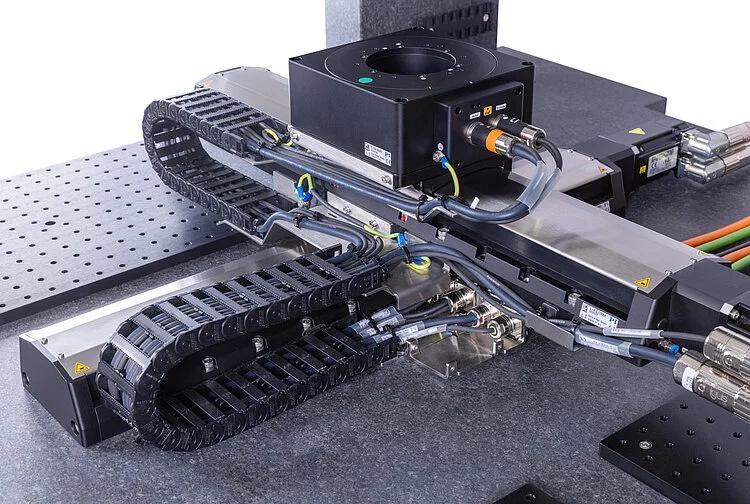
(3) Metrology, probe stations, and dicing equipment Granite bases are gradually being replaced by SiC lightweight platforms: lower vibration and higher dynamic accuracy, suitable for nanometer-scale defect detection and chip probe testing.
2. Ultra-precision optics and aerospace optoelectronic equipment Large-aperture mirrors for space telescopes, laser scanning galvanometer bases, and interferometer reference platforms: Maintaining mirror surface flatness of λ/100 RMS despite space temperature differences of ±200°C; Lightweighting significantly reduces satellite launch payload, while high stiffness resists space micro-vibrations and radiation deformation.
3. High-end metrology and ultra-precision machine tools CMM (Coordinate Measuring Machine) sliding tables, ultra-precision grinder beams, and nano-positioning platforms: Compared to granite: lighter weight and faster dynamic response; compared to aluminum alloy: thermal stability and rigidity improved by an order of magnitude, meeting nanometer-scale dimension detection requirements.
4. Next-generation vacuum and new energy precision equipment Vacuum robot wafer transfer arms, high-temperature crystal growth pedestals, and lithium battery precision coating platforms: balancing lightweight, high-temperature stability, and clean, dust-free operation.
III. Why it is the inevitable choice for next-generation upgrades compared to traditional materials
Table
Material Core Shortcomings (Pain points for next-gen precision equipment) Advantages of Silicon Carbide Ceramics
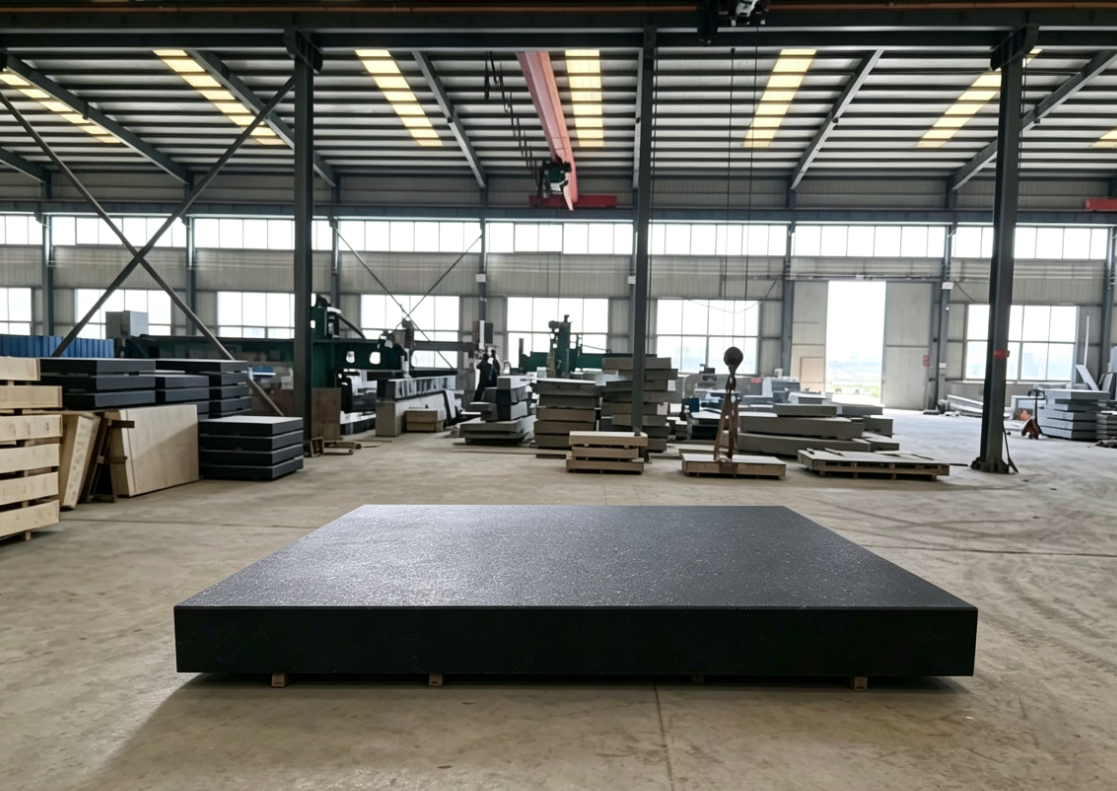
Natural Granite Heavy, poor thermal conductivity, prone to warping under local heating; average wear resistance, precision declines over long-term use; cannot form complex hollow lightweight structures High thermal conductivity, lightweight, can be integrally hollowed out, wear-resistant and stable
Aluminum Alloy / Steel Large coefficient of thermal expansion, micron-level deformation with slight temperature changes; low rigidity, significant deformation during high-speed movement Low thermal expansion, ultra-high specific stiffness, negligible thermal drift
Alumina Ceramic Poor thermal conductivity, prone to deformation due to uneven heating; relatively low specific stiffness Thermal conductivity improved by 5–10 times, significantly superior rigidity
Quartz Glass Low strength, prone to impact breakage, cannot support heavy-load motion platforms High hardness and strength, can be used for motion-bearing structural components
IV. Summary of Industrial Strategic Value
Breakthrough in precision ceiling: Traditional materials can only stably maintain micron-level precision, while silicon carbide ceramics support long-term stable sub-nanometer precision, serving as the technical threshold for advanced chips and ultra-high precision optical equipment;
Equipment miniaturization and high-speed operation: Lightweight and high-rigidity structures reduce driving energy consumption and increase motion speed, significantly improving the production efficiency of next-generation equipment;
Compatibility with extreme environments: Simultaneously adapts to multiple harsh working conditions including high temperature, vacuum, strong corrosion, and drastic temperature changes, covering the entire industry chain of lithography, etching, and metrology with a single material;
Long-term cost reduction: Wear-resistant, corrosion-resistant, and permanently dimensionally stable, significantly reducing equipment calibration frequency and spare part replacement costs;
Key to domestic high-end equipment autonomy: High-end SiC precision ceramic components have long been monopolized overseas, making them a core “bottleneck” material for the localization of semiconductors and precision machine tools, directly determining the independent controllability of next-generation high-end precision machinery.
In short: When next-generation precision machinery enters the nano-scale, high-speed motion, and high-temperature corrosion composite working conditions, the thermal and mechanical performance shortcomings of traditional materials like granite and metals cannot be compensated for. Silicon carbide ceramics are the only structural materials that can simultaneously meet the four stringent requirements of high rigidity, low thermal deformation, wear resistance/cleanliness, and corrosion resistance, thus becoming the core essential component for next-generation precision machinery.