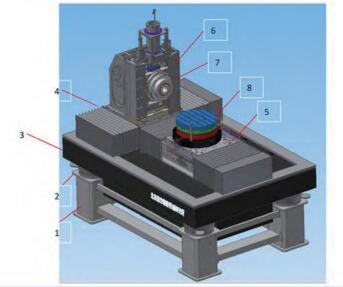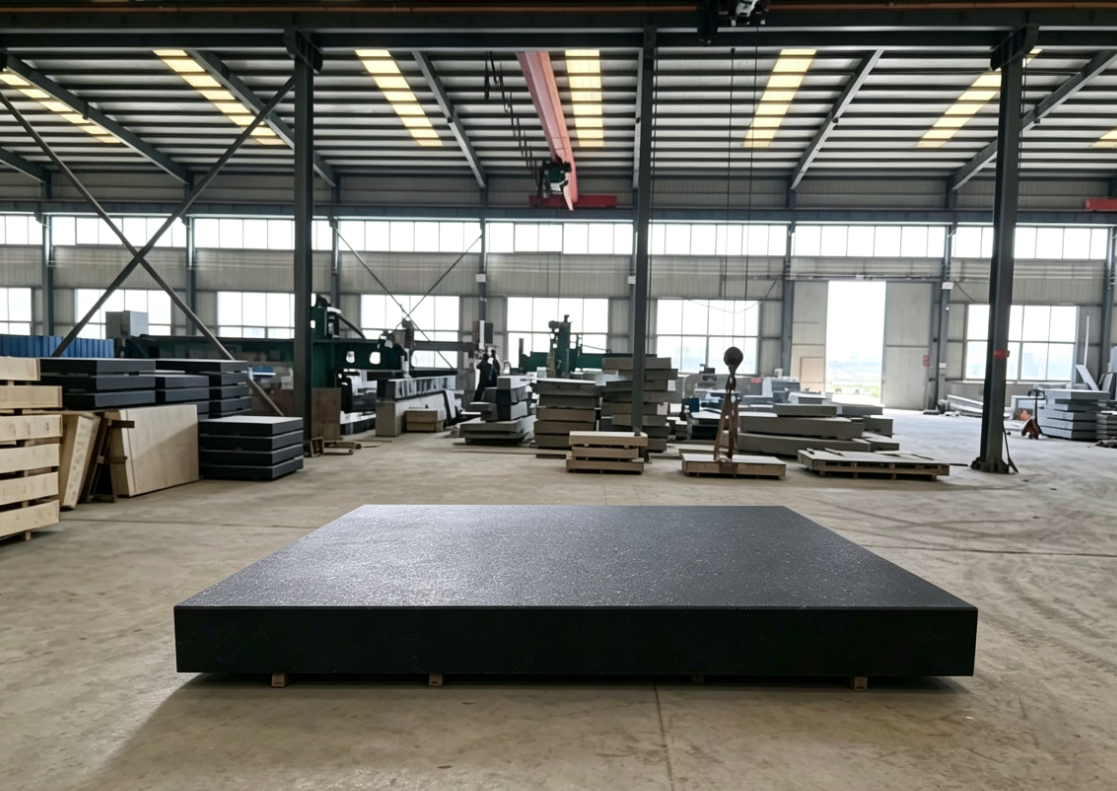
Combining the machining characteristics of five-axis ultra-precision machine tools with the advantages of granite bases—high vibration damping, low thermal deformation, high rigidity, and long-term accuracy stability—the core application areas are categorized, and the corresponding machining objects and working condition characteristics are explained:
Application Areas of Granite Bases for Five-Axis Ultra-Precision Machine Tools
I. Semiconductor and Pan-Electronics Industry (High-End Mainstream Field)
Semiconductor Component Machining
Machining ceramic substrates, silicon carbide carriers, wafer chucks, vacuum fixtures, semiconductor molds, and microfluidic chip molds. The granite base isolates workshop vibrations and resists temperature fluctuations, ensuring micron/sub-micron profile accuracy and adapting to cleanroom environments.
Optical and Optoelectronic Components
Mobile phone/automotive lens molds, lenses, prisms, optical mirror mounts, LiDAR optical structural parts, and infrared optical components. Five-axis linkage completes complex surface machining, and the base strongly suppresses vibration to prevent tool marks and deformation on optical surfaces.
PCB / Electronic Precision Molds
High-end circuit board micro-drill bit molds, precision stamping dies, and electronic connector cavities, adapting to the mass production of small, complex polyhedral workpieces.
II. Aerospace and National Defense
Aero-engine Precision Parts
Engine blade profiles, complex cavities, micro-flow channel parts, and high-temperature alloy irregular structural parts. Five-axis machining enables multi-angle cutting, while the high rigidity of granite resists deformation from cutting forces, and vibration damping ensures surface quality.
Aerospace Navigation / Inertial Devices
Gyroscope bases, precision sensor brackets, and small satellite structural parts, which have extremely high requirements for dimensional stability and geometric tolerances, with the base showing no long-term accuracy drift.
Military Precision Equipment
Guidance parts, optoelectronic sighting equipment structural parts, and special tooling fixtures, balancing heavy loads, high precision, and long-term reliability.
III. Medical Device Industry
Implantable Medical Ceramic / Metal Components
Zirconia ceramic dental crowns, implants, artificial joints, and bone repair scaffolds. Workpieces have high hardness and complex profiles; the granite base resists vibration, preventing chipping and micro-cracks in hard and brittle materials.
Core Components of Medical Equipment
Optical bases for imaging equipment, irregular parts for surgical instruments, and precision inspection fixtures, meeting the high cleanliness and high stability requirements of the medical industry.
IV. Mold Manufacturing Industry (High-End Precision Molds)
High-Finish Complex Molds
Appearance molds for 3C products, precision injection molds, die-casting molds, and micro-structure molds (textures, dot matrices, micro-grooves). Five-axis machining handles deep cavities, inclined cores, and complex surfaces, while the low thermal expansion characteristics of the base avoid mold dimensional deviations.
Precision Tooling Molds
Diamond tools, cemented carbide milling cutter/drill bit forming molds, adapting to high-hardness material cutting scenarios.
V. Optical Instruments and Astronomical Equipment
High-End Optical Systems
Lithography machine auxiliary structures, spectrometers, interferometers, microscope equipment bases and accessories; the nanometer-level accuracy requirement highly depends on the low expansion and high vibration isolation performance of granite.
Astronomical Observation Equipment
Telescope tube brackets, optical platforms, and large observation instrument support components; large-size integrated bases can be fabricated, ensuring accuracy stability under long-term outdoor/laboratory working conditions.
VI. New Energy Industry
Photovoltaic / Lithium Battery Precision Parts
Photovoltaic silicon wafer cutting tooling, lithium battery electrode molds, and micro-complex structural parts for new energy motors, adapting to the mass production and high consistency requirements of the new energy industry.
Hydrogen Energy Equipment
Fuel cell bipolar plate molds and precision valve bodies for fluid control; complex flow channels rely on five-axis machining, and the base…
VI. New Energy Industry
Photovoltaic / Lithium Battery Precision Parts
Photovoltaic silicon wafer cutting tooling, lithium battery electrode mold, miniature complex structural parts for new energy motors, adapted to the mass production and high consistency requirements of the new energy industry.
Hydrogen Energy Equipment
Fuel cell bipolar plate mold, precision valve body for fluid control, complex flow channels relying on five-axis machining, and the base ensuring uniform accuracy for mass machining.
VII. General High-end Precision Manufacturing
Precision Gauges / Measuring Instruments
Blank and finished product machining of measuring instruments such as square rulers, reference gauges, and non-standard testing tables.
Scientific Research Experimental Equipment
Experimental platforms, non-standard precision tooling, and special specimen processing equipment for universities and research institutes, adapted to multi-variety, small-batch R&D scenarios.
Supplementary Explanation (Material Selection Logic)
All the above fields are sensitive to vibration, temperature changes, and long-term accuracy retention, which is the core reason why this type of five-axis machine tool is generally equipped with an integrated granite base rather than cast iron or ordinary steel; among them, the three major fields of semiconductors, optics, and medical devices are the scenarios where ultra-precision granite bases are most concentrated and have the highest accuracy requirements.