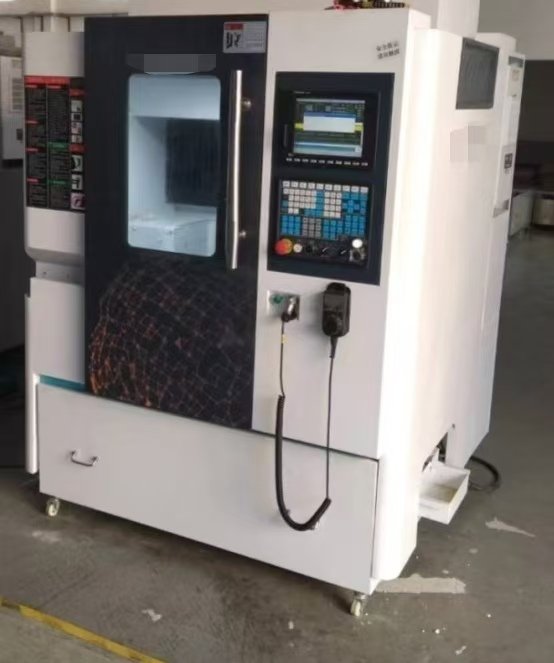
In the micron-level machining of semiconductor ceramic substrates and structural ceramic parts, the machine bed is stable foundation and the guide rails are the lifeline—together they determine the rigidity, vibration resistance, and thermal stability of the engraving and milling machine, directly locking in ±0.01mm precision, and can be called the “anchor” of equipment accuracy.
I. Machine Bed: Vibration-Resistant Stable Foundation, Eliminating Accuracy Drift
The characteristics ceramics (alumina, silicon carbide, silicon nitride, etc.)—high hardness, brittleness, and high-frequency vibration during machining—dictate that the machine bed must berigid enough to resist deformation, stable enough to suppress vibration, and stable enough to resist temperature differences.”
- Material Showdown: Granite Completely Outperforms Cast Iron
Table
Item | Precision Granite (Jinan Green / Zhangqiu Black) | Traditional Cast Iron (HT300) | Machining Impact
Thermal Expansion Coefficient | 0.81.2×10⁻⁶/℃ | 11×10⁻⁶/℃ | Granite is minimally affected by temperature; deformation is only at the 0001mm level for a 1℃ temperature difference
Damping Coefficient | 0.012–0.015 (High) | 0.03–0.005 (Low) | Granite absorbs 80% of vibrations, suppressing chipping and cracking
Density / Rigidity | 2.6–28g/cm³, high rigidity | 7.2g/cm³, average rigidity | Granite is integrally molded, offering stronger resistance to cutting force deformation
Aging Stability | stress-relieved, no long-term drift | Prone to internal stress accumulation, long-term deformation | Granite’s accuracy retention exceeds 10 years, suitable for-term semiconductor mass production - Structural Design: Integration High Rigidity
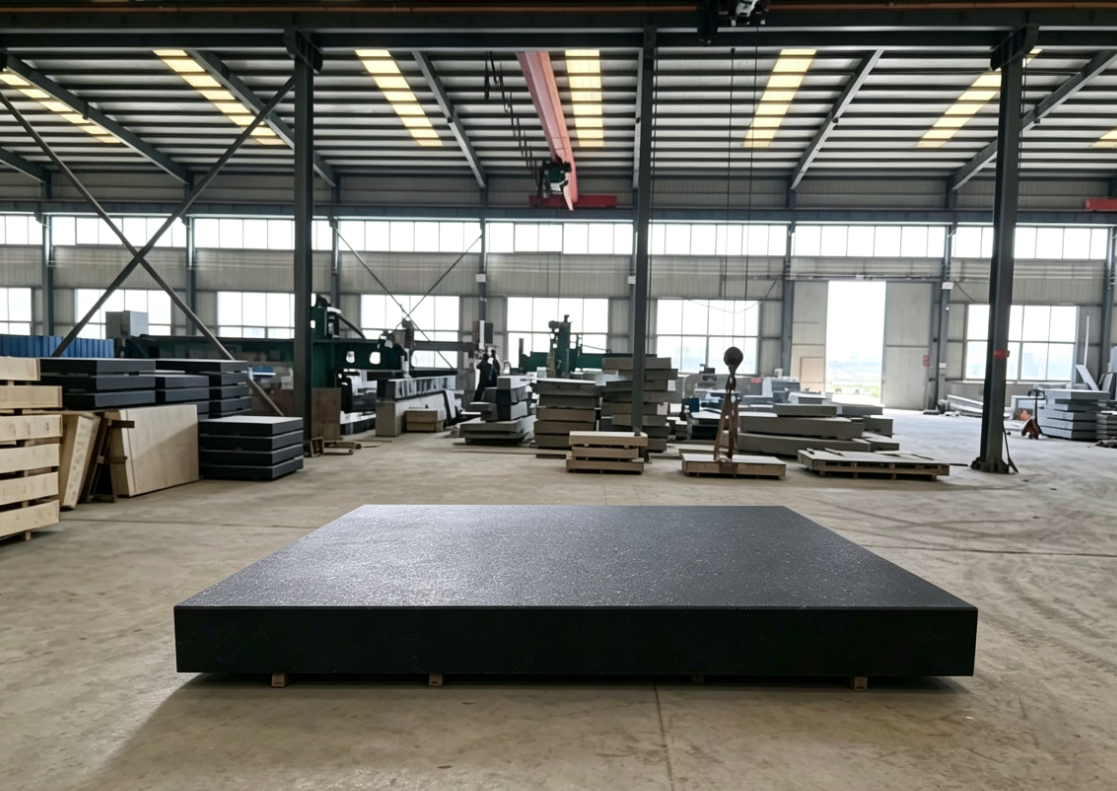
Integrated Granite Bed: No welding, no splicing, avoiding assembly errors; finite element optimized reinforcement increase rigidity by 60% .
Vibration-Isolating Foundation: Bottom equipped with air springs / damping pads to isolate ground vibrations (≤0.001), eliminating external interference.
Practical Value: A semiconductor plant used a cast iron bed to machine aluminum nitride substrates, with vibrations exceeding 0.005mm and a yield of 80%; after switching to a granite bed, vibrations were controlled within 0.001mm, the yield rate rose to 99.5%, and scrap losses were reduced by over 200,000 RMB.
II. Guide Rails: Micron Guidance, Locking Motion Accuracy
Guide rails are the “precision tracks” tool movement. Ceramic engraving and milling machines mainly use high-rigidity linear guide rails, while high-end models adopt ceramic guide rails. Core requirements: straightness ≤0002mm/m, wear resistance, low friction, and thermal stability.
- Mainstream Solution: Quenched Steel Linear Guide Rails (P3 Grade)
: Stainless steel quenched to HRC58–62, contact surfaces ultra-precision ground, equipped with plastic coating (PTFE) to reduce friction, with a lifespan of up to 10,000 hours.
Accuracy: Parallelism ≤0.002mm/m, backlash ≤0.001mm, paired with C grade preloaded ball screws, positioning accuracy ±0.005mm, repeatability ±0.001mm.
Application Scenarios: General ceramic machining (alumina zirconia), balancing accuracy and cost. - High-End Solution: Ceramic Guide Rails (SiC/Al₂O₃/ZrO₂)
Core Advantages:
Extreme Thermal: Thermal expansion coefficient 0.2–0.5×10⁻⁶/℃, matching silicon wafers, with no accuracy drift under temperature differences.
Ultra-Wear: Mohs hardness level 9, long-term wear ≤0.001mm, lifespan is 3–5 times that of steel guide rails.
Clean and-Resistant: Pore-free, rust-proof, resistant to plasma / acids and bases, suitable for semiconductor cleanrooms (ISO Class 1–5).
Application Sc: Semiconductor wafer inspection, lithography worktables, medical ceramic prosthetics, and other nano-level precision scenarios. - Guide Rail Failure = Accuracy Collapse
Straightness Out Tolerance: Machined surfaces show wave patterns, dimensional deviation ≥0.01mm.
Excessive Wear:
III. Bed Guide Rail Synergy: Micron-Level Precision Closed-Loop
- Vibration Suppression Closed-Loop
Granite bed (vibration absorption) ceramic / high-rigidity steel guide rails (stable motion) preloaded ball screw (backlash elimination), locking machining vibration at ≤0.001mm, eliminating chipping and micro-cracks. - Thermal Stability Closed-Loop
Granite bed (low thermal expansion) ceramic guide rails (near-zero thermal expansion) constant temperature workshop (±0.5℃), achieving annual precision drift ≤0.002mm, suitable for long-term stable mass production in semiconductors. - Precision Retention Closed-Loop
Granite aging stability ultra-wear-resistant ceramic guide rails regular laser interferometer calibration, 5-year precision decay ≤0.003mm, far superior to the cast iron steel guide rail combination.
IV. Selection Guide: Matching the “Anchor” by Scenario
✅ Semiconductor / Medical Precision Parts: All-granite bed SiC ceramic guide rails, ultimate thermal stability vibration resistance, suitable for nano-level machining.
✅ General Industrial Ceramics: Granite bed P3-grade quenched steel guide rails, high cost-performance, meeting ±0.005mm precision.
✅ Budget-Sensitive / Large-Size Parts: HT300 cast iron bed reinforcement ribs, equipped with high-rigidity steel guide rails, controlling vibration ≤0.003mm.
V. Summary
For ceramic milling machines, the bed determines the lower limit of stability, and the guide rails determine the upper limit of precision. The granite bed builds a solid foundation with “low expansion, high damping, and high rigidity,” while the ceramic / high-rigidity steel guide rails lock in precision with “micron guidance, ultra-wear resistance, and thermal stability.” Only through their synergy is micron-level, chip-free, and long-term stable machining of hard and brittle ceramics possible — this is precisely the core competitiveness of high-end ceramic milling machines.